
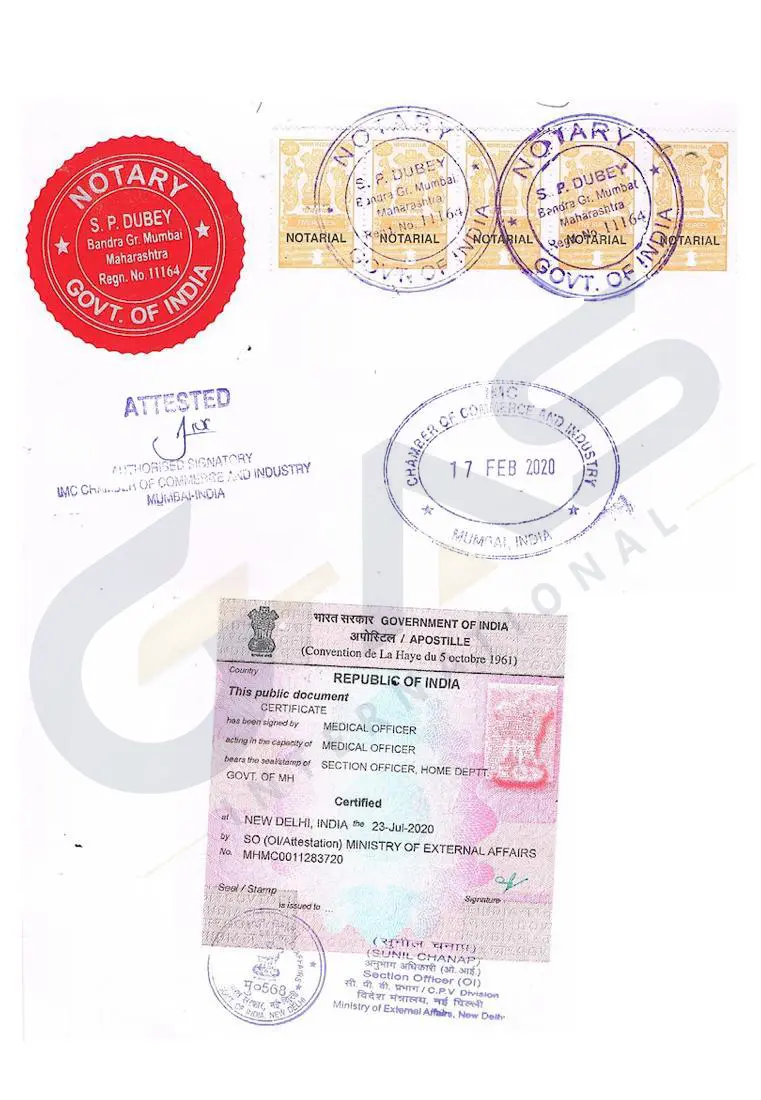
Certificate of Incorporation Attestation

Get professional Certificate of Incorporation Attestation from GOOD APOSTILLE SERVICES for overseas company registration, banking, branch setup, and other official business requirements.

call us

+91 7016754663

call us

+91 9824692246

Certificate of Incorporation Attestation for overseas business documentation
Certificate of Incorporation Attestation
01

When Is Certificate of Incorporation Attestation Required?

Certificate of Incorporation Attestation is used when an Indian company must present authenticated proof of incorporation to a foreign bank, regulator, registry, tender authority or business counterparty. The certificate confirms the company’s legal formation in India and may need legalization before overseas acceptance.

  • Overseas branch or subsidiary registration
  • Corporate bank account opening
  • Foreign tender participation
  • International contracts and joint ventures
  • Trade licence applications
  • Corporate existence verification
The route varies by destination. Review document attestation services process before submission.
02

Certificate of Incorporation Attestation Services: Attestation or Apostille?

The destination decides whether the certificate needs normal attestation or an apostille. MEA normal attestation applies where apostille is not accepted, while eligible Hague Convention destinations may use apostille. Some authorities also require embassy, consular or local legalization, so confirm the final requirement first.

  • Confirm the destination country
  • Check apostille eligibility
  • Verify embassy requirements
  • Confirm acceptable document format
  • Check supporting corporate records
  • Match the filing deadline
For a Hague destination, review the Certificate of Incorporation apostille process before choosing normal attestation.
03

How Attestation for Certificate of Incorporation Works in India

For the offline route, Certificate of Incorporation Attestation normally starts with Chamber of Commerce pre-authentication, followed by Ministry of External Affairs processing. If required by the destination, embassy or consular legalization follows. e-Sanad is relevant only where the required issuing authority or repository is integrated.

  • Check company details
  • Complete Chamber pre-authentication
  • Use the applicable MEA route
  • Complete embassy legalization if required
  • Confirm translation requirements
  • Retain submission records
Documents outside e-Sanad follow the applicable pre-authentication and outsourced submission route.
04

Documents Needed for Certificate of Incorporation Certificate Attestation

The submission set depends on the Chamber, MEA route, destination and receiving authority. Confirm whether the original, an eligible certified copy, company authorization or supporting corporate records are required. Company names, registration numbers, signatures and other details should remain consistent.

  • Certificate in required format
  • Company authorization letter
  • Signatory identification if requested
  • Chamber supporting papers
  • Related corporate records
  • Required translation
Before Certificate of Incorporation Attestation, confirm the exact document set because requirements differ by country and purpose.

Commercial Routes for Certificate of Incorporation Document Attestation

AP

Apostille Route for Certificate of Incorporation

When the destination accepts the Hague Apostille Convention route, the incorporation certificate may need commercial-document pre-authentication followed by an MEA apostille rather than normal attestation. Check the receiving authority because some commercial records may fall outside the Convention or have separate requirements.

  • Confirm the destination accepts apostille
  • Check the receiving authority’s document format
  • Complete required commercial pre-authentication
  • Use the applicable MEA apostille route
  • Verify whether translation is required
  • Keep the apostilled document securely stored
EL

Embassy Legalization for Certificate of Incorporation

Certificate of Incorporation Attestation may require embassy or consular legalization after Chamber of Commerce and MEA processing when the destination does not accept an apostille or specifically asks for embassy authentication. Country rules can change, so the embassy stage, fees and supporting documents should be verified for the intended business use.

  • Foreign branch or subsidiary registration
  • Corporate banking and account compliance
  • Commercial licensing and regulatory filings
  • International tenders and vendor onboarding
  • Contracts and corporate due diligence
  • UAE Certificate of Incorporation embassy attestation
CD

MEA Attestation for Certificate of Incorporation and Related Commercial Documents

A company may need several corporate records legalized together for the same overseas transaction. Our commercial document attestation services cover incorporation and governance records according to the destination requirement, helping businesses prepare a consistent file for foreign authorities.

Read More

Certificate of Incorporation Attestation FAQs

Practical answers about commercial pre-authentication, MEA processing, destination requirements, charges and secure document handling.

Overseas Business Use

When authenticated incorporation proof is requested for overseas corporate activity.

A foreign bank, company registry, tender authority or regulator may request it when an Indian company must prove its legal incorporation for an overseas account, branch, licence, contract or compliance filing. The receiving authority decides whether attestation, apostille or further legalization is required.

Not necessarily. Acceptance depends on the destination, document age, purpose and receiving authority. A bank may accept a document that another regulator asks to be freshly legalized or accompanied by additional corporate records, so each filing should be checked separately.

No. Authentication confirms the document through the prescribed legalization chain; it does not replace a separate current-status, good-standing or compliance certificate where a foreign authority specifically asks for one.

Corporate Document Set

Supporting company records that may need to accompany an incorporation certificate.

They should be prepared when the receiving authority requests a fuller corporate file. The Memorandum and Articles are separate records and may need their own authentication rather than being treated as automatically covered by the incorporation certificate.

Check the company name, registration number, dates, signatory details, seals and consistency across related records. Differences between the incorporation certificate, corporate resolutions and authorization letters can cause questions during Chamber, embassy or foreign-authority review.

It may be acceptable, but the required format depends on the Chamber, legalization route and receiving authority. Confirm whether the digitally issued record, a printed version, an original-equivalent copy or another certified format is required before submission.

Legalization Route

How commercial pre-authentication connects with MEA and any later embassy stage.

MEA requires commercial documents on the offline route to be pre-authenticated by the relevant Chamber of Commerce. That endorsement establishes the commercial-document verification stage before the document is submitted for MEA attestation.

The document proceeds to the relevant embassy or consulate when that destination requires an additional legalization stage. Embassy rules, submission methods and charges vary by country, so they should be checked after confirming the MEA route.

e-Sanad can be relevant when the required document-issuing authority or digital repository is integrated with the platform. Where the record is not covered, the applicable offline pre-authentication and outsourced MEA submission process continues.

Destination Rules

Choosing between apostille, normal attestation and additional destination-country legalization.

Check whether the destination and receiving authority accept the Hague Apostille Convention route. Where apostille is not accepted, normal attestation is used instead. The foreign authority may also require an embassy, consulate or local legalization step after the Indian process.

No. UAE commercial-document legalization can involve Chamber of Commerce, MEA and UAE-specific embassy or destination requirements rather than the standard Hague apostille route. Confirm the current UAE steps before submission because embassy and destination procedures can change.

Yes. A receiving authority may require a certified or approved translation in addition to the legalized company document. Translation rules depend on the destination language, filing body and document purpose, so they should be confirmed before the final submission.

Secure Handling

Safe preparation, dispatch and return checks for company legalization documents.

They can be sent together when they belong to the same legalization requirement, but each document should first be checked for its own pre-authentication and destination rules. Keep an itemized document list before handing the package to GOOD APOSTILLE SERVICES.

Keep clear scans of every page, the final document list, courier reference, authorization copy and any written instructions received for the process. Originals should be packed flat in a protective sleeve and rigid envelope to reduce bending or moisture damage.

Check the company name, certificate details, authority stamps or endorsements, attached legalization pages and destination-specific markings before using the document. Keep scans of the completed record and retain courier or submission references for future corporate compliance needs.

Need Apostille or Attestation Support for Your Documents?

Your Trust, Our Responsibility — That’s a G-AS Commitment.

call us

+91 7016754663

call us

+91 9104499727

whatsapp

+91 9824692246

Email us

info@goodapostille.com