
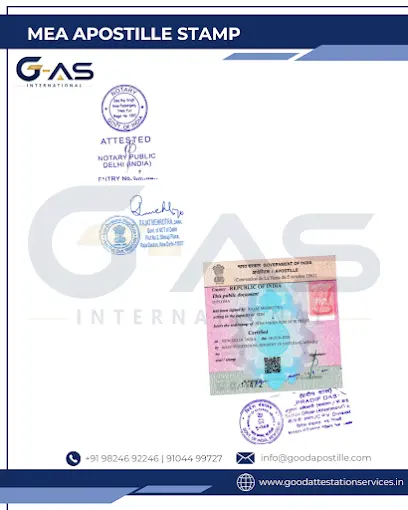
Degree Certificate Apostille

Get reliable Degree Certificate Apostille support from GOOD APOSTILLE SERVICES with professional document review, clear process guidance, and coordinated assistance for education, employment, visa, and other overseas requirements.

call us

+91 7016754663

whatsapp

+91 9824692246

Degree Certificate Apostille services for Indian educational documents
Degree Certificate Apostille
01

When Do Overseas Authorities Ask for a Degree Certificate Apostille?

A Degree Certificate Apostille can be required when an Indian university qualification must be submitted abroad for higher studies, employment, professional registration, residence formalities or credential review. The requirement depends on the destination country and the receiving authority, so applicants should confirm whether an apostille, another authentication route or no legalization is requested before sending the original.

  • University admission where an authenticated final degree is requested
  • Overseas employment requiring verified academic qualifications
  • Professional registration with a foreign licensing or regulatory body
  • Credential evaluation for education or skilled-migration applications
  • Residence or work documentation involving academic proof
  • Scholarship applications that specifically request legalized educational records
An apostille confirms the origin of a public document and the relevant signature, seal or official capacity; it does not certify academic merit, equivalence, grades or eligibility for a particular visa or course.
02

Which Verification Route Applies to Apostille for Degree Certificate?

The correct route depends on the university, State or Union Territory, document format and whether the issuing authority is integrated with e-Sanad. Where an eligible academic record is available through an integrated digital repository, verification can move through the online system. Other certificates may need educational pre-authentication before the Ministry of External Affairs completes the apostille stage.

  • Confirm the exact university that awarded the qualification
  • Check whether the academic record is available through e-Sanad
  • Verify the applicant name against the certificate and identity document
  • Review the registrar or authorized signatory shown on the degree
  • Check the certificate number, issue date, seal and readable details
  • Use the required State or educational verification route when applicable
Applicants handling several document types can also review the document apostille process overview before deciding which certificates actually need separate processing.
03

What Commonly Holds Up Degree Certificate Document Apostille Processing?

Degree Certificate Apostille processing can slow down before the MEA stage when the academic record cannot be matched quickly with the issuing university. Typical causes include incomplete certificate details, an unavailable digital record, an incorrect verification route, differences in the applicant's name, or additional clarification requested by the institution or State authority.

  • University records are old, archived or not digitally available
  • The certificate carries an unclear seal or signature
  • Name or spelling differs from the supporting identity record
  • The wrong issuing university or campus was identified
  • Required educational pre-authentication has not been completed
  • The receiving authority requests another academic record separately
A document pre-check cannot control university response times, but it can reduce avoidable resubmission caused by missing, inconsistent or unreadable information.
04

How Should You Prepare for MEA Apostille for Degree Certificate?

Before submitting a Degree Certificate Apostille request, identify the destination country, purpose of use, receiving organization and exact academic document requested. Check whether the final degree is required or whether the recipient also needs a transcript, mark sheet, diploma or provisional certificate. Preparing only the documents actually requested helps avoid unnecessary processing.

  • Confirm the destination accepts apostilles for the intended purpose
  • Check whether the final degree must be submitted in original
  • Keep a clear copy of the applicant's identification document
  • Review names, dates, certificate number, seal and signature
  • Confirm any translation or credential-evaluation requirement separately
  • Ask whether supporting academic records need independent authentication
A final degree, diploma and provisional certificate are separate academic documents. Their acceptance and authentication requirements should be checked individually with the foreign recipient.

Degree Certificate Apostille Services for Academic Document Planning

ED

Educational Records That May Accompany an Apostilled Degree

Degree Certificate Apostille applications often sit within a wider academic document requirement. A foreign university, employer or licensing authority may ask for the final degree alone or may request supporting records separately. Review the recipient's checklist first, then compare the requested items with available academic document apostille services.

  • Bachelor's or Master's final degree certificate
  • Doctoral or professional qualification certificate
  • Diploma apostille guidance when a diploma is requested instead
  • Provisional degree apostille guidance for temporary academic proof
  • Semester or consolidated mark sheets when separately requested
  • Academic transcripts required for admissions or credential evaluation
Read More
DV

Degree Record Checks Before Apostille Submission

Verification problems are easier to resolve before an original academic certificate enters the authentication chain. The awarding institution, degree title, year of award and authorized signatory should be identifiable, while names should match the applicant's supporting records. If the destination does not use the apostille route, review the applicable degree attestation route for overseas use.

  • Correct legal name of the degree-awarding institution
  • Applicant name matching the supporting identity record
  • Degree title and specialization shown without ambiguity
  • Award year and certificate reference clearly readable
  • Registrar or authorized signatory identifiable on the certificate
  • Institutional seal or stamp visible and undamaged
DP

Destination Checks Before Academic Legalization

Degree Certificate Legalization Services should begin with the foreign recipient's actual instructions, not assumptions based only on the country. A university, employer, immigration office or professional regulator may request different supporting records, translations or submission formats. Confirming those conditions before authentication helps keep the file focused on the academic evidence that will actually be reviewed.

  • Country where the qualification will be presented
  • Institution or authority receiving the academic document
  • Purpose such as study, employment, licensing or migration
  • Whether a certified translation must accompany the degree
  • Whether transcripts or mark sheets are separate requirements
  • Any recipient-specific validity, format or submission instructions

Degree Certificate Apostille FAQs

Answers to practical questions about university verification, e-Sanad eligibility, MEA processing, supporting academic records, destination checks and document handling.

Using an Indian Degree Overseas

Clarify what an apostille authenticates and when a foreign recipient may request it.

The apostille authenticates the origin of the public document by certifying the relevant signature or seal and the capacity of the person who signed it. It does not verify marks, course content, academic standing or equivalence of the qualification. A Degree Certificate Apostille therefore supports document authentication, not academic assessment.

Yes. Apostille is intended for use between countries where the Hague Apostille Convention applies, but the receiving authority still decides what documents it wants. Confirm the country, organization, purpose of use and exact academic certificate before beginning the authentication process.

No. Credential evaluation compares or interprets an academic qualification for a particular institution or system. Apostille addresses document origin and authentication. A university or licensing body can still require a separate evaluation even after the degree has been apostilled.

Degree Certificate Review Before Submission

Check the academic record carefully before it enters university or State verification.

Review the applicant name, university name, degree title, specialization, award date, certificate number, seal and authorized signature. If any detail is unclear or inconsistent with the supporting identity record, resolve it before submission rather than relying on the apostille process to correct the underlying certificate.

Not automatically. A provisional certificate is a separate academic document, and the foreign recipient may insist on the final degree. Confirm what the recipient accepts before processing either document, especially when the final certificate has already been issued by the university.

Only when the receiving authority asks for them. Apostille applies to the specific document being authenticated, so a degree does not automatically authenticate a transcript or mark sheet. Ask for the recipient's complete checklist before deciding how many academic records need separate processing.

University, e-Sanad and MEA Verification

Understand why the route can differ between universities and document records.

e-Sanad is designed for online document verification and apostille or attestation where the relevant Document Issuing Authority and document record are supported by the system. If the degree is not available through an integrated repository or authority, the applicable offline pre-authentication route may still be required.

Educational documents need to be traceable to the authority that issued them. Verification helps establish that the degree and its official signature or seal correspond with the issuing record. The exact pre-authentication path depends on the document source and the route available for that certificate.

MEA's e-Sanad platform provides an e-Register for checking issued apostille or attestation details. Keep a clear scan of the completed academic document and the certification information so the record can be checked without repeatedly handling the original certificate.

Cost and Turnaround Factors

Separate the MEA apostille stage from university, State, service and logistics requirements.

The total can vary because one degree may already be eligible for a supported verification route while another may need university or State pre-authentication first. Courier, scanning, service assistance and the number of documents can also affect the final quotation beyond the government apostille charge itself.

The largest variable is often the verification completed before the final MEA stage. University response time, availability of the academic record, State processing, document discrepancies and requests for clarification can all add time. A quoted timeline should therefore identify which verification steps are included.

No service provider can guarantee a faster response from a university, State authority or government office simply because travel is urgent. Applicants should start with a complete certificate and accurate supporting details, then plan around the verification route that actually applies.

Protecting the Original Academic Certificate

Prepare, record and package the degree carefully whenever physical handling is required.

Save a clear scan of the front and back of the certificate and record its certificate number, university, applicant name and visible condition. Remove unrelated papers from the package and use protective packaging so seals, signatures and printed details are not damaged in transit.

Do not make new alterations merely for authentication. If the certificate is already laminated, damaged, corrected or unusually formatted, disclose that before dispatch so the applicable verification route can be checked. Never remove seals, stamps or attached pages from an original certificate.

Confirm that the returned certificate is the same document submitted and that the apostille details are readable and securely associated with it. Check the applicant and document particulars, keep a fresh scan, and then follow any separate translation or submission instruction from the recipient.

Need Apostille or Attestation Support for Your Documents?

Your Trust, Our Responsibility — That’s a G-AS Commitment.

call us

+91 7016754663

call us

+91 9104499727

whatsapp

+91 9824692246

Email us

info@goodapostille.com

Our Apostille Process

01

Document Review

We check the document, purpose and destination country.

02

Route Confirmation

The correct verification route is confirmed before submission.

03

Authority Verification

Required verification is completed through the relevant authority.

04

MEA Apostille

The eligible document proceeds for final apostille processing.

05

Secure Delivery

Completed documents are checked, packed and safely dispatched.