
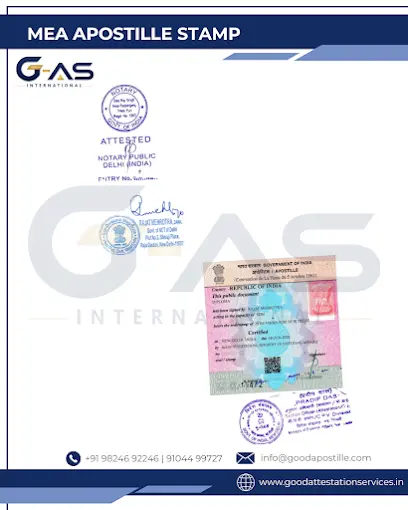
Apostille for Foreign-Issued Documents

GOOD APOSTILLE SERVICES provides reliable Apostille for Foreign-Issued Documents support with clear document checks, country-specific guidance, and coordinated processing for international use.

Apostille for Foreign-Issued Documents processing and international document authentication support
Apostille for Foreign-Issued Documents
01

Who Can Issue Apostille for Foreign-Issued Documents?

A document created outside India normally has to be apostilled by a Competent Authority in the country from which it originates. The first step is therefore to identify the issuing country, the exact issuing body and the country where the document will be presented. This prevents an incorrect submission to an authority that has no jurisdiction over the document.

  • Confirm the country that originally issued the public document
  • Identify whether the record is national, state, provincial or local
  • Check the destination country before selecting apostille or legalisation
  • Locate the correct foreign Competent Authority for that document type
  • Review whether notarisation or certification is required before apostille
  • Verify any receiving-authority rules for originals, copies or translations
India’s Ministry of External Affairs is the designated Competent Authority for Indian-origin documents; it does not replace the issuing-country authority for a foreign public document.
02

Online Apostille for Foreign-Issued Documents: What Can Be Checked Remotely?

Many cases can begin with a scan review even when the apostille itself must be issued abroad. A preliminary check can identify the document category, issuing jurisdiction, visible signatures or seals, and whether the destination falls under the Hague Apostille Convention. The actual filing method then depends on the rules of the foreign authority handling that document.

  • Clear scan of every page, endorsement and existing certification
  • Issuing city, state, province or federal authority details
  • Destination country and the office requesting the document
  • Purpose such as OCI, marriage, study, employment or business
  • Any deadline stated by the receiving institution or authority
  • Whether the original is currently in India or overseas
A remote review can reduce avoidable courier movement, but it cannot override an origin-country requirement for an original, certified copy, notarisation or in-person step.
03

How Apostille Convention Status Changes the Route for Foreign Documents

The Hague Apostille Convention applies when a qualifying public document from one Contracting Party is to be produced in another Contracting Party and the Convention is in force between them. If that route applies, the apostille replaces diplomatic or consular legalisation for the authentication covered by the Convention. If it does not apply, a separate foreign document authentication and legalisation route may be necessary.

  • Check the current HCCH status of both countries
  • Confirm the Convention is in force between the two countries
  • Determine whether the document qualifies as a public document
  • Review exclusions that can affect certain diplomatic or customs records
  • Ask whether the receiving authority requires a translation as well
  • Check for country-specific electronic apostille and verification options
The HCCH status table listed 130 Contracting Parties as of 30 June 2026, so current country status should be checked rather than relying on an old country list.
04

Apostille for Foreign-Issued Documents in India: Where Does the Process Actually Happen?

Applicants may be physically located in India while the legal authentication step takes place in the document’s country of origin. Depending on that country, the route may involve a national ministry, state or provincial office, court, notarial authority or another designated body. A well-planned case separates Indian-side document handling from the foreign authority that is legally entitled to issue the apostille.

  • Start with the issuing country rather than the applicant’s location
  • Match the document to the competent foreign jurisdiction
  • Check whether a representative may submit on the holder’s behalf
  • Confirm original, certified-copy and notarisation rules before dispatch
  • Plan international courier only after eligibility has been checked
  • Keep digital copies of the document and all apostille references
GOOD APOSTILLE SERVICES can review the case requirements from India and help identify the correct country route before originals are moved for processing.

Foreign-Issued Documents by Category and Origin-Country Rules

ED

Professional Apostille for Foreign-Issued Documents: Educational Records

Degrees, diplomas and academic records issued abroad may follow different apostille routes depending on the institution and country. Some authorities accept an original public certificate, while others require a certified copy, registrar verification or notarisation before the Competent Authority will act. Always match the academic record to the issuing jurisdiction before submission.

  • Degree or Graduation Certificate
  • Diploma or Professional Qualification
  • Academic Transcript
  • School Leaving Certificate
  • University Enrolment or Attendance Record
  • Certified Academic Copy
Read More
PD

Apostille for Foreign-Issued Documents Service for Civil Records

Foreign birth, marriage, death and other civil-status records are usually handled through the jurisdiction that created or registered them. The correct office may differ even within the same country. Recent certified copies can also be required by the receiving authority, particularly when an older certificate is damaged, lacks a verifiable signature or does not meet current filing rules. For country-specific birth certificate requirements, review the guidance for United Kingdom-issued birth certificates, Canada-issued birth certificates, United States-issued birth certificates, and Australia-issued birth certificates.

  • Birth or Adoption Certificate
  • Marriage or Civil Partnership Certificate
  • Divorce or Court Record
  • Death Certificate
  • Police or Background Record
  • Notarial Affidavit or Declaration
Read More
CD

Fast Apostille for Foreign-Issued Documents: Business Records

Corporate documents issued abroad can require a route based on how the record was created: government-issued, registry-issued, court-issued or privately signed and notarised. Not every business paper automatically falls within the Apostille Convention, and administrative documents dealing directly with commercial or customs operations are specifically excluded from its scope. Eligibility should be checked document by document.

  • Certificate of Incorporation
  • Certificate of Good Standing
  • Notarised Board Resolution
  • Corporate Power of Attorney
  • Registry Extract or Company Search
  • Notarised Business Agreement
Read More

Questions About Foreign Document Apostille and Legalisation

Practical answers on Apostille for Foreign-Issued Documents, issuing-country jurisdiction, Hague eligibility, digital apostilles and cross-border submission.

Issuing-Country Eligibility for Foreign Document Apostille

How origin, destination and Convention status determine the correct legalisation route.

The apostille must come from a Competent Authority designated by the country from which the public document emanates. The authority can vary by country and by document level. For example, federal, state, provincial, court and notarial records may be routed to different offices.

Check that the issuing country and India are within the Hague Apostille Convention framework and that the Convention is effective between them for the relevant document. When it applies, the apostille replaces the diplomatic or consular legalisation formality covered by the Convention, although the receiving office may still set translation, copy or filing requirements.

A non-Convention case normally follows the authentication and legalisation rules of the issuing country and the destination country. This can involve authentication by a foreign ministry or other authority followed by embassy or consular legalisation. The exact chain should be confirmed before any original document is sent.

Preparing Foreign Public Documents Before Submission

What to check on certificates, certified copies, notarised records and translations.

Sometimes, but only when the law and practice of the issuing country allow a certified or notarised copy to be apostilled. In other cases the Competent Authority requires the original public document. A plain photocopy should not be assumed eligible without checking the country-specific rule.

Often a privately signed document must first acquire a public character through notarisation or another recognised certification before an apostille can be issued. Powers of attorney, declarations and some company documents commonly follow this type of route, but the requirement depends on the law of the country of origin.

Translation order depends on the receiving authority and the issuing-country procedure. Some destinations want the original document apostilled first and the translation prepared afterward; others may require a certified translation that is separately notarised or apostilled. Confirm the requested language and certification format before arranging translation.

Competent Authority Routing for Overseas-Issued Records

How jurisdiction, digital systems and verification methods affect the filing route.

No. India’s Ministry of External Affairs is India’s designated Competent Authority under the Convention. A public document originating in another country must be routed to the competent authority designated by that country. Apostille for Foreign-Issued Documents therefore begins with the document’s country of origin, even when the holder is living in India.

Yes. The HCCH recognises an e-Apostille as an official apostille issued in digital form, and it cannot be rejected merely because it is electronic. However, applicants should still confirm the receiving office’s practical submission method, including whether it wants a printed copy, digital file, original underlying document or online verification reference.

Use the HCCH list of Contracting Parties and Competent Authorities, then match the document to the correct national or local jurisdiction. The issuing authority shown on the document, such as a state registrar, court, university or notary, is important because several countries designate more than one apostille authority.

Country Fees and Service Quotes for Overseas Apostille Work

Why government charges, certification steps and international handling vary by country.

Government fees are set by the country that issues the apostille, not by India. The total can also change if the document needs a fresh certified copy, notarisation, court or registry certification, translation, local submission assistance or international courier handling before and after the apostille.

It can where the relevant foreign authority offers expedited, same-day or priority service. Some authorities provide no urgent option at all. Any priority charge should be confirmed against the actual country procedure rather than assuming that every document can be accelerated.

A clear quotation should separate the foreign government or authority fee, any notarisation or certification charge, professional handling, translation if required, and domestic or international courier costs. It should also state which steps are conditional so unexpected country-specific requirements can be identified early.

International Document Handling from India

Practical decisions when the holder, document and apostille authority are in different countries.

Yes, a preliminary eligibility review can usually begin from a complete scan and the issuing-country details. Whether the original must later move depends on the foreign authority. In some jurisdictions a representative can obtain a certified copy or submit locally, while others require the holder or the original record.

That depends on the rules of the competent foreign authority. Some permit submission by any bearer, postal filing or an authorised representative; others require a signed authorisation, identity copy or specific application form. The representation rule should be checked before anyone attends an office or sends the document.

Confirm the exact destination office, document version, required supporting identification, return method, declared courier details and whether any pre-certification is still missing. Keep a full scan of the document and record all application or apostille reference numbers so the case can be checked after dispatch and issuance.

Need Apostille or Attestation Support for Your Documents?

Your Trust, Our Responsibility — That’s a G-AS Commitment.

call us

+91 7016754663

call us

+91 9104499727

whatsapp

+91 9824692246

Email us

info@goodapostille.com

Our Apostille Process

01

Document Review

We check the document, purpose and destination country.

02

Route Confirmation

The correct verification route is confirmed before submission.

03

Authority Verification

Required verification is completed through the relevant authority.

04

MEA Apostille

The eligible document proceeds for final apostille processing.

05

Secure Delivery

Completed documents are checked, packed and safely dispatched.