
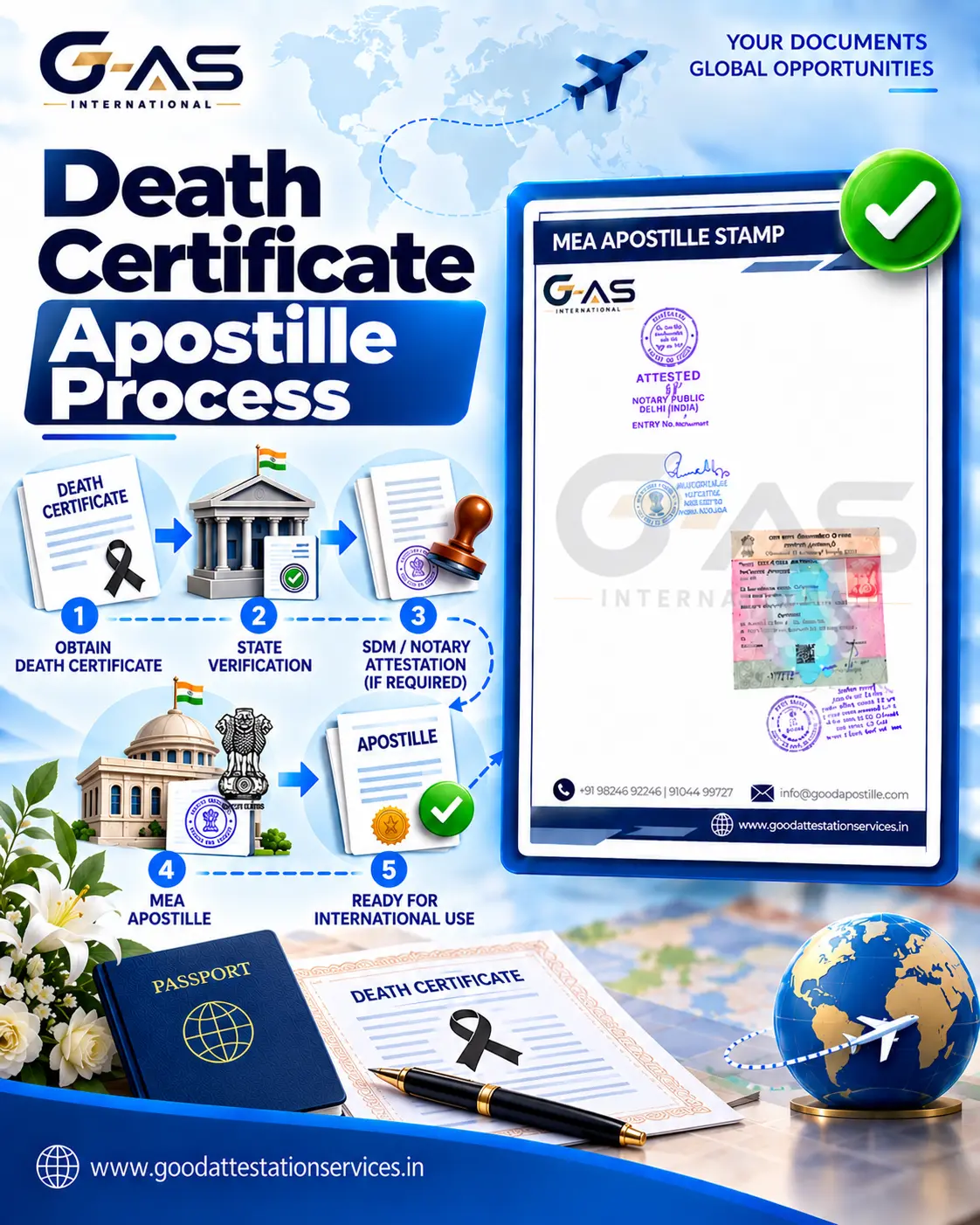
The Death Certificate Apostille Process is the formal route used to authenticate an Indian death certificate for use in a country that accepts Hague Apostilles. The process generally involves verification or pre-authentication through the relevant State or Union Territory authority before the Ministry of External Affairs issues the apostille. The exact route can depend on the issuing authority and document format.
This guide explains how to apostille a death certificate, the document checks to complete before submission, and how state-level verification and the MEA stage fit together. It also covers destination-country eligibility, supporting document considerations, processing factors, and common issues that can delay the procedure or affect acceptance abroad.
The Death Certificate Apostille Process is generally required when an Indian death certificate must be presented as authenticated proof of death to an authority in a Hague Apostille Convention country.
An apostilled death certificate may be requested during overseas inheritance, probate, property succession or estate administration when the foreign authority needs authenticated evidence of the deceased person's death.
Foreign insurers, pension authorities or financial institutions may request authenticated proof of death before settling benefits, closing accounts, releasing funds or completing survivor-related formalities.
Some overseas cases also require documents proving the applicant's relationship with the deceased. Related records may therefore need a separate birth-record apostille route or marriage-record authentication route.
Requirements can vary according to the certificate, issuing authority, verification route and submission arrangement. Review the detailed document preparation requirements before dispatching an original record.
Use a properly issued and legible death certificate containing traceable registration details, the issuing authority's information and the required official signature, seal or digital validation.
A clear identity or passport copy, authorization or other supporting record may be requested depending on who submits the certificate and the applicable processing channel.
The receiving institution may separately request relationship evidence, translations, succession papers, declarations or other documents connected with the underlying inheritance, insurance, pension or legal matter.
Names, dates, registration numbers, seals and signatures should be readable and consistent. Old, damaged, altered or recently corrected certificates may require additional verification before the Death Certificate Apostille Procedure can continue.
The exact route depends on how the certificate was issued and whether its authority supports digital verification. Review the applicable certificate verification route before beginning.
First confirm that the destination uses the Hague Apostille Convention and that the receiving authority actually requires an apostilled death certificate. Non-Hague destinations can follow a different legalization or attestation procedure.
The issuing authority and State or Union Territory determine the applicable verification stage. Eligible digitally available records may use an integrated e-Sanad route, while other documents can require the applicable State or local pre-authentication.
During this stage, the competent authority verifies the relevant official signature, seal or record details. The Death Certificate MEA Apostille Process proceeds only after the applicable verification requirement has been satisfied.
After pre-authentication, the eligible document proceeds through the authorised channel for Ministry of External Affairs apostille processing. Once issued, check the apostille particulars and retain a clear scan before sending the certificate abroad.
Overall time and cost depend on more than the final MEA stage, so both should be assessed before submission.
The time required for the Process for Death Certificate Apostille depends on pre-authentication, issuing-authority verification, the selected submission channel and document movement. For a fuller breakdown, review the factors affecting apostille turnaround rather than relying only on the final MEA stage.
Total expenditure can include the applicable government apostille charge together with verification, handling, scanning, collection, delivery or professional service costs where relevant. The apostille fee components should be checked separately because the final amount can vary by route.
Most avoidable problems occur before final apostille issuance. Reviewing common rejection and correction issues can help identify problems early.
Material differences in names, dates, registration information or other important details can create verification questions and may need correction before the Death Certificate Apostille Process continues.
A faint seal, unreadable signature, missing registration details or damaged certificate can make verification difficult and may result in additional checks or a request for reissue.
Submitting a document through an unsuitable route can cause avoidable delay. The correct channel should be determined from the issuing authority and available State or Union Territory verification system.
An apostille should not be arranged automatically for every foreign use. Confirm the destination country's Convention status and the receiving organisation's instructions before completing the authentication process.
A short pre-submission review can prevent avoidable corrections, repeat courier movement and unnecessary delays later in the procedure.
These answers cover practical questions that commonly arise before beginning the Death Certificate Apostille Process.
First confirm the overseas requirement, identify the correct verification route for the issuing authority, complete any required pre-authentication and then submit the eligible certificate through the applicable channel for MEA apostille processing.
No. The Death Certificate Apostille Procedure can vary according to the State or Union Territory, issuing authority, availability of digital verification and the certificate's condition or registration history.
An apostille authenticates the origin of the public document, including relevant official signature, seal and capacity. It does not independently certify that every factual statement recorded in the death certificate is correct.
An older certificate may still be processable, but its issuing authority, registration details, signature or seal must be capable of verification. Reissue may be appropriate where the record is badly damaged or unclear.
No. Apostille applies where the Hague Apostille Convention is effective between the document's country of origin and the destination. Other destinations may require normal attestation and additional embassy or consular legalization.
Yes. Before beginning the Death Certificate Apostille Process, confirm whether the receiving organisation requires an apostille, translation, recent certificate, relationship evidence or other supporting documents for the specific overseas purpose.
Your Trust, Our Responsibility — That’s a G-AS Commitment.
Get Document Guidance