
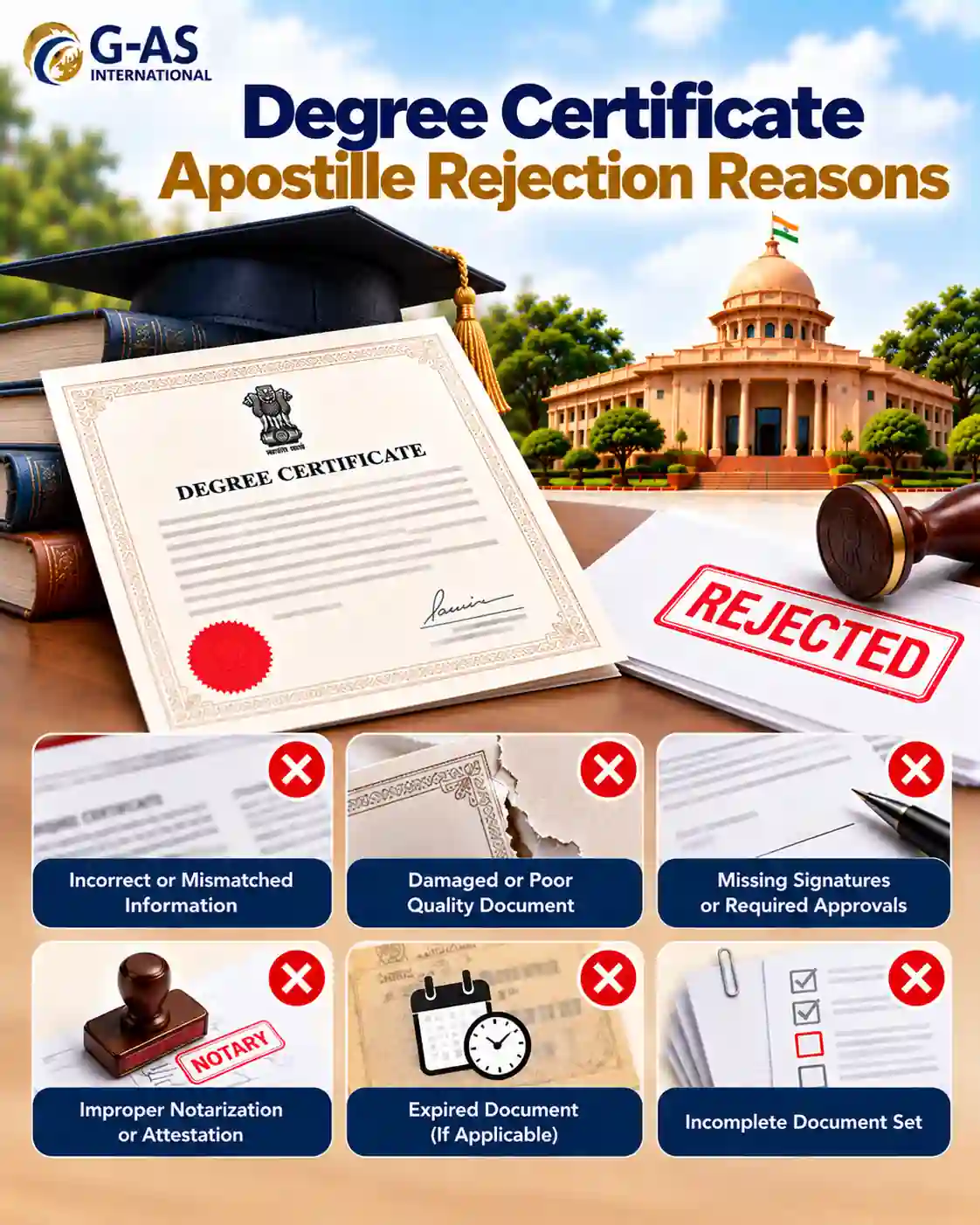
Degree Certificate Apostille Rejection Reasons often involve missing pre-authentication, unsuccessful university verification, inconsistent personal or academic details, incomplete documentation, or following the wrong legalization route for the destination. In India, documents outside e-Sanad generally need pre-authentication by the appropriate State or UT authority before submission for MEA apostille.
This article explains why degree certificate apostille gets rejected, the common degree certificate apostille problems and mistakes, practical ways to correct them, and the checks to make before resubmission. It also distinguishes an apostille-processing issue from rejection by a foreign university, employer, visa office, or licensing body, where additional recipient-specific requirements may apply.
A rejection or return does not always happen at the final apostille stage. Problems can begin during document review, university verification, state-level authentication, MEA submission, or later when the overseas recipient checks its own requirements. For broader context, see the educational-document authentication overview.
Differences in the applicant's name, degree title, university details, award date, registration information, seal, or authorised signature can trigger a query when records cannot be matched confidently.
For educational documents that require prior authentication, the application may stop if the issuing institution cannot verify the degree or the required state or education authority authentication is incomplete.
An apostille authenticates the document's origin and official signature or seal. A university, employer, licensing body, or credential evaluator can still request transcripts, translations, qualification recognition, or another recipient-specific document.
Before resubmission, review the exact document and supporting records used in the failed application. Requirements vary by issuing institution, verification route, and receiving authority, so avoid assuming that one checklist applies to every degree.
Check that the certificate is legible and that the university name, qualification, award information, official seal, certificate number, and authorised signature are clear and consistent.
Compare the applicant's name and other identifying details with the passport or identity record requested for the route. Unexplained spelling or name differences should be resolved before another submission.
Some authorities or universities may request supporting academic records during verification. Confirm the case-specific requirement instead of sending unnecessary papers. Use the degree apostille document checklist to review the usual preparation points.
If the degree has been reissued, corrected, damaged, laminated, or altered in appearance, confirm whether the authority handling verification will accept that format before sending it again.
The safest response to a rejected or returned file is to identify the exact failed stage first. Repeating the complete application without correcting that stage can produce the same problem again.
Determine whether the issue arose during university verification, state or education-authority authentication, MEA submission, or review by the overseas recipient. The verification-route guidance helps separate these stages.
If the problem is an incorrect name, unclear seal, wrong academic detail, damaged certificate, or incomplete university record, resolve it with the relevant issuing institution or competent authority before proceeding.
Educational documents outside an eligible digital route generally require the applicable prior authentication before MEA apostille. Check the step-by-step submission sequence before restarting the file.
Confirm the destination, recipient instructions, document type, verification completion, and identity consistency. This is especially important when the original problem occurred after apostille because the recipient required something beyond authentication.
Correction time depends on what failed. A document-format issue may be resolved quickly, while university confirmation or state-level verification can take longer because another authority must respond.
Name corrections, reissued certificates, clearer copies, or missing supporting records depend on how quickly the applicant and issuing institution can resolve the problem. Do not estimate the apostille completion date until the corrected document is actually ready.
Verification-dependent files can remain pending until the university or designated authority confirms the record. Review the processing-time factors separately from courier or recipient-side review.
A useful Degree Certificate Apostille Error Guide should separate genuine authentication problems from recipient-side requirements. The following mistakes commonly create avoidable queries or repeat work.
Names, initials, dates, or academic identifiers that do not align with the supporting record can prevent straightforward verification and may require clarification or correction.
Educational documents must follow the route applicable to their issuer and verification status. Skipping a required prior authentication can cause the file to be returned before final processing.
Unreadable seals, incomplete signatures, unexplained alterations, damaged areas, or records that the issuing institution cannot confirm can interrupt verification and require a fresh document.
A receiving organisation can raise an issue even after authentication. The recipient may apply separate rules for translation, equivalence, transcripts, or professional recognition.
Before sending the corrected file again, verify the document, route, recipient instructions, and supporting records as one complete case.
These answers clarify Degree Certificate Apostille Rejection Reasons that commonly arise after a file is returned, delayed, or questioned.
Yes. Where the applicable route requires verification or prior educational authentication, the file should not proceed as though that step were complete. The missing verification normally needs to be resolved first.
The overseas recipient can reject the application for reasons separate from the apostille itself, such as missing transcripts, translation requirements, qualification recognition rules, or a document format it does not accept.
Yes. Do not hide the difference. Check what correction or supporting proof the issuing university, authentication authority, and receiving organisation accepts, then resolve the discrepancy before resubmission.
It can. If important seals, signatures, numbers, or academic details are unclear, verification may be difficult. Ask the issuing institution whether a replacement or reissued certificate is required.
First identify the specific reason the file was returned or questioned. Correct that failed stage, confirm the required verification has cleared, and then prepare the application for resubmission.
No. An apostille authenticates the origin of the public document and the relevant official signature or seal. Academic equivalence and professional recognition remain separate decisions for the receiving authority.
Your Trust, Our Responsibility — That’s a G-AS Commitment.
Get Document Guidance