
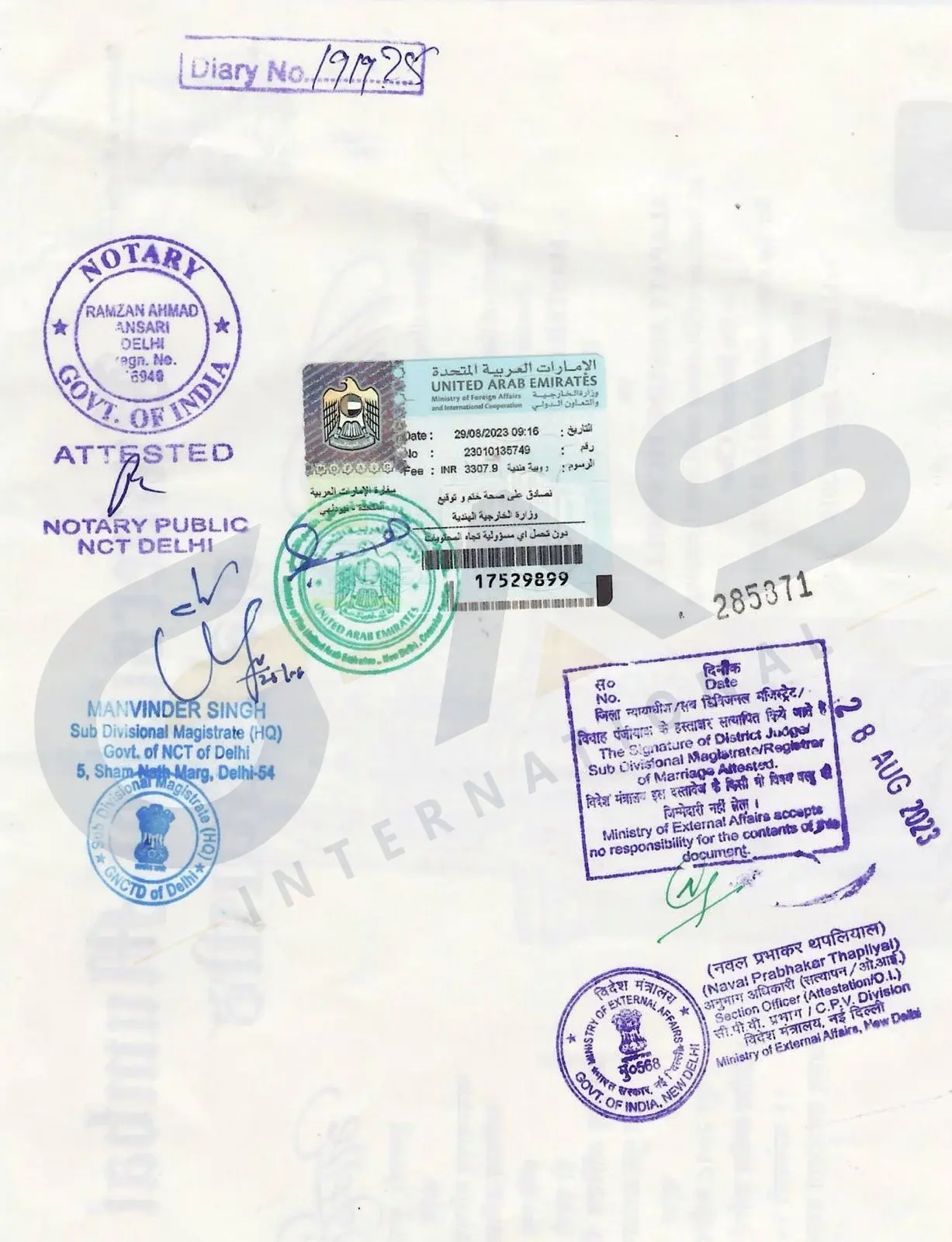
Embassy Legalization Services

GOOD APOSTILLE SERVICES provides Embassy Legalization Services for personal, educational, and commercial documents, with clear guidance for official use abroad.

Embassy Legalization Services for educational, personal and commercial documents
Embassy Legalization
01

When Are Embassy Legalization Services Required?

Embassy legalization is generally required when an Indian document will be used where an apostille is not accepted and the destination embassy or consulate requires legalization. Where the receiving authority uses attestation terminology, the foreign-mission attestation route should also be checked before submission.

  • Employment and professional credential use abroad
  • University admission and academic certificate submission
  • Residence, dependent and immigration documentation
  • Marriage, birth and civil-status procedures
  • Powers of attorney and overseas legal matters
  • Company, export and commercial documentation
Confirm the destination and receiving authority before starting because embassy requirements can differ.
02

What Does Embassy Legalization Service India Confirm?

Embassy legalization typically follows Indian authentication. Depending on the document, prior verification may involve a State or Union Territory authority, Chamber of Commerce and MEA normal attestation before the foreign mission. These stages can also be reviewed within the broader document legalization workflow for overseas document use.

  • Prior state or designated authority authentication
  • MEA normal attestation, where applicable
  • Embassy or consulate acceptance requirements
  • Signatures, seals and supporting endorsements
  • Document category and intended foreign use
  • Country-specific forms or supporting papers
Legalization authenticates the document chain; final acceptance still depends on the receiving authority.
03

What Affects the Embassy Legalization Process India Timeline?

Processing time varies because each embassy or consulate can set submission days, document checks, fees and return schedules. Prior authentication can also add time when state-level, issuing-authority or commercial verification is required. Some destinations may also require destination-side foreign ministry attestation after embassy processing, adding a separate stage where applicable.

  • Destination embassy or consulate procedure
  • Document type and issuing authority
  • State, Chamber or MEA authentication
  • Translation or notarization requirements
  • Appointment and submission availability
  • Embassy holidays and verification checks
Check the current mission checklist before submission, especially when a deadline is involved.
04

What Is Required for Online Embassy Legalization?

Online Embassy Legalization can begin with document review and requirement checking, but legalization may still require originals or physical submission. GOOD APOSTILLE SERVICES checks the destination, document category and authentication route first.

  • Original document or acceptable certified copy
  • Passport or identity copy, if requested
  • Destination country and purpose of use
  • Prior state or Chamber authentication
  • MEA attestation before embassy submission
  • Embassy forms, translations or supporting papers
Confirm current embassy instructions before dispatching originals, because requirements vary by mission.

Documents Covered by Professional Embassy Legalization

ED

Educational Documents for Embassy Legalization

As part of Embassy Legalization Services, educational certificates may require formal embassy or consular legalization for overseas employment, higher education, professional registration or equivalency. Depending on the destination and issuing state, the route can include competent education-authority verification, MEA normal attestation and then the concerned embassy or consulate.

  • Degree Certificate
  • Diploma Certificate
  • Mark Sheet
  • Academic Transcript
  • Provisional Degree
  • School Leaving Certificate
Read More
PD

Personal Documents for Embassy Legalization

Personal and civil documents may need legalization for residence, dependent visas, marriage registration, family matters, immigration or legal use abroad. The required path depends on the issuing authority, destination country and whether state authentication, MEA attestation or additional consular documents are requested.

  • Birth Certificate
  • Marriage Certificate
  • Police Clearance Certificate
  • Affidavit
  • Divorce Decree
  • Personal Power of Attorney
Read More
CD

Commercial Documents Through an Embassy Legalization Agency

Commercial papers can require legalization for exports, overseas company registration, tenders, banking, contracts or representation before foreign authorities. A common India-side route is Chamber of Commerce authentication followed by MEA attestation, after which the destination embassy or consulate applies its own requirements. Where a consular channel applies, confirm the consular submission and attestation procedure before dispatch.

  • Certificate of Origin
  • Commercial Invoice
  • Export Documents
  • Board Resolution
  • Commercial Power of Attorney
  • Company Agreement
Read More

Embassy Legalization Services FAQs

Practical answers about country eligibility, document preparation, MEA attestation, embassy requirements, fees and secure handling.

Embassy Legalization Basics

Core facts about legalization, apostille differences and country eligibility.

Embassy legalization is the authentication of an Indian document by the embassy or consulate of the destination country after the required India-side verification. It is commonly used where apostille is not accepted or the receiving authority specifically requires consular legalization.

No. An apostille is used when the Hague Apostille Convention applies between the relevant countries and the document is eligible for that route. Embassy legalization is a separate process, generally used where normal attestation and foreign-mission legalization are required.

No. First check whether the destination accepts an apostille for the document. Where the Hague Convention applies, further embassy legalization should generally not be required for an apostilled public document. Otherwise, confirm the current embassy or consulate procedure.

Document Requirements

Common document categories and submission requirements for foreign missions. Documents issued abroad for use in India can follow a separate India process for foreign-issued documents.

Degree certificates, diplomas, mark sheets, transcripts, provisional certificates and school records are common examples. The exact route can depend on the issuing institution, state or Union Territory, destination country and the foreign mission's current checklist.

Birth and marriage certificates, police clearance certificates, affidavits, divorce-related documents and personal powers of attorney may require legalization. Requirements vary by issuing authority and intended use, so the destination-specific procedure should be checked before submission.

Not in every case. The embassy, MEA route and prior authentication authority may accept an original, true copy or another specified format depending on the document. Confirm the current mission checklist before sending any irreplaceable original.

Embassy Legalization Process

State authentication, MEA attestation and embassy or consulate processing.

The route normally starts by confirming the destination requirement. The document then follows the applicable state, education, Home or General Administration, or Chamber of Commerce authentication route, followed by MEA normal attestation and embassy or consulate legalization where required.

Preliminary review, forms, requirement checks and service coordination can often be handled online, but a physical document may still be required. e-Sanad can support MEA verification and attestation for eligible digitally available documents; it does not replace a foreign mission's own legalization rules.

There is no universal turnaround time. The schedule depends on the document category, prior authentication, embassy or consulate submission windows, appointment availability, verification, translation requirements, public holidays and the mission's return procedure.

Fees & Payment

Government, consular, verification, service and delivery cost factors.

The Ministry of External Affairs states that normal attestation is done free of cost. Separate charges can still arise for authorized collection or delivery, state or Chamber verification, translation, professional handling and the destination embassy or consulate.

Embassy or consulate tariffs differ by destination and can also vary by document type, number of documents and service category. Prior verification, Chamber authentication, translation, notarization, professional handling and courier requirements can further change the total amount.

Yes. A clear quotation should distinguish embassy or consular charges from verification, Chamber, translation, professional service and courier costs where applicable. This makes it easier to understand which charges are official and which relate to supporting services.

Pickup & Delivery

Practical guidance for sending, tracking and receiving important originals.

Address collection may be available subject to courier coverage, document type and the selected service. GOOD APOSTILLE SERVICES can confirm collection instructions, package requirements and tracking arrangements before any original document is handed over.

Keep documents flat in a protective sleeve and rigid envelope. Avoid adding staples, folds, lamination or marks unless an authority specifically instructs you to do so. Retain clear scans and the courier receipt before dispatching originals.

Check names, dates, registration numbers, seals and signatures first. Confirm the destination country and current embassy checklist, keep clear scans, prepare a document inventory and use trackable collection and return delivery whenever originals must be sent.

Need Apostille or Attestation Support for Your Documents?

Your Trust, Our Responsibility — That’s a G-AS Commitment.

call us

+91 7016754663

call us

+91 9104499727

whatsapp

+91 9824692246

Email us

info@goodapostille.com

Our Apostille Process

01

Document Review

We check the document, purpose and destination country.

02

Route Confirmation

The correct verification route is confirmed before submission.

03

Authority Verification

Required verification is completed through the relevant authority.

04

MEA Apostille

The eligible document proceeds for final apostille processing.

05

Secure Delivery

Completed documents are checked, packed and safely dispatched.