
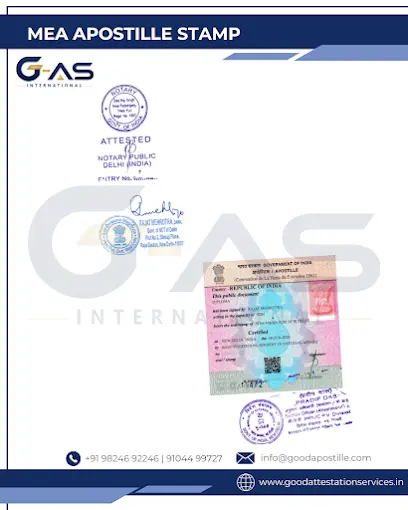
Migration Certificate Apostille

Migration Certificate Apostille helps authenticate an Indian migration certificate for official use in Hague Convention countries, with document verification and MEA apostille support from GOOD APOSTILLE SERVICES.

call us

+91 7016754663

call us

+91 9824692246

Migration Certificate Apostille Services for Indian educational documents
Migration Certificate Apostille
01

When Is Certificate Apostille Required for Overseas Use?

A migration certificate is issued by a school, board, college or university to show that a student has been permitted to move from one institution or education system to another. An apostille may be requested when the certificate will be presented to an authority in a country where the Hague Apostille Convention applies and that authority asks for apostilled educational records.

  • Admission or transfer to a foreign school, college or university
  • Academic record evaluation by an overseas education authority
  • Submission during student visa or residence documentation, when requested
  • Recognition of prior study while joining a new institution abroad
  • Credential review for further education or professional study
  • Institution-specific compliance where a migration certificate is listed
Always confirm the receiving institution’s document checklist first; an apostille is not automatically required for every country or every admission case.
02

How Apostille Services Are Verified in India

The verification route depends on the issuing authority and whether its records are available through e-Sanad or another integrated digital repository. For eligible online records, verification can be completed through the connected Document Issuing Authority before MEA apostille. Where the certificate is not available through an integrated repository, the applicable State or Union Territory pre-authentication route is generally required before offline MEA submission.

  • Check the exact school, board, college or university that issued it
  • Confirm whether the issuing authority is integrated with e-Sanad
  • Use the digital route when the eligible record is available online
  • Use State or Union Territory pre-authentication when required offline
  • Ensure the issuing authority can verify the certificate details
  • Submit for MEA apostille only after the required verification stage
The route should be chosen from the certificate’s actual issuer and record availability, not from a one-size-fits-all HRD or SDM assumption.
03

What to Check Before Apostille for Migration Certificate

Before submission, check the migration certificate paperwork for consistency. The holder’s name, institution name, certificate number, date of issue, authorised signature and seal should be clear and should match supporting academic or identity records where relevant. If the certificate is damaged, laminated, altered or difficult to verify, the issuing institution may need to clarify or reissue the record before apostille processing can proceed.

  • Original migration certificate or eligible record for the chosen route
  • Clear certificate number, issue date, signature and official seal
  • Name spelling consistent with passport and academic records
  • Supporting mark sheets or admission records if verification requests them
  • Passport copy or other identification required for the submission route
  • Destination and receiving authority confirmed before processing begins
If a related academic proof is requested, a bonafide certificate apostille may be relevant only when the receiving authority specifically asks for that document.
04

Timeline and Fees for MEA Migration Certificate Apostille

Processing time is driven mainly by pre-authentication and issuer verification. MEA’s 2025 Citizen’s Charter states that apostille processing is usually completed within seven working days after the document is received by MEA, but the earlier university, board, State or Union Territory verification stage can add time. For MEA Migration Certificate Apostille, the official MEA fee is ₹50 per apostilled document, while delivery, scanning, verification or service charges can be separate.

  • MEA apostille fee: ₹50 per document
  • e-Sanad speed-post delivery charge may apply
  • Offline outsourced collection, delivery and scanning charges may apply
  • Issuer or State verification can extend the total turnaround time
  • Incomplete records or mismatched details can cause additional checks
  • Courier transit time is separate from authority processing time
Ask for a route-specific estimate rather than relying on a fixed “same-day” promise, because preliminary verification is outside the final MEA apostille stage.

Educational Context and Verification

ED

Educational Document Apostille Services for Academic Records

A migration certificate sits within the wider educational-document category. GOOD APOSTILLE SERVICES can help applicants understand the route for the specific certificate and, when other academic records are also requested, related document apostille services should be handled according to each record’s issuer and verification requirement.

  • Migration Certificate
  • Degree or Diploma Certificate
  • Academic Mark Sheets
  • Transcripts and Provisional Certificates
  • HSC Certificate Apostille
  • School or University Academic Records
Read More
VR

Migration Certificate Document Apostille Verification Route

The correct route starts with the certificate issuer. A digitally available record may move through e-Sanad after issuer verification, while a non-integrated record may need the designated State or Union Territory pre-authentication before MEA processing. The same route should not be assumed for every university or board.

  • Identify the exact issuing institution
  • Check e-Sanad or repository availability
  • Confirm the designated pre-authentication authority
  • Resolve name or certificate-number mismatches
  • Complete issuer verification before MEA submission
  • Keep supporting academic records ready if requested
AU

Migration Certificate Attestation vs Apostille

Attestation and apostille are not interchangeable labels. Apostille is used for qualifying public documents intended for countries where the Hague Apostille Convention applies, while other destinations may require a different legalization chain. If your case needs non-apostille authentication, review the migration certificate attestation route before submitting the original record.

  • Destination country determines the legalization route
  • Receiving authority requirements should be checked first
  • Apostille applies only where the Convention operates
  • Non-Convention destinations may need additional legalization
  • Verification requirements still depend on the certificate issuer
  • Do not process multiple routes unless the authority requires them

Migration Certificate Apostille FAQs

Practical answers on eligibility, certificate checks, MEA processing, current fees and document return.

Migration Certificate Apostille Basics

When the certificate is used abroad and what an apostille actually confirms.

A foreign university, education authority or other receiving body may ask for an apostilled migration certificate when it needs an authenticated Indian educational record for cross-border use. The requirement depends on the destination country and that authority’s own document checklist, so confirm the need before starting the apostille process.

The apostille authenticates the origin of the public document by certifying the relevant signature, capacity of the signer and, where applicable, the seal or stamp. It does not independently prove that every statement inside the migration certificate is academically correct or guarantee that a foreign institution will accept it for a particular purpose.

No. Apostille is relevant when the Hague Apostille Convention applies between the issuing and receiving countries and the receiving authority requires it. For a destination where apostille is not the applicable route, a different attestation or consular legalization process may be needed instead.

Migration Certificate Readiness

Checks that reduce avoidable verification queries before the certificate is submitted.

Check the holder’s full name, institution or board name, certificate number, issue date, authorised signature and seal. The record should be legible and traceable to the issuing authority. If any detail is unclear, confirm it with the issuer before sending the certificate for Apostille for Migration Certificate.

Do not conceal or manually alter a mismatch. Ask the issuing institution whether the migration certificate needs a correction, clarification letter or reissue. Apostille authenticates the document’s origin; it does not correct differences between the certificate and the applicant’s identity or academic records.

Yes. The verifying authority may ask for related academic records when it needs to confirm the certificate or the holder’s study history. Depending on the case, mark sheets, enrolment records, transfer documents or other issuer-supported evidence can be relevant. Submit only what the designated authority or receiving institution actually requests.

MEA Apostille for Migration Certificate Process

How issuer verification, e-Sanad and offline pre-authentication affect the route.

Start with the certificate’s issuing school, board, college or university. If its eligible records are integrated with e-Sanad, verification can occur through the connected digital repository. If digital verification is unavailable, the applicable State or Union Territory pre-authentication procedure should be completed before offline submission to MEA.

Allow separate time for preliminary verification and final MEA processing. MEA’s 2025 Citizen’s Charter says apostille is usually completed within seven working days after the document reaches MEA. University, board or State verification may take additional time, especially when records are older, incomplete or not digitally available.

Use the e-Register on the e-Sanad portal with the apostille or attestation number shown on the issued certificate. This check helps confirm that the apostille record corresponds with the Ministry’s electronic register and is more reliable than relying only on a scanned image shared by another party.

Migration Certificate Apostille Fees

Current government charges and the items that can change the total quotation.

MEA’s current Citizen’s Charter lists a government apostille fee of ₹50 per document. For online e-Sanad cases, a speed-post delivery charge is listed separately. For offline outsourced submission, collection, delivery and per-page scanning charges are also listed separately from the MEA fee.

The final amount can include preliminary verification, document handling, scanning, collection, courier or professional service charges, depending on the route. Older certificates or records requiring direct issuer confirmation can also involve additional procedural steps. The fee should therefore be based on the actual Migration Certificate Apostille route, not a generic package.

Ask for the government fee, verification charges, service fee, courier or pickup cost, scanning charges and any taxes to be shown separately. GOOD APOSTILLE SERVICES should also confirm which authority will verify the migration certificate and whether the quoted timeline starts before or after that verification is completed.

Migration Certificate Handling & Return

Practical steps for protecting the certificate during physical submission or courier movement.

Physical submission may be needed when the certificate is not eligible for a fully digital verification route or when the designated authority requires the original or an eligible physical record. Confirm the route first so an original certificate is not couriered unnecessarily when digital verification is available.

Keep the document flat in a protective sleeve and rigid envelope, retain a clear scan, and use a trackable delivery method. Avoid writing on, trimming, stapling or laminating the certificate before submission unless the issuing or verifying authority specifically instructs you to do so.

Check the holder’s details, certificate pages, apostille number and physical condition as soon as the document is returned. Then verify the apostille in the e-Sanad e-Register and keep the tracking receipt and a digital scan for your records before sending the certificate to the overseas receiving authority.

Need Apostille or Attestation Support for Your Documents?

Your Trust, Our Responsibility — That’s a G-AS Commitment.

call us

+91 7016754663

call us

+91 9104499727

whatsapp

+91 9824692246

Email us

info@goodapostille.com