
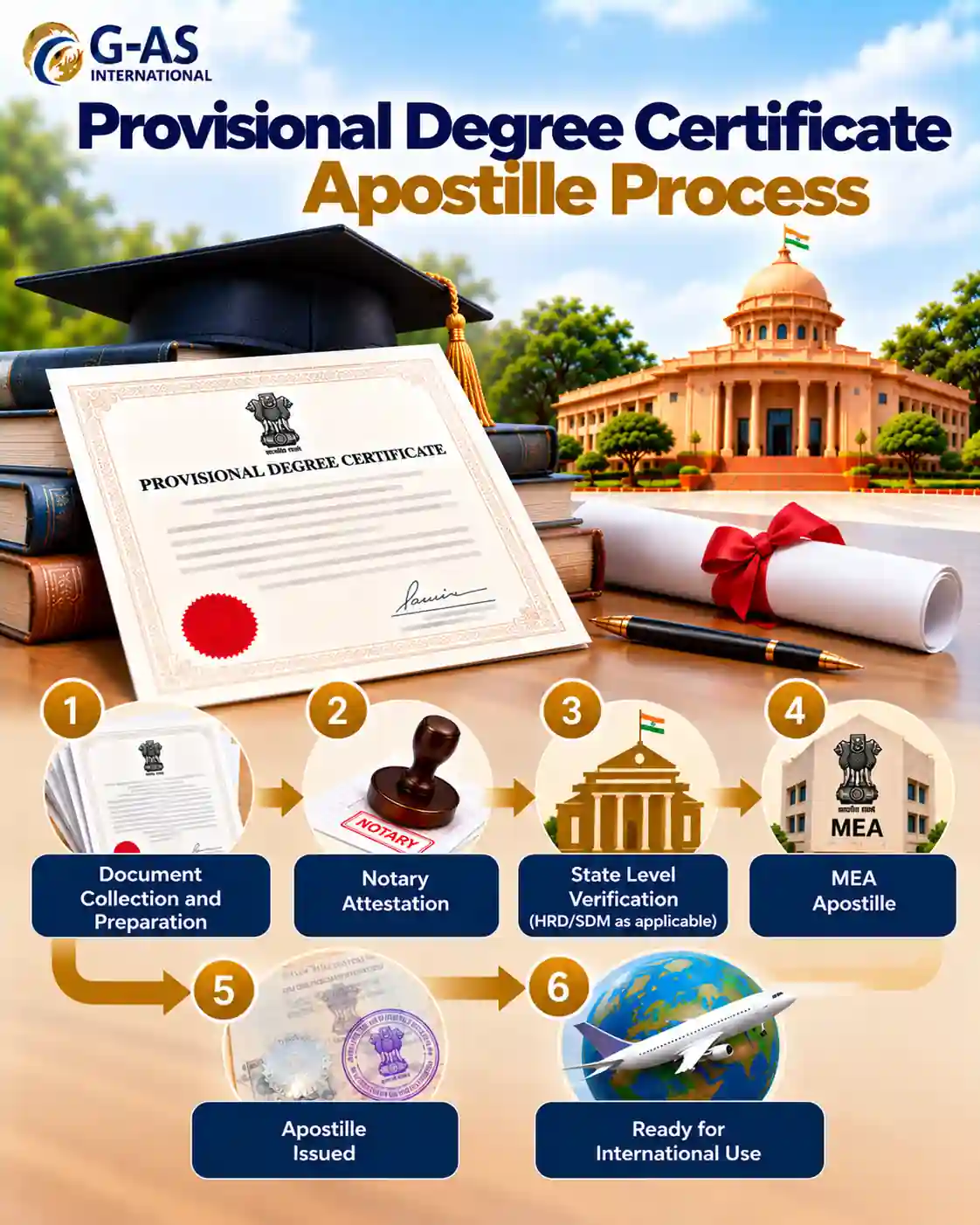
The Provisional Degree Certificate Apostille Process authenticates an educational document for use abroad where an apostille is required. In India, the applicable route can depend on the issuing authority and document availability, with eligible records processed through e-Sanad or other documents requiring State/UT pre-authentication before MEA apostille.
This guide explains the key apostille steps, document verification route, pre-authentication requirements, and MEA processing. It also helps you understand how to apostille a provisional degree certificate correctly, what should be checked before submission, and why confirming the receiving university, employer, or authority’s document requirements can prevent avoidable complications.
The Provisional Degree Certificate Apostille Process may be required when a temporary university-issued degree record must be presented to an overseas authority that accepts apostilled Indian educational documents.
A foreign university may request an authenticated provisional degree while the final degree certificate is still unavailable. Always confirm whether the receiving institution accepts a provisional certificate.
Employers, licensing bodies, or credential evaluators may ask for authenticated academic evidence. Acceptance depends on the organisation, destination country, and purpose for which the certificate is submitted.
A provisional certificate can provide interim proof of qualification. Once the permanent certificate becomes available, requirements may differ; review the permanent degree apostille workflow when applicable.
Requirements can vary according to the issuing university, State or UT verification system, processing route, and the authority receiving the document abroad.
The certificate should be issued by the relevant university or authorised educational institution and should contain clear, consistent academic and student information.
University or State-level verification may require supporting academic records or information. The exact supporting set should be confirmed for the applicable authority before submission.
Identification, authorisation, application details, or university verification information may be requested depending on the route. Review the detailed document preparation checklist before proceeding.
Do not assume one document list applies nationwide. Requirements can change according to the university, State or UT authority, digital availability, and verification method.
The Provisional Degree Certificate Apostille Process depends mainly on how the educational document can be verified and pre-authenticated before final processing by the Ministry of External Affairs.
First confirm that the receiving university, employer, licensing body, or other authority accepts a provisional certificate and requires an apostille. Apostille applies when the document is intended for a destination where the Apostille Convention is applicable.
The certificate may need verification through the issuing university or the relevant State or UT system. The authority and method can differ, so the correct verification-route details should be checked before submission.
For educational documents using the physical route, pre-authentication by the designated State or UT authority may be required. Where the document is available through an integrated digital repository, verification may instead proceed through the applicable e-Sanad workflow.
After the necessary verification or pre-authentication is completed, the document proceeds for Ministry of External Affairs apostille. The Provisional Degree Certificate MEA Apostille Process should follow the route applicable to that specific certificate rather than an assumed universal sequence.
Total completion time depends on the verification route and should not be confused with the final MEA processing stage alone.
The MEA stage is only part of the overall timeline. University verification and State or UT pre-authentication can add time before the document reaches MEA. For a closer breakdown, review the turnaround and delay factors.
Processing arrangements can differ according to the issuing State, university verification method, submission channel, document condition, and delivery requirements. Applicants comparing the overall requirements can also review the separate government and service charge factors.
Most avoidable problems occur before final apostille, especially when document details or the selected verification route are incorrect.
Sending the certificate through a route that does not match its issuing authority can cause additional verification, return of documents, or a fresh submission.
Differences in names, course details, university information, signatures, or other essential records can require clarification or correction before authentication can continue.
Where the relevant authority requires confirmation from the issuing university, processing can remain pending until the institution completes or responds to the verification request.
A receiving authority may require the final degree instead of a provisional certificate. Review common rejection triggers before starting the process.
A short pre-submission review can prevent avoidable verification problems and help identify the correct Provisional Degree Certificate Apostille Procedure.
These answers address practical questions that commonly arise before beginning the Provisional Degree Certificate Apostille Process in India.
A university-issued provisional degree may be processed when it is eligible for the required verification and apostille route. The receiving authority should also be asked whether it accepts a provisional certificate instead of the final degree.
The verification method depends on the issuing institution and applicable State, UT, or digital system. Some records can be verified electronically, while others may require confirmation through the university or designated authority.
For documents following the physical route, designated State or UT pre-authentication may be required before MEA processing. Eligible digitally available records can follow the applicable e-Sanad verification workflow.
Start by identifying the issuing university, State or UT, digital verification availability, and destination requirement. These details determine which authentication sequence applies before the document reaches MEA.
No. Apostille authenticates the relevant public-document origin for international use under the applicable Convention framework; it does not require a university, employer, or other receiving organisation to accept a provisional certificate.
That depends on the receiving authority. If the final degree has already been issued or is specifically requested, confirm whether it should replace the provisional certificate before beginning another authentication process.
Your Trust, Our Responsibility — That’s a G-AS Commitment.
Get Document Guidance