
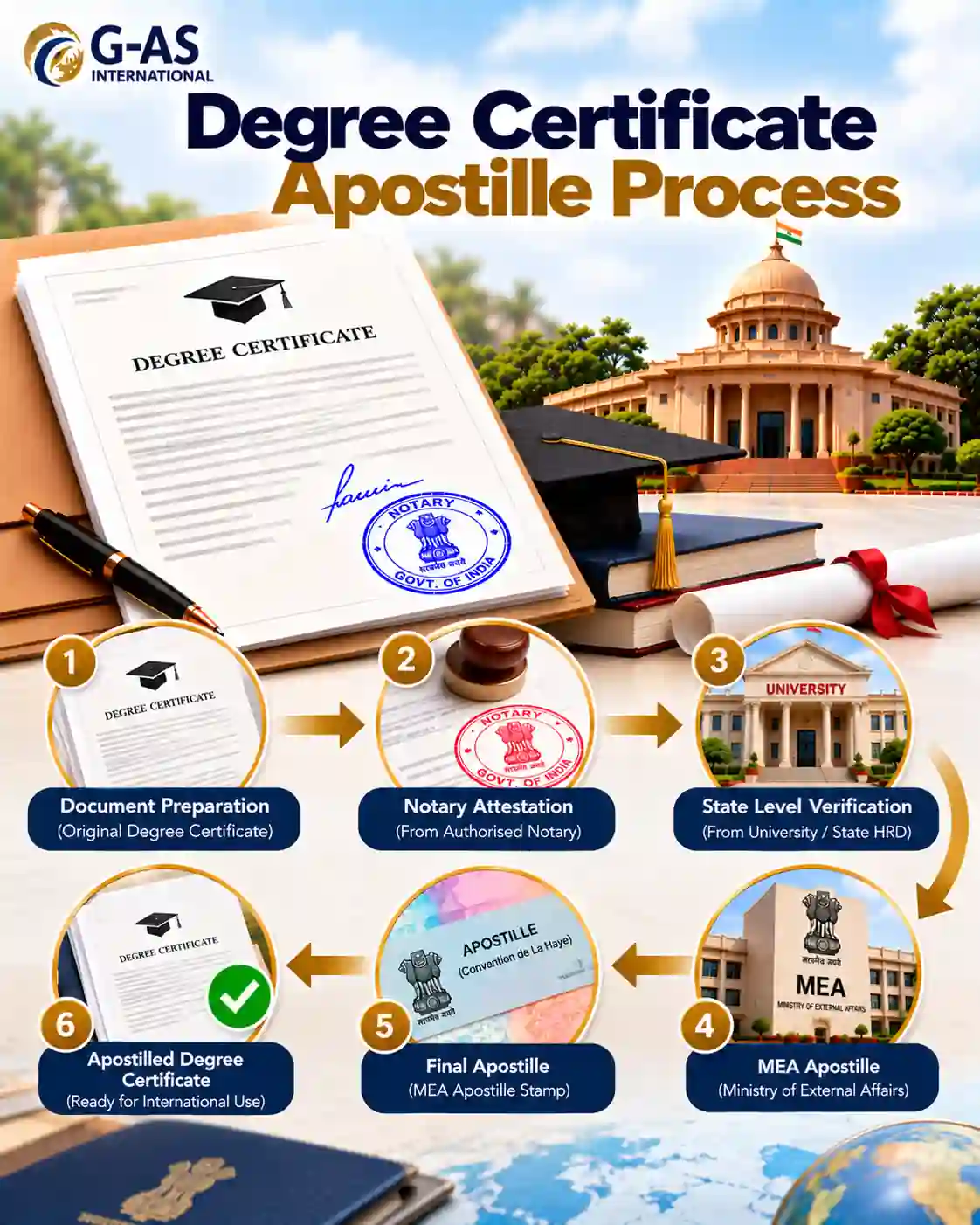
The Degree Certificate Apostille Process authenticates an Indian educational qualification for official use in countries covered by the Hague Apostille Convention. Educational documents generally require pre-authentication from the appropriate State or Union Territory authority before proceeding to the Ministry of External Affairs for apostille.
This article explains how to apostille a degree certificate, from initial document checks and state-level authentication to MEA submission. It also covers the Degree Certificate Apostille Procedure, available e-Sanad routes, important verification points, and practical steps that can help applicants prepare correctly before starting the process.
A degree may need apostille authentication when it will be presented to an overseas authority in a country where the Hague Apostille Convention applies and the receiving organisation specifically asks for an apostilled educational record. For broader academic-document context, review our educational document apostille guidance.
Universities and credential-evaluation bodies may request an apostilled degree when checking the authenticity of an Indian academic qualification for admission, recognition, or further study.
An overseas employer, licensing body, or professional regulator may ask for an authenticated degree before accepting the qualification for employment, registration, or professional assessment.
Some visa, residence, or immigration applications require educational credentials to be authenticated. The applicant should follow the written checklist issued by the destination authority.
The exact submission set depends on the issuing university, State or Union Territory, verification route, and whether the degree can be verified through an integrated digital repository.
Prepare the degree in the form accepted by the applicable verification authority. Physical and digital workflows can have different document-handling requirements.
Keep the applicant's identification and relevant university details available when requested, especially where the authority needs to match the certificate with institutional records.
Some cases may require additional academic records or clarification from the issuing institution. Use the degree apostille document checklist to prepare the likely supporting set.
Confirm that the applicant name, university name, qualification title, certificate number, seals, and signatures are readable and consistent before starting authentication.
The correct route depends mainly on whether the degree can be digitally verified through e-Sanad or requires State or Union Territory pre-authentication before MEA processing.
First confirm that the receiving organisation actually requires an apostille and that the destination accepts apostilles under the Hague Convention. Also verify that the degree details are complete and legible.
Check whether the issuing authority is available through e-Sanad or another integrated digital repository. If not, the degree generally needs the applicable State or Union Territory pre-authentication. See the state and digital verification pathways for route-specific guidance.
For documents outside the applicable e-Sanad workflow, the designated State or Union Territory authority verifies or authenticates the educational document before it becomes eligible for the Ministry stage.
After the required verification or pre-authentication is complete, the eligible degree proceeds through the authorised submission channel for MEA apostille. The completed apostille details should be checked before overseas use.
There is no single end-to-end timeline for every degree because university verification, State-level authentication, digital availability, and document corrections can affect completion.
The MEA stage is only one part of the workflow. University responses, State or Union Territory pre-authentication, e-Sanad eligibility, document condition, and clarification requests can all change the total duration. Review the factors that affect the overall timeline before planning travel or submission dates.
Confirm the required pathway before sending an original certificate. Route selection, document handling, courier movement, and supporting verification can affect the overall arrangement. A separate degree apostille cost planning guide can help with practical preparation.
Most avoidable problems arise before the final Ministry stage, particularly when the document, issuing authority, or verification pathway has not been checked carefully.
Differences in the applicant name, course title, university name, dates, or certificate number can trigger additional clarification before verification is completed.
Submitting a degree through the wrong State, authority, or digital pathway can cause the application to be returned or require the verification stage to be repeated.
Older records, archived university data, unclear seals, or delayed responses from the issuing institution can extend the Degree Certificate Apostille Process.
Do not resubmit unchanged documents without identifying the issue first. Review common causes of rejection or return and correct the specific problem before trying again.
A short review before submission can prevent avoidable delays and help ensure the degree follows the correct verification pathway.
These answers cover common practical questions that arise before and during degree verification and apostille processing in India.
First confirm the correct verification route. A digitally available record may follow the applicable e-Sanad workflow, while other degrees generally require State or Union Territory pre-authentication before the MEA apostille stage.
No. The route can vary by issuing university, State or Union Territory, digital repository availability, and the verification system used by the relevant authority.
The degree must be verifiable through the applicable authority or digital system. The exact verification method depends on the issuing institution and the route used for authentication.
Yes. Unclear seals, unreadable details, unexplained overwriting, or physical damage can make verification difficult. The issuing institution may need to clarify or reissue the record.
No. Apostille authenticates the origin of the public document, such as the relevant signature or seal. It does not evaluate grades, course quality, equivalence, or academic recognition.
Check that the returned certificate is the same document submitted, the apostille details are clear, and the receiving authority does not require any separate translation or additional academic record.
Your Trust, Our Responsibility — That’s a G-AS Commitment.
Get Document Guidance