
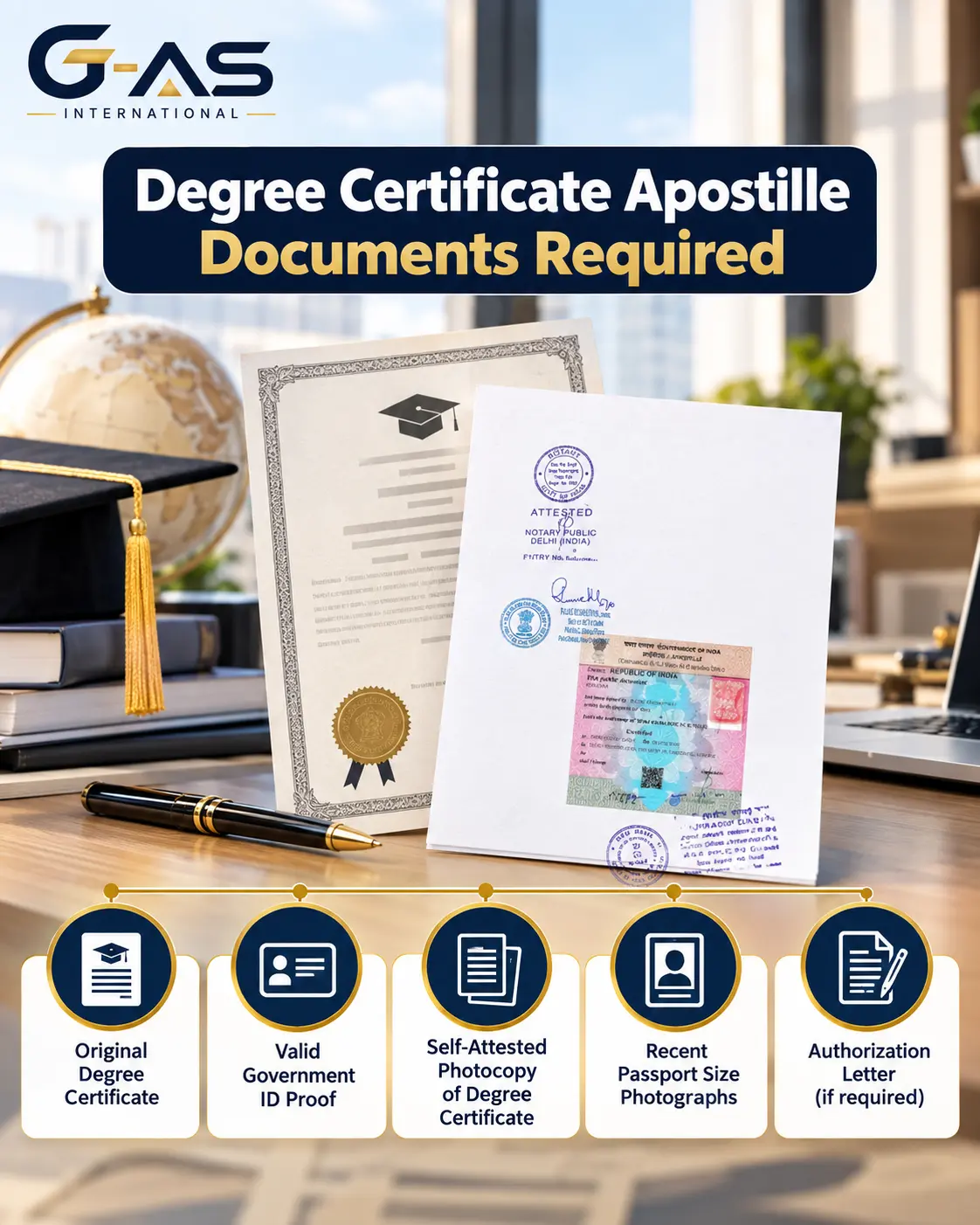
Degree Certificate Apostille Documents Required generally include the original degree certificate and valid identity proof, while supporting papers such as mark sheets, transcripts, or authorization documents may be needed depending on the verification route. In India, educational documents may also require verification by the relevant issuing or state authority before the apostille stage.
This article explains the essential and conditional documents, how e-Sanad and physical verification routes can differ, and what applicants should check before submission. It provides a practical Degree Certificate Apostille Checklist to help prepare the correct paperwork and avoid preventable delays caused by incomplete or route-specific requirements.
Degree Certificate Apostille Documents Required depend on the certificate, verification route, and instructions of the overseas authority receiving it. Preparing the correct records first helps avoid sending unnecessary or incomplete paperwork.
Universities and credential evaluators may ask for an apostilled degree when checking an Indian qualification. Some cases also require separate transcripts or mark sheets, so the recipient's document instructions should be confirmed first.
Overseas employers or licensing bodies may request authenticated educational records before accepting a qualification. The broader educational document route is useful when more than one academic record needs review.
Some immigration, residence, or skilled-migration files require proof of educational qualifications. The documents requested should therefore be checked against the destination country and the exact authority handling the application.
For the physical MEA route, the core papers normally include the eligible original document or true copy, a document photocopy, and the applicant's passport photocopy.
The certificate submitted for physical processing must be an eligible original or accepted true copy. A plain photocopy alone is not treated as the document being authenticated.
A clear photocopy should accompany the document for the physical route. Check that the university name, award details, seal, signature, and certificate reference are readable.
A photocopy of the applicant's passport is generally required with physical MEA submission. Identity details should be consistent with the information appearing on the academic record.
The submission may also require completion of the applicable prior verification. The authority involved depends on the issuing institution and available processing route.
Requirements can differ when the degree is available through an e-Sanad-integrated digital repository. Eligible digital records can be verified electronically by the relevant Document Issuing Authority before MEA processing.
The correct sequence depends on whether the academic record is digitally verifiable or must follow a physical authentication route. A route-by-route verification guide explains this distinction in more detail.
Confirm whether the receiving authority wants only the final degree or also asks for transcripts, mark sheets, translations, or another academic record. Separate documents should be prepared individually when required.
Check whether the degree is available through an e-Sanad-connected digital repository. If it is not, the required records should be prepared for the applicable physical verification and authentication route.
For non-e-Sanad educational records, the relevant designated authority verifies the document before MEA processing. The applicable authority can vary according to the issuing source and current authentication arrangement.
After the required verification is complete, the eligible document proceeds through the applicable MEA channel. The step-by-step certificate process provides a fuller chronological explanation.
Preparing the correct Degree Certificate Apostille Documents Required can reduce avoidable document queries, although completion still depends on verification availability and authority response.
Digital verification can move differently from physical university or state-level verification. Older records, delayed responses, unclear certificate details, or additional confirmation can affect completion. Review the detailed timing factors for a focused explanation.
Document preparation should remain separate from other planning questions so the core submission stays accurate. Additional certificate-related planning information is available in this related certificate planning guide.
Even when the main submission records are available, inconsistencies, missing verification, or an incorrect route can result in additional checks.
Differences between the degree and supporting identity records can require clarification. Check spelling, initials, surname order, and other identifying details before submission.
Submitting a record through an unsuitable route can cause delays. Confirm whether the degree is digitally available or needs prior authentication through the applicable authority.
Faded seals, unreadable signatures, missing university details, or damaged records can make verification difficult and may lead to a request for clarification or replacement documentation.
An apostille on the degree does not automatically cover transcripts or mark sheets. The common rejection and correction issues explain additional document-specific problems to check.
Use this checklist to verify the required records and the applicable route before handing over or uploading any document.
These answers clarify common questions about Degree Certificate Apostille Documents Required and route-specific supporting records.
For a physical MEA submission, the basic documents generally include the eligible original degree or accepted true copy, a photocopy of the document, and the applicant's passport photocopy after applicable prior authentication.
Not for every route. Physical processing generally uses an eligible original document or accepted true copy, while e-Sanad depends on the academic record being available through an integrated digital repository.
Not automatically. An apostille applies to the specific document being processed. If the receiving institution asks for a degree, transcript, and mark sheets separately, each requested record may require separate handling.
A translation does not automatically replace the underlying degree for apostille purposes. Translation requirements come from the receiving authority, while the academic record still follows its applicable verification route.
Requirements can vary because the issuing institution, digital availability, authentication route, destination authority, and requested academic record are not identical in every case.
Check the applicant name, university name, degree title, award details, seal, authorised signature, document condition, destination instructions, and correct verification route before submitting the certificate.
Your Trust, Our Responsibility — That’s a G-AS Commitment.
Get Document Guidance