
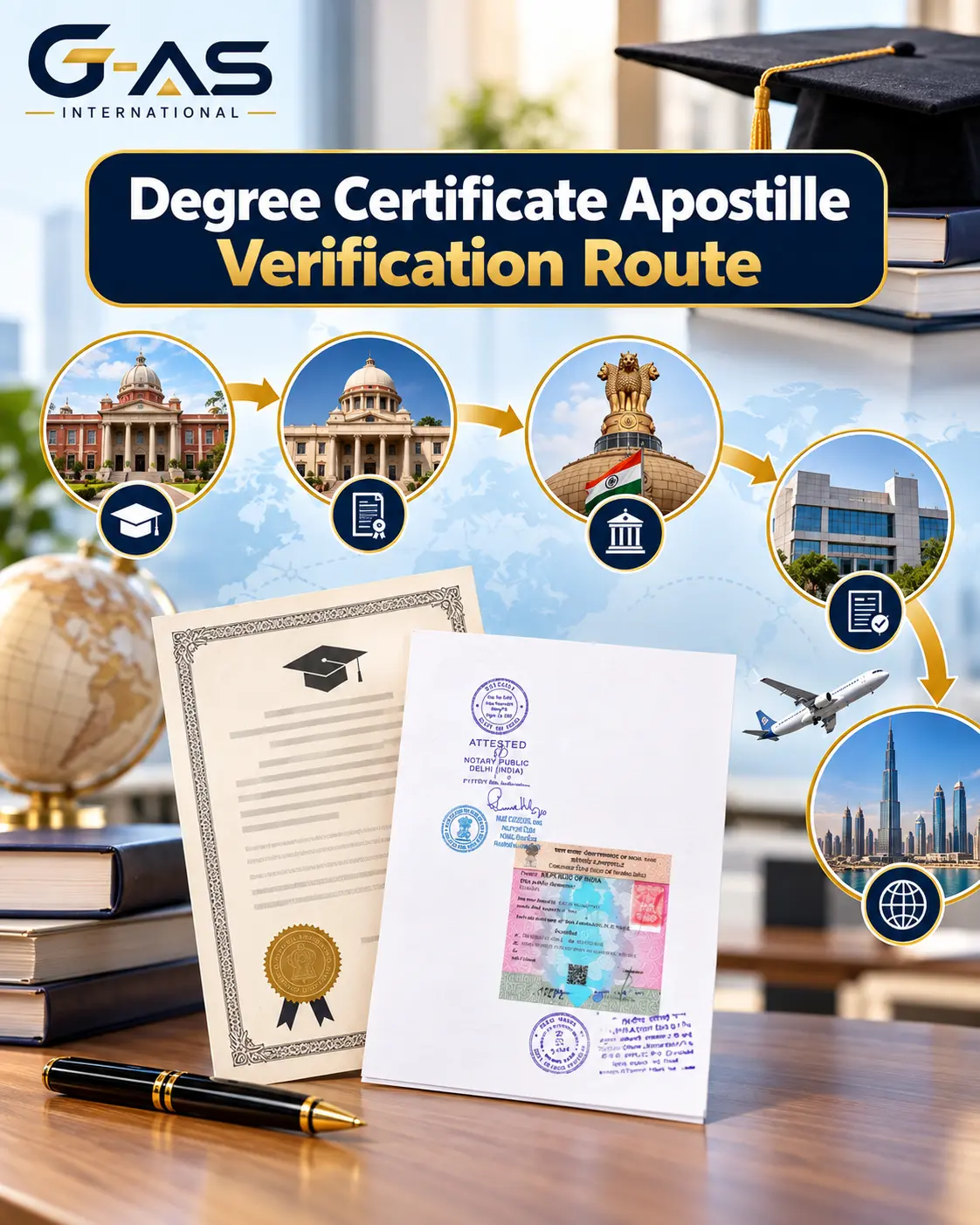
The Degree Certificate Apostille Verification Route explains how an Indian university degree is authenticated before the Ministry of External Affairs (MEA) issues the apostille. Educational documents generally require verification by the appropriate State or Union Territory authority, while eligible digitally available records may follow the e-Sanad verification system.
This article explains how university and state verification fit into the route, where HRD/Higher Education or SDM authentication may apply, and what MEA checks before apostille issuance. It also helps readers understand why the issuing authority, destination-country requirements, and receiving institution’s checklist should be confirmed before selecting a verification path.
The Degree Certificate Apostille Verification Route is relevant when an Indian degree must be authenticated for use in a country where an apostille is accepted and the receiving authority asks for authenticated academic credentials.
A foreign university or credential evaluator may ask for an apostilled degree to confirm the document's origin before admission, qualification assessment, or academic recognition.
Employers and licensing bodies may request authenticated qualifications when checking academic credentials for regulated work, professional registration, or overseas employment documentation.
Some immigration or assessment files require verified educational records. The exact document list should be confirmed with the receiving authority before starting the educational document apostille route.
Before the Degree Certificate Apostille Verification Route begins, confirm the issuing university, certificate details, destination requirement, and whether the record can be verified digitally or needs the applicable state-level authentication.
The certificate should clearly show the holder's name, degree title, university, award details, authorised signature, seal, and reference information needed for verification.
For physical processing, the applicable submission route may require the eligible original or accepted true copy, a document copy, and the applicant's passport copy. Review the supporting document checklist before dispatch.
Keep accurate university, enrolment, certificate, course, and award information available because the issuing institution or designated authority may need these details to trace the academic record.
Do not assume every degree follows one identical path. The issuing state, university, digital-repository availability, certificate format, and receiving authority can change the verification route.
The Degree Certificate Apostille Verification Process should follow the verification channel applicable to the issuing authority before the document reaches the Ministry of External Affairs for apostille issuance.
Check that the receiving country and organisation require an apostille for the degree. Also confirm whether they need only the final degree or separate academic records such as transcripts or mark sheets.
Determine whether the record is available through a Document Issuing Authority integrated with e-Sanad. If digital verification is unavailable, the applicable educational authentication route for the issuing State or Union Territory may be required.
The relevant authority verifies the academic record, signature, seal, or issuing details as required by the selected route. For a fuller sequence, review the step-by-step degree apostille stages.
After the required verification is complete, the eligible document proceeds to MEA for apostille. The issued apostille can then be checked through the e-Register using its identifying details.
There is no single turnaround for every Degree Certificate Apostille Verification Route because the verification stage can depend on the university, state authority, and digital availability.
University response time, older records, state-level authentication, record mismatches, holidays, and requests for additional confirmation can extend processing. For route-specific planning, see the turnaround factors for degree processing.
Applicants should account for the verification channel, number of documents, courier handling, and any additional authentication required by the case. A separate guide explains service and submission cost factors without changing the verification sequence itself.
Most delays occur before final apostille issuance, especially when the academic record cannot be verified quickly or the wrong verification channel is selected.
Submitting through a route that does not match the document's issuing authority can result in extra checks, redirection, or a fresh authentication step.
Differences in the holder's name, degree title, award year, certificate number, or university record can lead to clarification before verification is completed.
Damage, alterations, unreadable seals, unclear signatures, or incomplete certificate details can make authentication more difficult and may require additional confirmation.
Apostilling the wrong academic record can create unnecessary rework. Review common causes of rejection and correction before submission.
A short Degree Certificate Apostille Authority Check can prevent avoidable verification queries before the document enters the authentication route.
These answers clarify common route, authority, digital-verification, and destination questions for Indian degree certificates.
The degree must complete the verification required by its applicable route. Depending on the issuing authority, that may involve digitally verified records or state-level educational authentication before MEA processing.
e-Sanad can support online processing when the document is available through an integrated digital repository or Document Issuing Authority. Records not available digitally continue through the applicable non-digital route.
No universal route should be assumed. MEA's published physical procedure identifies State or Union Territory educational authentication for educational documents. Any alternative handling should be confirmed for the specific document and recipient before use.
An apostille authenticates the origin of the public document, including the relevant signature, official capacity, or seal. It does not assess grades, academic equivalence, or course quality.
An apostille applies to the specific document on which it is issued. If the receiving organisation separately requests transcripts or mark sheets, those records may need their own authentication.
The apostille can be checked through the e-Sanad e-Register using the apostille or attestation number and the required verification details shown on the portal.
Your Trust, Our Responsibility — That’s a G-AS Commitment.
Get Document Guidance