
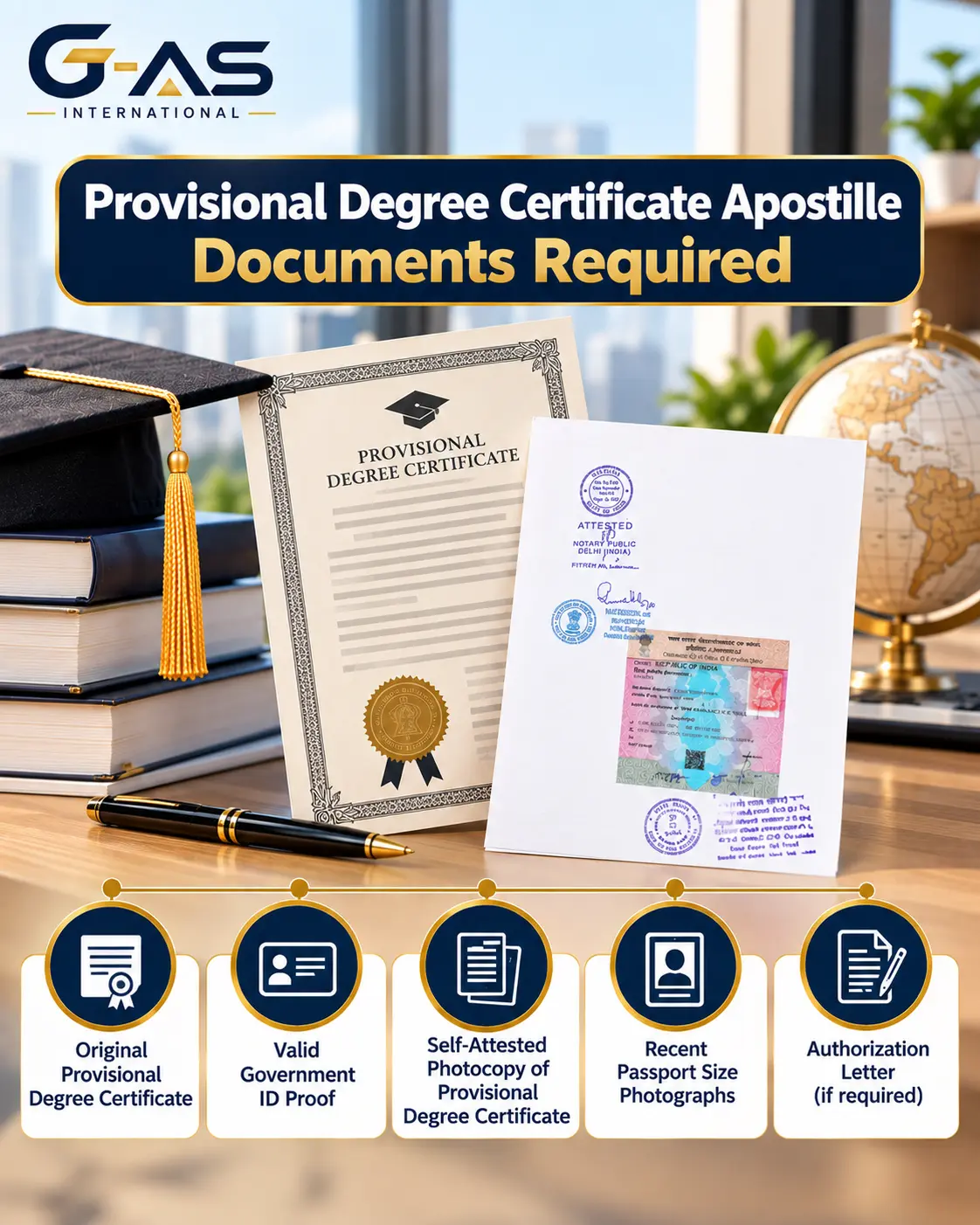
Understanding the Provisional Degree Certificate Apostille Documents Required is important before submitting an educational certificate for use abroad. In India, the file generally starts with the provisional certificate and applicant identification, while supporting academic records or verification papers may be requested depending on the issuing university, authentication route, and receiving authority.
This article explains which documents are commonly needed, when marksheets, university verification, authorization, or photocopies may be requested, and why requirements can differ between cases. It will help you prepare a practical checklist and avoid submitting unnecessary or incomplete papers before the apostille process begins.
A provisional degree is temporary proof that a university has completed the award process before the permanent degree is issued. Apostille may be requested when an overseas recipient accepts this temporary academic record.
An overseas university may accept a provisional certificate for admission or enrolment while the permanent degree is still pending. The institution should confirm that an apostilled provisional record is acceptable.
Employers, licensing bodies, or credential evaluators may request authenticated evidence of degree completion. Their written checklist determines whether a provisional certificate is sufficient or the final degree is required.
Some immigration or residence files include academic credentials. Applicants should confirm both apostille eligibility and acceptance of a provisional certificate before preparing supporting records.
The exact file depends on the university, verification route, and receiving authority. The following items cover the documents most commonly checked without treating every supporting record as universally mandatory.
The certificate should be complete, legible, and issued by the university or authorised institution. Names, course details, issue date, signatures, seals, and certificate references should be clearly readable.
For physical MEA submission routes, a passport photocopy is commonly submitted with the eligible original document or accepted true copy and a photocopy of that document.
Marksheets, university verification, student details, or an authorisation document may be requested in a particular case, but they should not be treated as automatic requirements for every applicant.
The requirements may change when the issuing authority is integrated with e-Sanad or another supported digital repository. Confirm the applicable route before sending an original certificate.
Preparing the right papers is only one part of the process. The certificate must also follow the verification path that applies to its issuing authority and record format.
Check whether the foreign university, employer, licensing body, or immigration authority accepts a provisional certificate. If the permanent degree is already available, compare the degree certificate authentication workflow before choosing which record to process.
Review the certificate for spelling, university details, signatures, seals, and readable identification. Supporting records should be added only when the selected verification route or recipient specifically requires them.
Documents available through an integrated digital repository may follow e-Sanad verification. Other records can require applicable state or educational pre-authentication before MEA processing. Review the verification path for a provisional certificate when route selection is unclear.
Once the required prior verification is complete, the eligible document can proceed for apostille through the applicable authorised channel. A separate guide to the step-by-step provisional certificate workflow can help distinguish document preparation from later processing stages.
The time needed for apostille is not determined only by how quickly the applicant supplies the papers. Verification availability can be the main variable.
Digital verification may reduce document movement where the issuing authority is integrated with e-Sanad. A non-integrated record may need additional educational or state verification first. For planning purposes, review the factors that influence completion time.
Document requirements, verification, delivery, and other application components can vary independently. If you are preparing the complete file, review provisional certificate cost considerations separately rather than assuming they determine which papers are required.
A complete-looking file can still face queries when the certificate details or verification route do not match the underlying university record.
Different spellings, incomplete names, incorrect course details, or inconsistent dates can trigger additional verification. The certificate and identity record should be checked before submission.
Damage, heavy lamination, unclear printing, or missing institutional details may make verification difficult and can require clarification from the issuing university.
Assuming that every provisional degree follows the same state or digital process can delay the application. The correct route depends on the issuing authority and available verification system.
An apostille authenticates the document's origin; it does not force a foreign institution to accept a temporary academic credential. Review common rejection and correction causes before submitting.
Use this short checklist to confirm the file is ready for the route that actually applies to your document.
These answers clarify practical document questions and explain when additional supporting papers may be necessary.
No. The required format depends on the applicable verification and submission route. Physical MEA routes can involve an eligible original or accepted true copy, while integrated digital records may follow a different process.
A passport photocopy is commonly required for the physical submission route described by MEA. Digital or authority-specific processes can have different supporting-data requirements, so the selected route should be checked first.
No. Marksheets can be supporting academic evidence, but they are not automatically mandatory in every case. A university, verification authority, or foreign recipient may request them when relevant.
Potentially. e-Sanad supports online verification for documents available through integrated digital repositories. Eligibility depends on the issuing authority and availability of the particular record in the connected system.
Ask the receiving organisation which credential it wants. A final degree and a provisional certificate are separate academic records, and the foreign recipient may prefer the permanent certificate once available.
Confirm recipient acceptance, document condition, identity details, issuing university information, the applicable verification route, and whether any supporting record is specifically requested before dispatching originals.
Your Trust, Our Responsibility — That’s a G-AS Commitment.
Get Document Guidance