
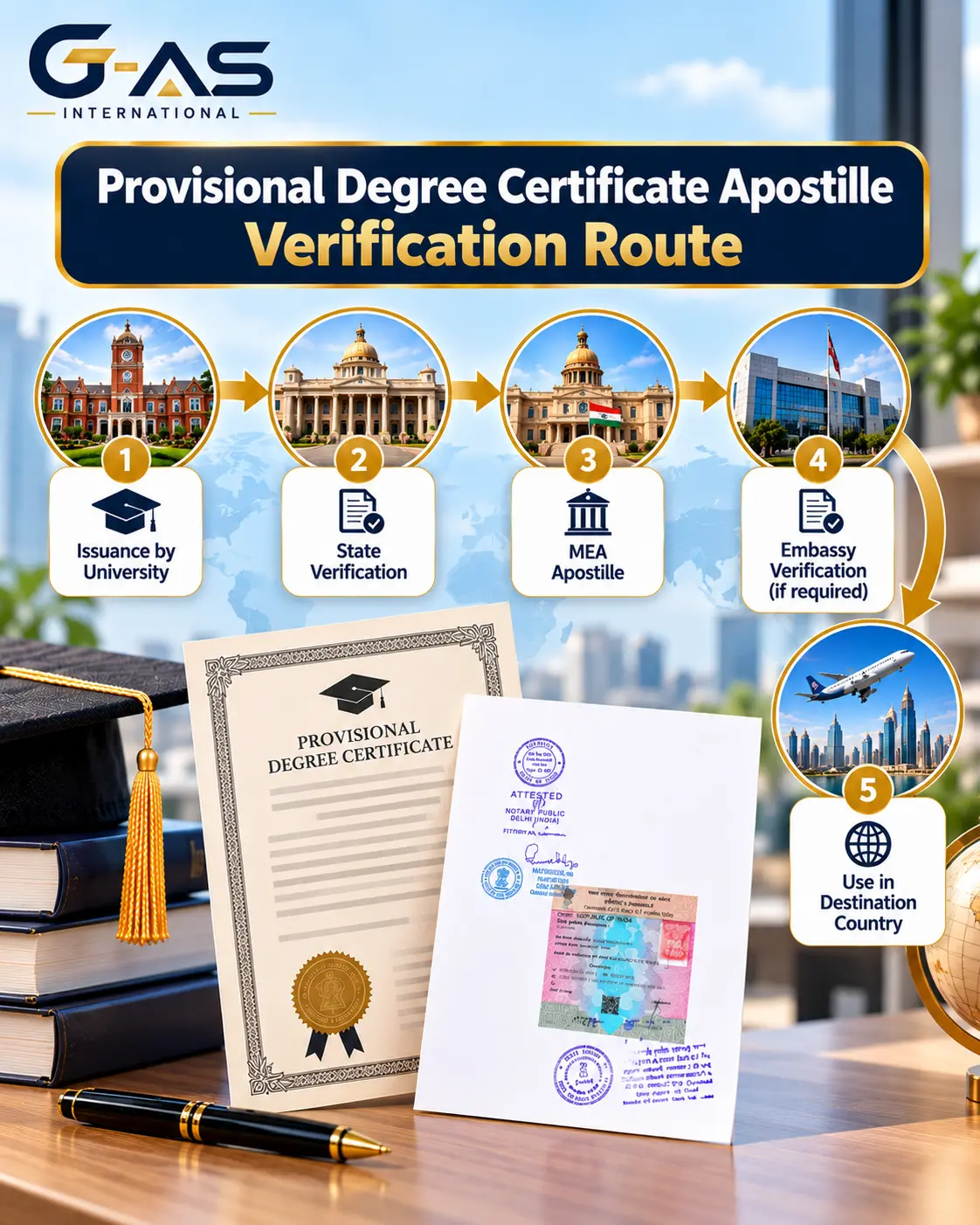
The Provisional Degree Certificate Apostille Verification Route explains how an Indian provisional degree is verified before the Ministry of External Affairs (MEA) issues an apostille for use in a Hague Convention country. The route can vary: eligible digitally available educational records may use e-Sanad, while documents outside e-Sanad generally require authentication through the designated State or Union Territory authority before MEA processing.
This article explains the Provisional Degree Certificate Apostille Verification Process, including how to identify the applicable pre-authentication route, how state-level verification and e-Sanad differ, and where MEA fits into the sequence. It will also clarify why the issuing authority, digital availability of the academic record, and correct authentication channel should be checked before submission.
A provisional degree may need authentication when it is being used abroad before the permanent degree is issued, but the receiving organisation should first confirm that provisional proof is acceptable.
Universities may accept a provisional certificate for an application or enrolment deadline. If the permanent award is later requested, compare the authentication route for the final degree.
An overseas employer, licensing body, or credential evaluator may request authenticated academic proof while the final degree remains pending. Acceptance depends on that organisation's document rules.
Some overseas applications ask for authenticated educational evidence. Before starting the Provisional Degree Certificate Apostille Verification Route, confirm that the destination authority accepts the provisional certificate itself.
The verification route starts with the certificate and its issuing details. Supporting requirements can differ by university, State or Union Territory authority, and submission channel.
The certificate should clearly show the holder's name, programme or qualification, issuing institution, date or reference details, and the authorised signature or seal where applicable.
Identity copies, mark sheets, enrolment details, or other supporting records should be supplied only when the university, State authority, e-Sanad workflow, or receiving body requires them.
Check whether the foreign university, employer, licensing body, or authority accepts a provisional degree and whether it also requests a final degree, transcript, or translation.
Requirements are not identical for every issuing institution. Use the supporting-document preparation checklist to review likely paperwork without assuming that every item applies to every case.
The correct sequence depends mainly on whether the issuing authority can verify the academic record through an e-Sanad-connected digital repository or whether State-level pre-authentication is required.
Check that the destination uses the Apostille Convention for the intended document and that the recipient accepts provisional academic proof. For the broader sequence, review the complete provisional certificate processing sequence.
e-Sanad requires the document to be available through a supported digital repository or integrated Document Issuing Authority. If that route is unavailable, the certificate follows the applicable offline pre-authentication procedure.
These labels should not be treated as interchangeable shortcuts. For educational documents outside the digital route, follow the designated State or Union Territory educational authentication channel applicable to the issuing institution and document.
After the required verification or pre-authentication is completed, the eligible document proceeds to the Ministry of External Affairs for apostille. The issued apostille can then be checked through India's e-Register.
The total duration includes more than the final MEA stage because university, issuing-authority, or State verification may need to finish first.
MEA processing begins after the required earlier verification has been completed. The complete route can take longer when university or State-level checks remain pending. See the stage-wise turnaround factors for related timing considerations.
The authority sequence should be chosen from the document's verification requirements rather than convenience alone. For broader submission planning, review the separate provisional certificate planning guide.
Most avoidable problems arise when the verification route, certificate details, or recipient requirements are assumed instead of checked before submission.
e-Sanad depends on digital availability and integration with the issuing authority. A certificate that is not supported must follow the applicable alternative verification route.
Differences between the certificate and supporting records can trigger additional checks or correction requests. Review the common rejection and correction causes before submission.
The issuing State, university, document type, and available digital route determine the applicable verification channel. Using an unsuitable authority can lead to delay or resubmission.
An apostille authenticates the document's origin; it does not force an overseas institution to accept provisional proof instead of the final degree or another academic record.
Before submission, verify the route and the document itself so the certificate reaches the correct authority in a usable form.
These answers clarify common route and authority questions before a provisional degree is submitted for apostille.
It can be processed when the document is eligible for apostille and the required verification route can be completed. The overseas recipient should also confirm that it accepts provisional rather than final proof.
Not through one universal method. Digitally supported records may be verified through an integrated issuing authority, while other cases can involve university confirmation within the State or Union Territory authentication workflow.
It depends on digital availability. e-Sanad requires the document to be available in a supported digital repository or through an integrated Document Issuing Authority. Unsupported records follow the applicable alternative procedure.
The authentication process checks the origin of the public document, including the relevant signature or seal and official capacity. It does not establish academic equivalence or guarantee overseas acceptance.
The issued apostille can be checked through the e-Register available on India's e-Sanad portal using the relevant apostille or attestation details and the portal's verification process.
Possibly. The receiving university, employer, licensing body, or authority decides whether provisional proof is enough or whether the permanent degree must later be submitted separately.
Your Trust, Our Responsibility — That’s a G-AS Commitment.
Get Document Guidance