
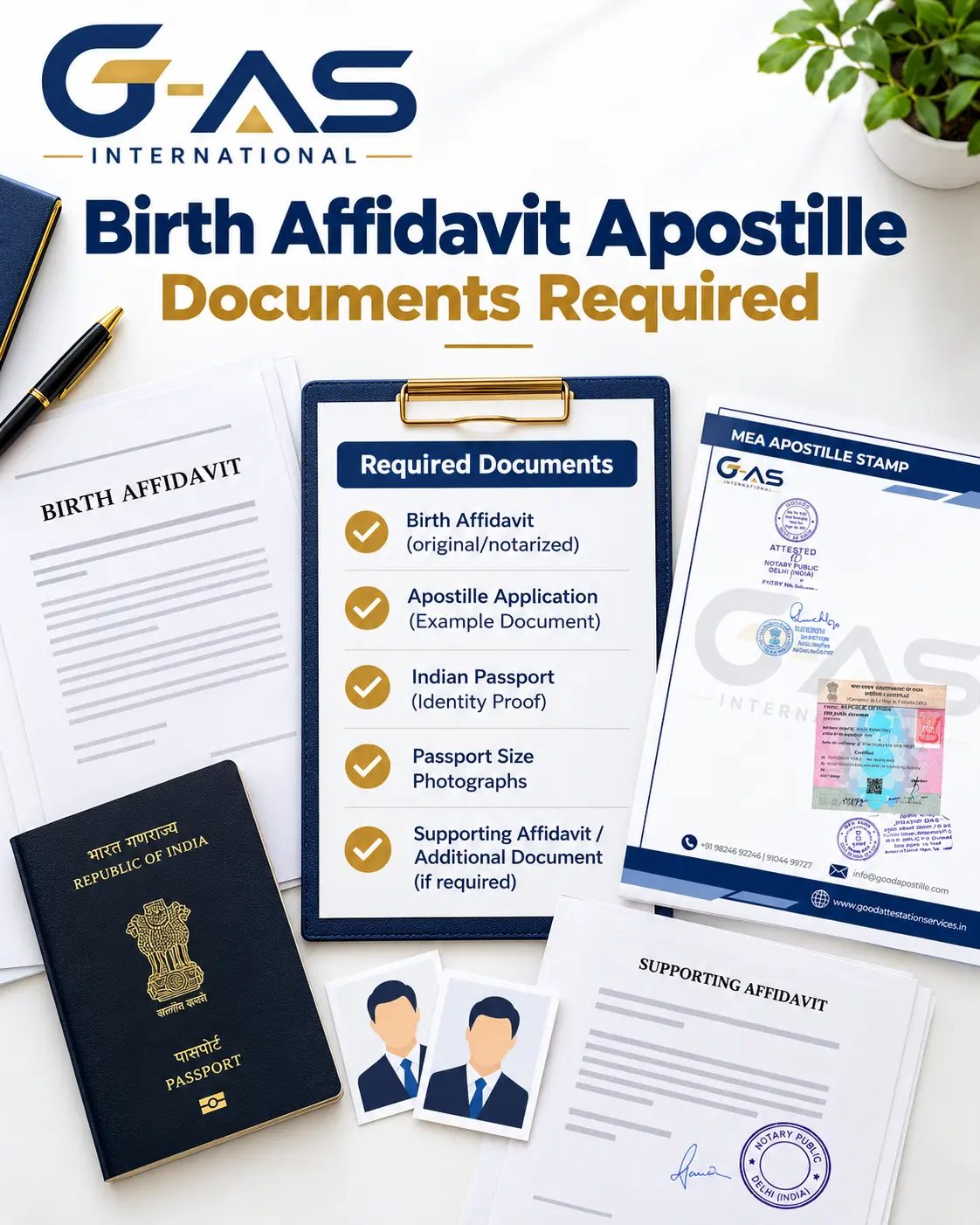
Understanding the Birth Affidavit Apostille Documents Required helps prevent avoidable delays before submitting an affidavit for international use. The basic paperwork generally starts with the original, properly executed birth affidavit along with identity or supporting records required for verification. The exact checklist can vary depending on the affidavit, authentication route, and destination-country requirements.
This guide explains the documents for Birth Affidavit Apostille, supporting identification, possible pre-authentication requirements, and details that should be checked before submission. It will also clarify which papers are commonly required and which may be requested only in specific cases, helping applicants prepare a more accurate Birth Affidavit Apostille checklist.
The Apostille Documents Required depend on why the affidavit is being used abroad, how it was executed, and the receiving authority's instructions.
A birth affidavit may be requested when an overseas authority needs sworn evidence of birth-related facts and the available civil record does not fully meet its documentation requirement.
The affidavit and supporting identity records should use consistent names, dates, places, and parent details. Where a legal name change is also involved, review the separate name-change document route.
Before apostille, confirm that the destination accepts the Hague Apostille Convention route and that the receiving office accepts a birth affidavit for the intended purpose.
The core Birth Affidavit Apostille Documents Required normally begin with the original affidavit and supporting submission records applicable to the chosen authentication route.
Use the complete original affidavit intended for overseas use. It should contain the required signatures, notarial details where applicable, and clear, readable information.
MEA guidance for offline submission requires a photocopy of the applicant's passport together with the document. Keep the identity details consistent with the affidavit.
For the offline route, the submission set includes a photocopy of the document along with the original or eligible true copy presented for apostille processing.
Additional papers can depend on the State or Union Territory verification route, the affidavit's execution, and the overseas recipient's instructions. Check the pre-authentication and verification route before finalising the file.
The Birth Affidavit Apostille Documents Required should be prepared for the correct sequence because verification and MEA submission are separate stages.
Confirm that the receiving authority accepts a birth affidavit and requires an apostille. Review names, dates, signatures, seals, notarial details, and document condition before starting.
Documents not covered by the relevant e-Sanad workflow generally require authentication through the designated State or Union Territory route before they are submitted for MEA apostille.
For offline cases, MEA states that individuals submit documents through designated outsourced service providers rather than directly at the Ministry counter. The step-by-step submission route explains the sequence in more detail.
After processing, confirm that the apostille is attached to the correct affidavit and that the document details remain readable and consistent with the overseas submission file.
Preparing the Birth Affidavit Apostille Documents Required correctly can reduce avoidable resubmission, but the overall timeline still depends on verification and handling stages.
MEA's Citizen's Charter states that apostille is usually completed within seven working days after the document is received by MEA. State or Union Territory authentication, corrections, dispatch, and return movement can extend the total duration. See the turnaround and delay factors.
Plan for document review, pre-authentication where applicable, authorised submission, and return handling rather than considering only the MEA stage. A separate submission planning overview may also help when organising the application.
Even when the main Birth Affidavit Apostille Documents Required are present, inconsistencies or an incorrect route can interrupt processing.
Differences in spelling, dates, places, or parent details between the affidavit and identity records can create verification questions and should be corrected before submission.
Missing signatures, unclear seals, incomplete notarial information, alterations, or unreadable pages can prevent the affidavit from moving smoothly through authentication.
Using the wrong State, Union Territory, or document route can lead to correction or resubmission. Review common rejection and correction causes before filing.
An apostille is appropriate only when the destination and receiving authority accept that route for the intended use. Confirm the recipient's document requirement before submission.
Use this short Birth Affidavit Apostille Checklist to review the Birth Affidavit Apostille Documents Required before the document enters the authentication and apostille route.
These answers clarify common questions about the Birth Affidavit Apostille Documents Required and related submission checks.
The Birth Affidavit Apostille Documents Required normally start with the original executed affidavit. For the offline MEA route, current guidance also calls for a photocopy of the document and a photocopy of the applicant's passport.
For offline apostille submission through authorised providers, MEA guidance states that a photocopy of the applicant's passport should accompany the document and its photocopy.
Yes. The applicable route can depend on how the affidavit was executed, the responsible State or Union Territory authority, and whether an eligible digital workflow covers the document.
Yes. The Birth Affidavit Apostille Requirements can vary with the executing authority, pre-authentication route, applicant circumstances, and the receiving authority's own documentary requirements.
Identity details should be reviewed for consistency before submission. Unexplained differences can create verification problems, especially where the receiving authority compares the affidavit with identity records.
No. Confirm that the destination accepts apostilles under the Hague Apostille Convention and that the receiving authority requires an apostille for this particular affidavit and purpose.
Your Trust, Our Responsibility — That’s a G-AS Commitment.
Get Document Guidance