
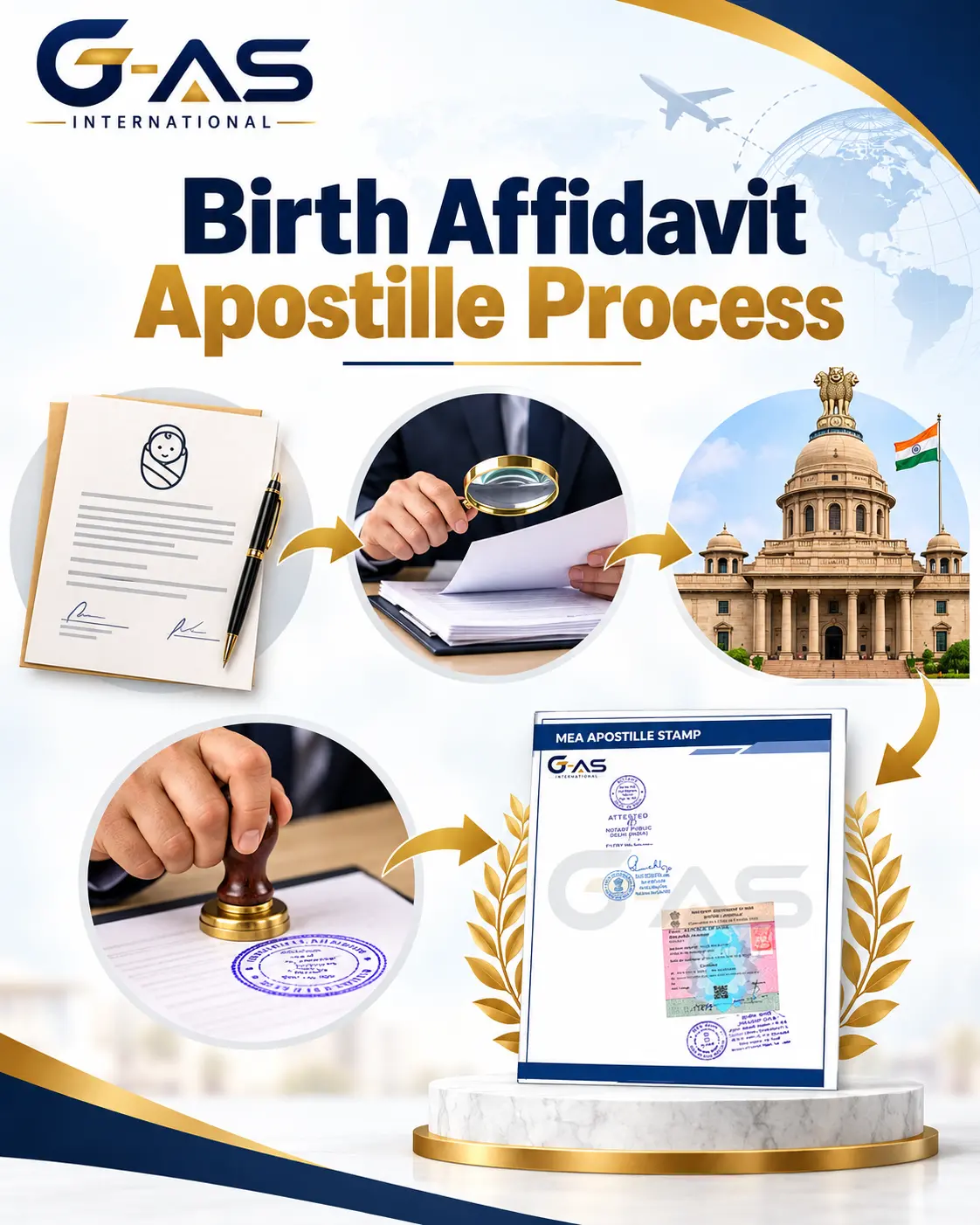
The Birth Affidavit Apostille Process authenticates a sworn birth-related declaration for official use in a Hague Convention country. In India, the process generally involves preparing the affidavit correctly, completing the required notarization or preliminary authentication, and obtaining the final apostille through the Ministry of External Affairs route.
This guide explains the Birth Affidavit Apostille Procedure step by step, including document preparation, verification, pre-authentication, MEA apostille, and important checks before submission. It will also help you understand how to apostille a birth affidavit correctly and avoid common procedural mistakes that may cause delays.
The Birth Affidavit Apostille Process is used when a sworn birth-related declaration must be authenticated for official use in a Hague Convention country. The receiving authority should first confirm that an affidavit is acceptable for the intended purpose.
A birth affidavit may support a case where a standard civil birth record is unavailable or where the receiving authority specifically permits a sworn declaration as supporting evidence.
Some foreign immigration, residency, family, or civil procedures may request authenticated birth-related declarations when additional proof of birth facts or family details is required.
If older and current records show different names, the affidavit and supporting records should be consistent. Where relevant, review the supporting name-change record workflow before submission.
Document requirements can vary by route and receiving authority. Before starting the Birth Affidavit Apostille Process, confirm what must accompany the affidavit for verification and final submission.
The affidavit should clearly state the relevant birth facts, carry the required signatures, and be notarized or otherwise executed in the form accepted for the applicable authentication route.
Identity or supporting birth records may be requested depending on the authority, document history, and purpose. Use the birth-affidavit document checklist to review common supporting-paper requirements.
Translation, authorization, or additional evidence should be included only when required by the applicable submission route or the foreign authority receiving the apostilled affidavit.
The Birth Affidavit Apostille Process authenticates the relevant document for international use; it does not automatically make an affidavit a substitute for a civil birth certificate where the receiving authority specifically requires that certificate.
The Birth Affidavit Apostille Steps can vary, but the practical sequence is document preparation, applicable preliminary authentication, MEA apostille, and a final acceptance check.
Draft the affidavit with accurate names, date and place of birth, declaration details, and purpose where required. Complete notarization or the accepted initial execution before moving to the next authentication stage.
Depending on the document and route, a competent state authority or SDM-related authentication may be required before MEA submission. Check the verification-route overview before choosing a path.
After the required preliminary authentication is complete, the document proceeds through the authorized channel for Ministry of External Affairs apostille. This is the central government-authentication stage for the affidavit.
Verify that the document details, signatures, seals, and apostille are legible and consistent. The Birth Affidavit Apostille Process should also be matched to the destination authority's current document-acceptance requirements.
Timing depends on document readiness, the preliminary route, authority workload, corrections, and submission logistics rather than one universal completion period.
The Birth Affidavit Apostille Process can take longer when notarization is incomplete, preliminary authentication is pending, details need correction, or authority processing is delayed. Review the typical processing-time factors before planning a deadline.
Confirm the route, supporting documents, collection or return method, and whether any extra verification applies. For related planning considerations, see the document processing considerations.
Most avoidable problems arise from inaccurate document details, incomplete execution, the wrong verification route, or destination requirements being checked too late.
Differences in spelling, date of birth, place of birth, or identity details can trigger clarification or correction before the Birth Affidavit Apostille Process continues.
Missing signatures, unclear stamps, incomplete declarations, or an improperly executed affidavit can interrupt the procedure and require the document to be corrected.
Using the wrong pre-authentication path can delay MEA submission. Applicants should verify the competent route before proceeding with final apostille authentication.
An apostille does not override a receiving authority's document rules. Review common rejection triggers before final submission and overseas use.
Before the Birth Affidavit Apostille Process begins, a short pre-submission check can prevent avoidable corrections and help the document follow the appropriate authentication sequence.
No. The receiving authority decides what evidence it accepts. The Birth Affidavit Apostille Process authenticates the affidavit, but it does not automatically replace a civil birth certificate when that certificate is specifically required.
The Ministry of External Affairs is India's competent authority for apostille. Preliminary verification or authentication may still be required before the document reaches the final MEA stage.
Notarization can be an initial stage when required by the applicable route. Further authentication may still be necessary before the affidavit reaches the MEA apostille stage.
Yes. The route can depend on the affidavit, state-level practice, supporting records, and the applicable submission channel. Confirm the current route instead of assuming every case follows an identical sequence.
Correct the underlying affidavit before continuing wherever possible. Errors in names, dates, or declarations can cause additional verification and interrupt the authentication sequence.
Start after confirming the document format, preliminary authentication route, and receiving authority's requirements. Allow extra time for corrections or authority delays instead of relying on a guaranteed completion date.
Your Trust, Our Responsibility — That’s a G-AS Commitment.
Get Document Guidance