
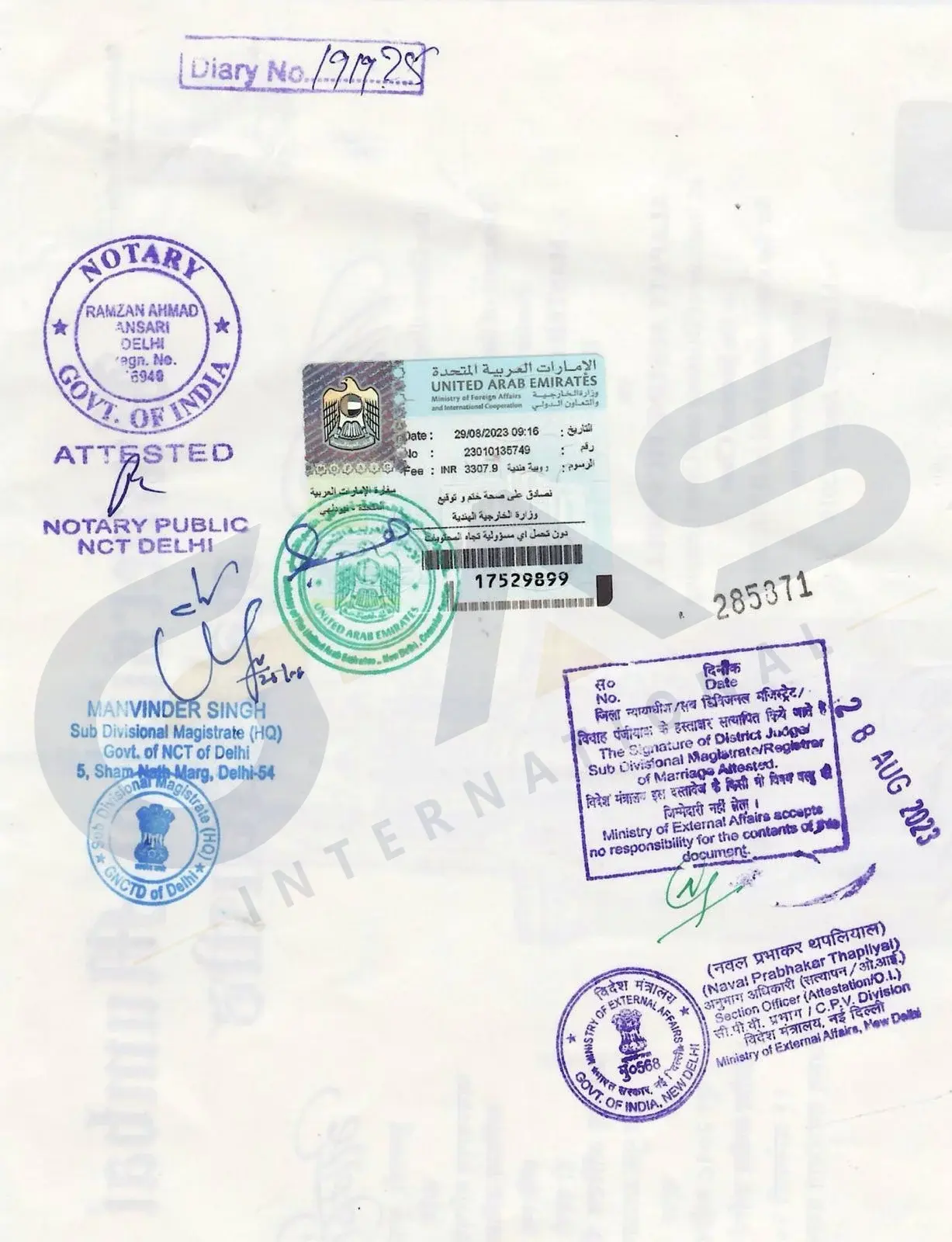
Certificate of Origin Attestation

Certificate of Origin Attestation authenticates commercial origin documents for overseas customs clearance, export transactions, and international business requirements.

call us

+91 7016754663

call us

+91 9824692246

Certificate of Origin Attestation for commercial export documents
Certificate of Origin Attestation
01

When Is Attestation Required?

This attestation may be required when an Indian Certificate of Origin must be presented to a foreign customs authority, embassy, importer, bank or other receiving body that asks for authenticated commercial documentation. The certificate identifies the declared origin of exported goods, while attestation confirms the authenticity of the document for overseas use. Requirements differ by destination and transaction, so verify the requested legalisation route before dispatching originals. Businesses handling several commercial records can also review document attestation services for related authentication needs.

  • Customs or import-clearance documentation requested by the destination authority
  • Buyer, distributor or overseas client verification of commercial records
  • Banking, trade-finance or letter-of-credit document compliance
  • Embassy or consular legalisation for countries requiring normal attestation
  • Government tender, product registration or overseas business submission
  • Supporting export documentation where authenticated origin evidence is requested
Attestation does not determine tariff eligibility or certify the commercial truth of every statement; the receiving authority decides what form of authentication it requires.
02

How Attestation Work in India

For commercial documents processed outside the e-Sanad route, the usual sequence begins with authentication by the appropriate Chamber of Commerce. The Ministry of External Affairs then legalises the document on the basis of the recognised signature or seal. For a destination where apostille is not accepted, normal MEA attestation may be followed by embassy or consular legalisation when the foreign authority requires it. This commercial route is different from personal and educational document verification, so the destination country and receiving authority should be checked before the document is submitted.

  • Check the destination country's current authentication requirement
  • Obtain Chamber of Commerce authentication where the route requires it
  • Submit the eligible original or true copy through the authorised channel
  • Complete Ministry of External Affairs normal attestation when applicable
  • Proceed to destination-country embassy legalisation if specifically required
  • Confirm any final foreign-ministry step after arrival in the destination country
MEA distinguishes apostille from normal attestation, so the destination country's status and the receiving authority's instructions should be checked before processing.
03

What Is Needed for Attestation for Certificate of Origin?

The submission set should be checked before processing because a Certificate of Origin often sits alongside invoices, packing details and shipping records. For MEA handling, the applicable original document or eligible true copy, a document photocopy and passport copy are commonly required through the authorised submission route. A Chamber of Commerce may also ask for company-specific supporting records such as a covering letter, commercial invoice, transport evidence or authorised-signatory details. If the invoice itself also needs authentication, review the separate commercial invoice attestation process.

  • Certificate of Origin in the format accepted for the transaction
  • Supporting commercial invoice matching the shipment and exporter details
  • Company covering letter or authorisation where requested by the Chamber
  • Clear exporter, consignee, destination and goods information
  • Document photocopy and applicant or authorised representative identification
  • Additional shipping evidence requested for verification of the export
Exact supporting documents vary by issuing Chamber, destination and transaction; mismatched company, invoice or shipment details can cause avoidable rechecking.
04

Avoiding Delays in Certificate of Origin Document Attestation

Most preventable delays come from inconsistent document data or choosing the wrong legalisation route. Before submission, compare the exporter name, consignee, invoice reference, goods description, origin details and destination across the Certificate of Origin and supporting records. Leave adequate space for official stamps where required and avoid unauthorised alterations after issuance. If related export paperwork needs separate authentication, coordinate it at the same time; for example, an export invoice attestation may have its own document checks and destination-specific requirements.

  • Confirm whether normal attestation, apostille or embassy legalisation applies
  • Match company names and addresses across all supporting commercial documents
  • Check invoice numbers, dates, product descriptions and destination details
  • Use authorised signatures, company seals and current supporting records
  • Avoid laminating, overwriting or damaging original commercial documents
  • Plan for Chamber, MEA, embassy and courier stages where applicable
A route check before submission is especially important because a Hague Convention destination may use apostille, while a non-Convention destination may require normal attestation and further legalisation.

Related Commercial Requirements

AP

Certificate of Origin Apostille for Hague Destinations

When the destination is covered by the Hague Apostille Convention and the receiving authority accepts apostille, the legalisation route may use an apostille instead of normal embassy attestation. Commercial documents still require the applicable prior authentication before MEA processing. The correct route should be confirmed for the specific importing authority because trade documents can have transaction-specific requirements. Review the dedicated Certificate of Origin apostille process before choosing this route.

  • Check Hague Convention applicability for the destination
  • Confirm that the receiving authority accepts an apostille
  • Complete required commercial pre-authentication
  • Use the MEA apostille route when applicable
  • Verify shipment and certificate details before submission
  • Keep copies of the completed authenticated document
UAE

Certificate of Origin Certificate Attestation for UAE Use

For UAE-bound commercial documents, the authentication chain may involve Indian commercial pre-authentication, MEA attestation and UAE mission legalisation, followed by any local requirement specified by the receiving authority. Because embassy rules and supporting-document expectations can change, exporters should confirm the current route before dispatch. For destination-specific guidance, see Certificate of Origin embassy attestation for the UAE.

  • Confirm the UAE recipient's exact legalisation requirement
  • Check Chamber authentication before MEA submission
  • Prepare matching invoice and shipment information
  • Allow for embassy or consular verification where required
  • Keep company authorisation documents ready
  • Confirm final UAE-side acceptance requirements
CD

Commercial Documents Used With Certificate of Origin

A Certificate of Origin is often submitted with other export and corporate records. Depending on the transaction, a foreign buyer, bank, customs authority or government body may ask for one or more related commercial documents to be authenticated separately. Treat each document according to its own issuer, purpose and destination requirement rather than assuming one attestation covers the complete shipment file.

  • Certificate of Origin
  • Commercial Invoice
  • Export Invoice
  • Packing List
  • Agency or Distribution Agreement
  • Company Authorisation or Board Resolution
Read More

Certificate of Origin Attestation FAQs

Practical answers on commercial document checks, MEA processing, destination routes, fees and secure submission.

Certificate of Origin Basics

Purpose, legal effect and destination checks for authenticated origin documents.

It authenticates the commercial document for overseas use through the applicable authorities. It does not independently verify every commercial statement or guarantee that customs, a buyer or another recipient will accept the underlying transaction details.

A recipient may require authenticated origin evidence for customs, import licensing, banking, procurement, product registration or other cross-border procedures. The exact requirement depends on the destination, the transaction and the receiving authority.

No. Some transactions require only the issued Certificate of Origin, while others require apostille, normal MEA attestation, embassy legalisation or additional destination-country formalities. Confirm the recipient's current requirement before processing.

Attestation for Certificate of Origin

Documents and consistency checks before commercial authentication begins.

Check the Certificate of Origin against the commercial invoice, exporter and consignee details, destination, goods description, invoice reference and any shipping evidence requested by the Chamber or receiving authority.

The phrase generally refers to authenticating the Certificate of Origin through the commercial-document legalisation route. The exact authorities involved depend on whether the destination requires normal attestation, apostille or embassy legalisation. If the certificate was issued electronically through India's eCoO system, keep its certificate or verification details available.

Yes. Differences in company names, addresses, invoice numbers, dates, goods descriptions or destination details can trigger rechecking. Correct inconsistencies before the Certificate of Origin and related export documents are submitted.

MEA Attestation for Certificate of Origin

How Chamber, MEA and destination-country legalisation stages can fit together.

Commercial documents not handled through a digital route are generally pre-authenticated by the appropriate Chamber of Commerce before MEA processing. Further embassy or consular legalisation may be required for a non-Hague destination.

An apostille is used when the document is destined for a country covered by the Hague Apostille Convention and the receiving authority accepts apostille. Otherwise, normal attestation and further legalisation may apply.

There is no single timeline for every case. Processing depends on Chamber verification, MEA submission, destination-country embassy requirements, document accuracy, working days and whether additional supporting records are requested.

Fees for Certificate of Origin Legalisation

What may influence the overall cost of commercial document legalisation.

No. MEA's published framework distinguishes normal attestation from apostille. Service-provider, scanning, Chamber, embassy, courier and other destination-specific charges can still apply separately depending on the chosen route.

The total may include Chamber authentication, outsourced submission charges, scanning, embassy or consular fees, courier costs and professional handling. Ask for a written breakdown that separates government and service charges.

It is better to confirm the destination authority's current requirement first. Paying for an unnecessary stage can waste time and money, especially where an apostille or a simpler authentication route is accepted.

Certificate of Origin Submission

Practical handling, dispatch and tracking guidance for original commercial records.

The required format depends on the authority and route. When an original or eligible true copy is required, protect it from folds, staples, lamination, overwriting or damage and retain a clear scan before dispatch.

Verify the recipient address, contact details, document count, supporting copies and return instructions. Use secure packaging and retain the shipment receipt and tracking number until the completed documents are safely returned.

Yes, related commercial records can be planned together when each document's requirements are confirmed separately. Coordinating the Certificate of Origin with invoices or other export documents can reduce duplicate handling and avoid inconsistent shipment details.

Need Apostille or Attestation Support for Your Documents?

Your Trust, Our Responsibility — That’s a G-AS Commitment.

call us

+91 7016754663

call us

+91 9104499727

whatsapp

+91 9824692246

Email us

info@goodapostille.com