
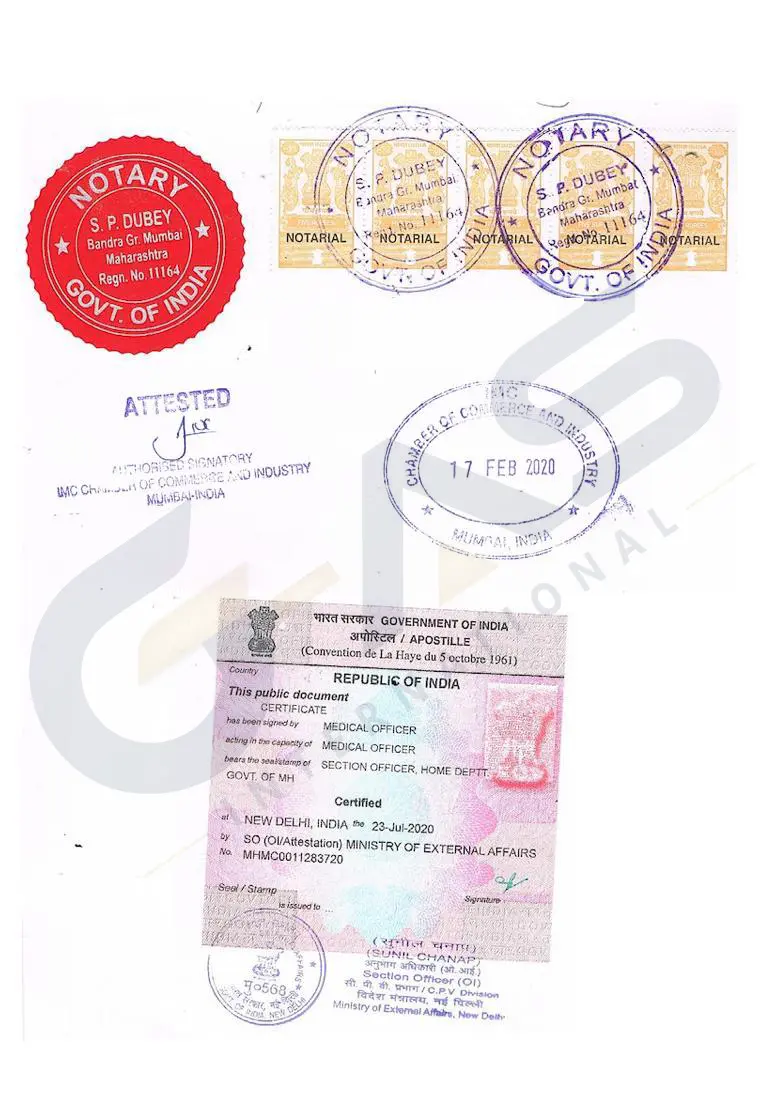
Certificate of Origin Apostille

Get reliable Certificate of Origin Apostille support from GOOD APOSTILLE SERVICES for streamlined commercial document processing, secure handling, and overseas use.

Certificate of Origin Apostille services for commercial documents
Certificate of Origin Apostille
01

When Can Certificate of Origin Apostille Be Requested for Overseas Use?

For an export transaction, a foreign recipient may ask for formal authentication of the Certificate of Origin before accepting it with the shipment or trade file. The request may come from an importer, bank, regulator, tender authority or another overseas party. Confirm the recipient’s written requirement first because the correct route can be apostille, normal attestation, consular legalization or no additional legalization.

  • Identify the destination country and the organization receiving the certificate
  • Verify whether the recipient asks for apostille, attestation or consular legalization
  • Confirm the type of Certificate of Origin used for the transaction
  • Cross-check exporter, consignee, invoice and shipment references before submission
  • Confirm whether Chamber or other pre-authentication is required for the route
  • Follow the destination-specific instruction instead of applying one route universally
The Apostille Convention excludes certain administrative documents dealing directly with commercial or customs operations. In Indian practice, however, commercial documents may still be processed by MEA after the applicable Chamber of Commerce or business-association authentication when an overseas authority requires it.
02

What Does Apostille for Certificate of Origin Actually Authenticate?

The apostille concerns the formal origin of the authenticated signature or certification, not the truth of the commercial statements printed on the Certificate of Origin. It confirms the authenticity of the relevant signature, the capacity of the signer and, where applicable, the seal or stamp. The overseas recipient still decides whether the underlying trade document satisfies its own requirements.

  • Authentication of the relevant signature attached to the certified document
  • Capacity or official role in which the signer acted
  • Identity of the associated seal or stamp where one is present
  • Apostille particulars recorded by the competent authority
  • Traceable relationship between the apostille and the submitted document
  • Authentication of documentary origin rather than verification of trade facts
An apostille does not validate product origin, pricing, quantities or other commercial facts; acceptance of the document remains with the foreign receiving authority.
03

How Does Certificate of Origin Document Apostille Move Through Verification?

The processing path depends on the certificate’s issuing or certifying authority and whether its record can be verified through an e-Sanad-integrated source. When the document is not handled through the supported digital route, commercial-document processing can require Chamber of Commerce or other applicable pre-authentication before the Ministry of External Affairs stage.

  • Review the certificate type and the purpose stated by the overseas recipient
  • Verify the issuing body, certifying authority, signature and seal details
  • Complete Chamber of Commerce authentication when required for the commercial route
  • Use e-Sanad verification where the relevant document source is integrated
  • Submit for MEA processing after the required pre-authentication is complete
  • Check the issued apostille details before forwarding the document abroad
For related India-issued records that also require overseas authentication, the broader document apostille services workflow can help identify the appropriate verification route before MEA submission.
04

What Should Be Checked Before MEA Apostille for Certificate of Origin?

Before submission, compare the Certificate of Origin with the related export records and the foreign recipient’s instructions. Company names, consignee details, product descriptions, dates, invoice references, signatures and seals should be legible and consistent wherever the same information appears. Any required supporting document or destination-specific format should be prepared before authentication begins.

  • Exporter or manufacturer legal name is consistent across the transaction file
  • Consignee and destination country details match the intended overseas submission
  • Invoice, shipment and reference numbers correspond with supporting records
  • Product descriptions and origin statements are complete and readable
  • Authorized signatures, Chamber marks and seals are clearly visible
  • Translation or further legalization requirements are confirmed before dispatch
If the destination does not accept an apostille for the intended use, a Certificate of Origin attestation route or consular legalization may be required instead. The foreign recipient should confirm which form it will accept.

Certificate of Origin Apostille: Preparation, Verification and Commercial Support

CO

Certificate of Origin Preparation Checks

This section should be used to verify the Certificate of Origin against the same shipment records that the foreign recipient will see. A clean, consistent document set makes it easier to identify errors before authentication and reduces avoidable questions during commercial verification.

  • Exporter or manufacturer legal name
  • Consignee and destination country details
  • Goods description and declared origin
  • Invoice and shipment reference numbers
  • Authorized signature, seal or Chamber mark
  • Foreign recipient’s authentication requirement
CV

Chamber Verification and MEA Readiness

When the supported digital route is not available, a commercial certificate may need pre-authentication by the appropriate Chamber of Commerce or business association before MEA handling. The exact sequence should be confirmed from the issuing/certifying source and the foreign recipient before the original commercial document is sent for processing.

  • Certificate issuer and certifier identified
  • Applicable Chamber verification confirmed
  • Authorized signatory and seal checked
  • Required original or accepted format confirmed
  • Relevant export records kept ready
  • Destination authentication route confirmed
CD

Commercial Documents

Certificate of Origin Apostille Services are often handled alongside other export and corporate records used in the same international transaction. Depending on the overseas buyer, bank, regulator or contractual file, a business may need more than one commercial document authenticated before the complete set is accepted abroad.

Read More

Certificate of Origin Apostille Questions for Exporters and Businesses

Focused guidance on overseas acceptance, document consistency, commercial pre-authentication, MEA procedure, charges, expected variables and safe return of the completed certificate.

Apostille for Certificate of Origin: Destination Use

How to identify the authentication method requested for a specific overseas transaction.

A Certificate of Origin Apostille may be requested when the foreign recipient wants formal authentication of the signature, certification or seal connected with the document. Before processing, ask the importer, bank, regulator or other receiving body to confirm the exact form of authentication it requires.

No. The requirement depends on the destination, the nature of the commercial record and the receiving authority’s rules. Some recipients accept an apostille, while others ask for normal attestation, consular legalization or only the certificate in its standard certified form.

No. Apostille is an authentication formality. It does not replace customs declarations, preferential-origin evidence, banking documents, product compliance records, licences or any other trade requirement that applies separately to the shipment.

Certificate of Origin Document Apostille Checks

Key commercial fields to compare with the supporting export file before submission.

Check the exporter or manufacturer name, consignee, destination, goods description, origin statement, dates, invoice references, signature and seal. Where the same details appear on invoices or shipment records, they should correspond with the Certificate of Origin.

Yes. A mismatch can cause the Chamber, service provider or foreign recipient to ask for clarification. Material errors should be corrected through the issuing or certifying authority so that the commercial document remains traceable and formally valid.

Yes. When the recipient reviews the shipment as one file, repeated information should agree across the Certificate of Origin, invoice and related records. Compare party names, invoice references, dates, product descriptions and other repeated commercial particulars before authentication.

MEA Certificate of Origin Apostille Route

How commercial pre-authentication and e-Sanad eligibility connect with the MEA stage.

For commercial records handled outside the supported digital route, MEA processing follows the required pre-authentication. A Certificate of Origin commonly reaches that stage after verification or certification by the appropriate Chamber of Commerce or other recognized commercial authority.

It can use the online route when the relevant document source or issuing authority is integrated for e-Sanad verification. If the certificate cannot be verified through the supported repository or issuer, the applicable non-e-Sanad commercial-document route must be followed.

MEA’s apostille confirms the authenticity of the relevant signature, the signer’s capacity and, where applicable, the identity of the seal or stamp. It does not confirm that every commercial statement or origin declaration inside the certificate is factually correct.

Certificate of Origin Apostille Cost and Timing

MEA fee information plus the separate verification, handling and delivery factors that affect total cost and timing.

MEA currently lists a government apostille fee of ₹50 per document. Pre-authentication, outsourced handling, postal, courier or service-provider charges are separate where applicable, so the total payable amount should be confirmed for the route being used.

The total can change according to the number of documents, required Chamber or other verification, collection location, return delivery and any additional destination-specific step. A clear quotation should distinguish the government fee from handling, verification and logistics charges.

No single completion period applies to every request. Timing depends on the pre-authentication route, issuer or Chamber response, document readiness, submission channel, working days, courier movement and whether the destination asks for another legalization step after MEA processing.

Certificate Handling and Online Verification

Checks for the required document format, secure dispatch and verification of the completed authentication.

Confirm the accepted format before sending the document. Depending on how the certificate was issued and how it will be verified, the process may require the original, an accepted certified version or a record that can be validated through the relevant digital source.

The e-Sanad e-Register allows an issued Indian apostille or attestation record to be checked using its apostille/attestation number. Keep a clear scan of the completed certificate and its authentication details so the overseas recipient can compare the returned document with the verification record.

Before return dispatch, check the recipient name, address, contact number, document count and deadline. Retain scans of the completed set, use trackable delivery for valuable originals and reconfirm whether the destination requires any further step after the authenticated certificate is received.

Need Apostille or Attestation Support for Your Documents?

Your Trust, Our Responsibility — That’s a G-AS Commitment.

call us

+91 7016754663

call us

+91 9104499727

whatsapp

+91 9824692246

Email us

info@goodapostille.com

Our Apostille Process

01

Document Review

We check the document, purpose and destination country.

02

Route Confirmation

The correct verification route is confirmed before submission.

03

Authority Verification

Required verification is completed through the relevant authority.

04

MEA Apostille

The eligible document proceeds for final apostille processing.

05

Secure Delivery

Completed documents are checked, packed and safely dispatched.