
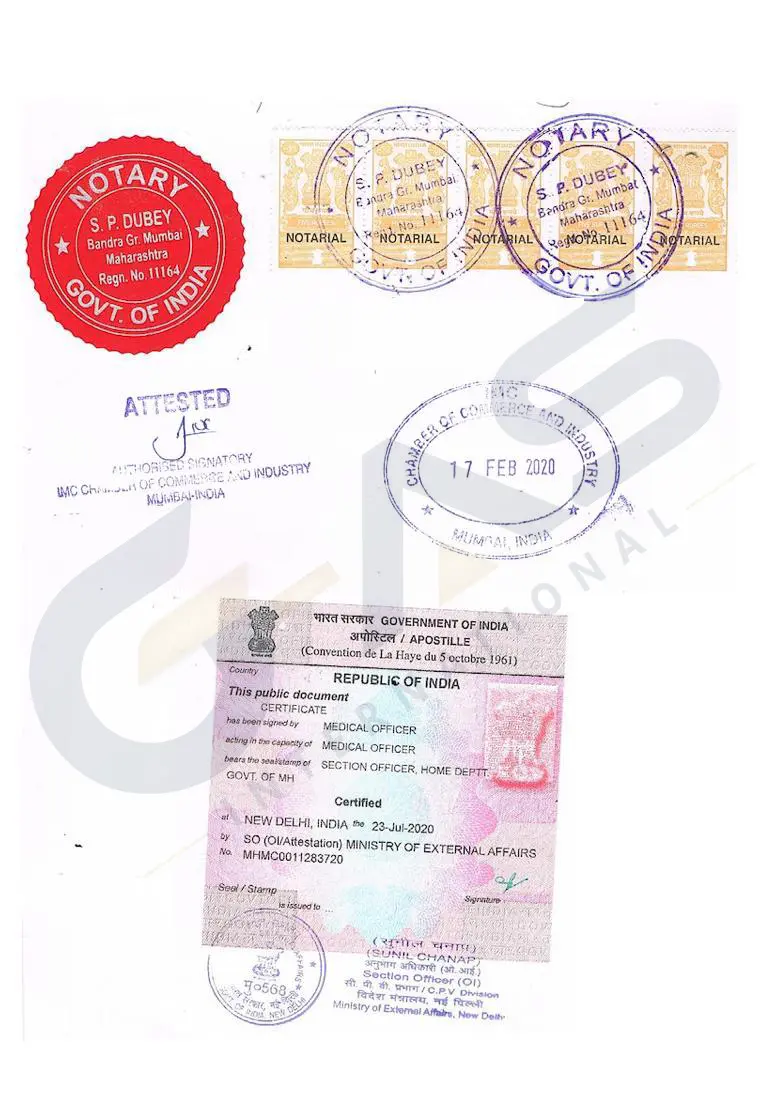
Export Invoice Apostille

Get reliable Export Invoice Apostille assistance from GOOD APOSTILLE SERVICES with clear guidance and professional document handling for overseas submission requirements.

call us

+91 7016754663

call us

+91 9824692246

Export Invoice Apostille services for Indian commercial documents
Export Invoice Apostille
01

When Is Export Invoice Apostille Required?

Export Invoice Apostille may be requested when an Indian export invoice is being presented to an overseas buyer, bank, regulator, tendering body, or another receiving authority that specifically asks for authenticated commercial documentation. The exact requirement should be confirmed before processing because an apostille is not automatically necessary for every international shipment or every Hague Convention destination.

  • Buyer or distributor requests authenticated invoice documentation
  • Bank asks for verified trade papers for transaction review
  • Foreign regulator requires authenticated commercial supporting records
  • Tender or vendor registration asks for certified business documents
  • Import-side compliance requires verification of invoice signatures or seals
  • Receiving authority gives written instructions for apostille submission
The Hague Apostille Convention excludes certain administrative documents dealing directly with commercial or customs operations. Confirm the exact requirement with the overseas recipient; where apostille is not accepted, export invoice attestation or another legalisation route may be requested instead.
02

What Does Apostille for Export Invoice Authenticate?

An apostille authenticates the origin of the public certification attached to an eligible document. It verifies the relevant signature, the capacity in which the signer acted and, where applicable, the seal or stamp. It does not confirm that invoice values, product descriptions, quantities, tax details, shipment terms, or other commercial statements are factually correct.

  • Authenticity of the signature presented for official verification
  • Capacity or authority in which the signer acted
  • Identity of an applicable official seal or stamp
  • Origin of the certification attached to the document
  • Apostille issue details recorded by the competent authority
  • Formal authentication rather than approval of invoice contents
For a broader explanation of document eligibility and overseas use, review document apostille services before deciding which commercial papers need separate authentication.
03

How Does MEA Apostille for Export Invoice Work in India?

Export Invoice Apostille normally starts with checking the invoice and the receiving authority's instructions. For commercial documents handled through the physical route, the Ministry of External Affairs legalises documents on the basis of signatures from designated authorities, including Chambers of Commerce. Where an eligible commercial record is available through an integrated digital repository, e-Sanad may provide an online verification route.

  • Confirm destination, recipient and exact legalisation requirement first
  • Check company name, address, invoice number and invoice date
  • Verify authorised signature and applicable company or trade details
  • Complete Chamber of Commerce authentication where the route requires it
  • Submit through the applicable MEA or e-Sanad channel
  • Verify the completed apostille details before overseas submission
e-Sanad can process commercial documents only when the relevant document issuing authority or repository is integrated and the record is digitally available for verification.
04

What Should Be Checked for Export Invoice Document Apostille?

Before submission, check that the invoice presented for authentication is complete, legible and consistent with the related shipment records. Mismatched names, altered figures, unclear signatures, missing company details or inconsistent invoice references can cause questions during verification or later when the document is reviewed overseas.

  • Exporter legal name and registered business details are consistent
  • Invoice number and date match the transaction records
  • Buyer or consignee information is entered correctly
  • Goods description, quantity and declared value are clear
  • Signature, seal and authorisation details are readable
  • Supporting trade documents use matching shipment references
Export Invoice Apostille should be requested only after the recipient confirms the required format, authentication route and supporting documents for the specific overseas transaction.

Supporting Documents for Export Invoice Apostille

EI

Export Invoice Apostille Services: Pre-Submission Checks

A practical pre-check reduces avoidable delays. Confirm who will receive the invoice, why authentication is required, which version of the invoice must be submitted and whether the authority expects Chamber of Commerce verification, MEA processing, e-Sanad verification, or another legalisation route.

  • Destination country and receiving authority
  • Final signed export invoice
  • Exporter and buyer details
  • Invoice number and date
  • Required prior authentication
  • Recipient's written document instructions
TD

Export Invoice Certificate Apostille and Related Trade Papers

Overseas transactions may require more than one authenticated commercial document. A Certificate of Origin can establish the declared origin of goods, while a packing list records package-level shipment details. These documents have separate purposes and should be processed only when the foreign recipient specifically asks for them.

CD

Commercial Documents

Export Invoice Apostille belongs within the wider commercial-document authentication workflow used for cross-border business records. Depending on the transaction, the recipient may also request company resolutions, agreements, certificates, powers of attorney or other corporate papers, each with its own verification and legalisation requirements.

  • Commercial Invoice
  • Certificate of Origin
  • Packing List
  • Commercial Power of Attorney
  • Business Agreement
  • Board Resolution
Read More

Export Invoice Apostille FAQs

Practical answers on invoice eligibility, commercial-document checks, MEA procedure, current government fees, supporting trade papers and secure document handling.

Export Invoice Authentication Basics

Start by confirming whether the overseas recipient actually requires an apostille.

No. The requirement depends on the destination, the nature of the document, and the instructions of the buyer, bank, regulator, customs authority or other recipient. Because the Apostille Convention excludes certain administrative documents dealing directly with commercial or customs operations, obtain the recipient's exact requirement before starting the process.

It authenticates the relevant signature, official capacity and, where applicable, the seal or stamp connected with the document's certification. It does not verify whether the price, quantity, product description, tax treatment or other commercial information written on the invoice is correct.

No. Apostille and attestation or legalisation are different authentication routes. The correct route depends on the destination and receiving authority. If the recipient asks for embassy or non-apostille legalisation, review the requirements for attestation for an export invoice before submission.

Export Invoice Document Checks

Make sure the invoice and related shipment records are complete and consistent.

Check the exporter name, registered address, buyer or consignee details, invoice number, invoice date, goods description, quantity, declared value and authorised signature. The version submitted for authentication should match the transaction record that will be presented to the overseas recipient.

Yes, but it is a separate trade document with a different purpose. If the importer, bank or authority asks for authenticated origin evidence, the Certificate of Origin apostille should be checked and processed according to its own requirements rather than treated as part of the invoice.

Only when the overseas recipient specifically requires it. A packing list records package, quantity and shipment details and is distinct from an invoice. When both documents are requested, check the separate packing list apostille requirements and make sure shipment references remain consistent.

MEA Commercial Apostille Process

Understand pre-authentication, MEA processing and electronic verification options.

First confirm that the recipient requires apostille. For commercial documents outside the applicable e-Sanad route, the document is generally pre-authenticated through the relevant designated authority, commonly a Chamber of Commerce for commercial papers, before Ministry of External Affairs legalisation through the authorised submission route.

e-Sanad can support commercial documents, but online processing depends on whether the relevant issuing authority or document repository is integrated and the record is digitally available for verification. If it is not available through the integrated repository, the applicable physical procedure is used instead.

The Ministry of External Affairs provides an e-Register through e-Sanad for checking issued apostilles. Use the apostille or attestation number shown on the completed document and confirm that the verification result corresponds with the document being submitted overseas.

Commercial Apostille Fees

Separate the official government fee from verification, service and delivery costs.

The Ministry of External Affairs lists an official apostille fee of ₹50 per apostilled document. This government fee is separate from any applicable Chamber verification, authorised collection, scanning, professional service, postal or courier charges.

The total depends on the required pre-authentication, document quantity, collection method, scanning, professional handling and return delivery. A quotation should distinguish the government fee from all other charges so the applicant can understand what is being paid for at each stage.

No. The official apostille fee applies per apostilled document, not as a single fee for the shipment. If several commercial documents require separate apostilles, calculate them separately and confirm whether each document is actually required by the recipient before submitting the set.

Export Invoice Handling & Delivery

Protect the signed commercial document before, during and after authentication.

For MEA's physical apostille route, the original document or an eligible true copy is submitted through the applicable authorised channel, together with the required supporting copies. Confirm the exact document format before dispatch because MEA does not legalise ordinary photocopies as substitutes for the document being authenticated.

Keep documents flat in a protective sleeve and rigid envelope, retain clear scans before dispatch and avoid unnecessary folding, marking or alteration. Use trackable delivery where available and record the exact document count before handing the package to a courier or collection service.

Check the exporter name, invoice reference, document pages and attached authentication carefully. Confirm that the apostille verification details correspond with the returned document, then make a secure scan before sending the original to the overseas recipient or including it in the final trade-document set.

Need Apostille or Attestation Support for Your Documents?

Your Trust, Our Responsibility — That’s a G-AS Commitment.

call us

+91 7016754663

call us

+91 9104499727

whatsapp

+91 9824692246

Email us

info@goodapostille.com

Our Apostille Process

01

Document Review

We check the document, purpose and destination country.

02

Route Confirmation

The correct verification route is confirmed before submission.

03

Authority Verification

Required verification is completed through the relevant authority.

04

MEA Apostille

The eligible document proceeds for final apostille processing.

05

Secure Delivery

Completed documents are checked, packed and safely dispatched.