
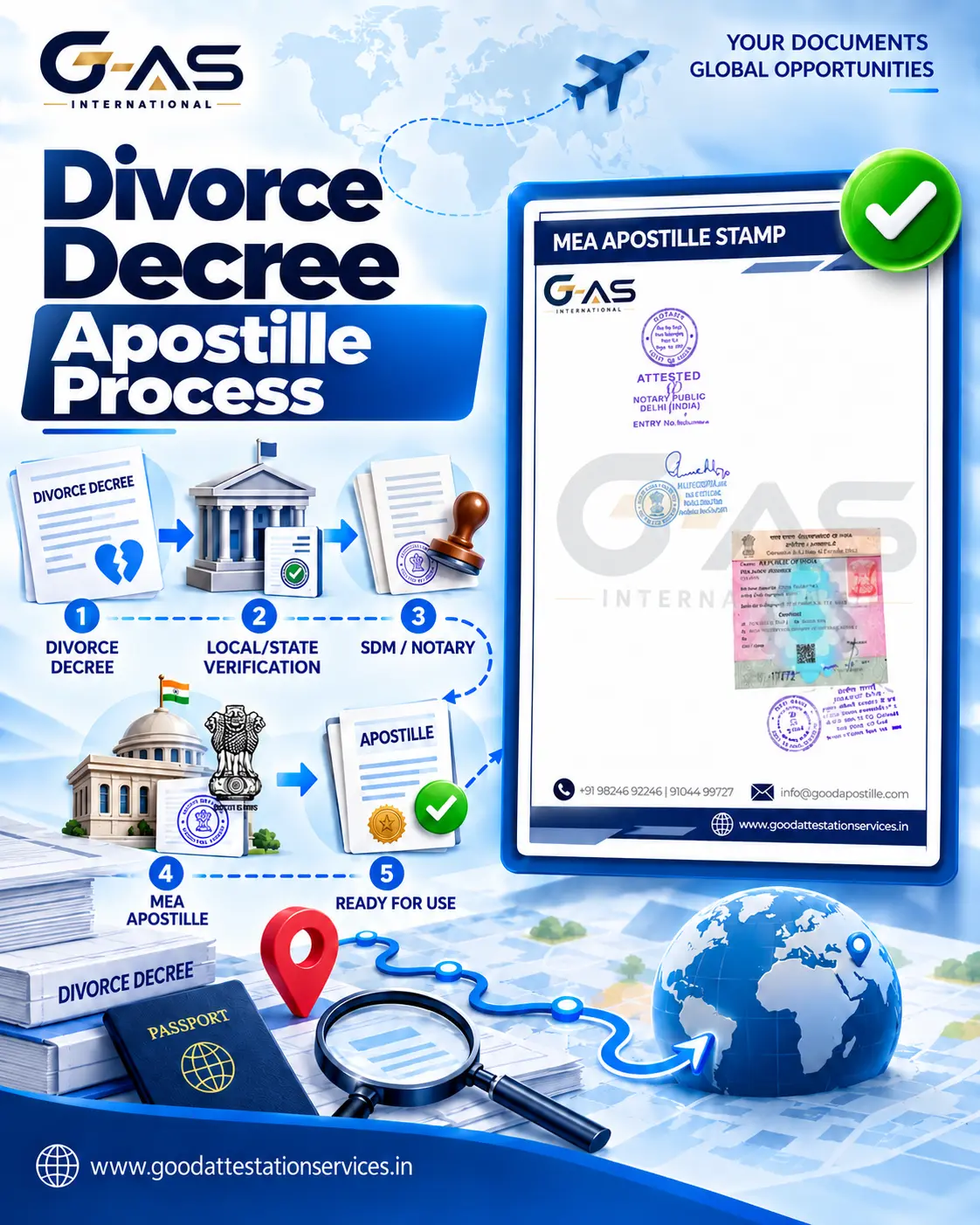
The Divorce Decree Apostille Process authenticates an Indian court-issued divorce decree for official use in countries covered by the Hague Apostille Convention. Depending on the document and applicable route, preliminary verification or authentication may be required before the Ministry of External Affairs issues the apostille.
This guide explains the main apostille steps, document preparation, verification route, MEA stage, and important checks before submission. It will also help you understand how the destination country, document format, court details, and discrepancies in names or records can affect the procedure.
The Divorce Decree Apostille Process is generally required when an Indian court-issued divorce decree must be presented to an authority in a country that accepts Hague Apostilles.
A foreign marriage registrar may request an apostilled final divorce decree to confirm that a previous marriage has legally ended before allowing a new marriage registration.
Immigration, residence, dependent-visa or citizenship authorities may require authenticated proof of previous marital status when assessing an application or updating civil records.
An apostilled decree may also be requested for overseas legal proceedings, name or status updates, inheritance matters, family records or other official transactions involving marital history.
Requirements can vary according to the issuing court, authentication route and destination country, so the document should be checked before submission.
The decree should be a complete final court document or an acceptable certified court copy with clear judicial seals, signatures, case details and relevant pages.
A clear passport copy is commonly submitted with documents handled through the MEA's authorised outsourced channel. Additional identification may be requested depending on the route.
Some cases may need preliminary state authentication, supporting court verification or a translation depending on the document, destination authority and language requirements.
Before sending the decree, review the detailed document checklist and preparation requirements to reduce avoidable verification problems.
How to Apostille Divorce Decree documents depends partly on whether preliminary authentication or an eligible digital verification route applies before MEA processing.
Confirm that the decree is final, complete and suitable for authentication. The destination country should also be checked because Apostille is intended for countries where the Hague Apostille Convention applies.
Documents outside an applicable e-Sanad route may first require authentication by the designated State or Union Territory authority. The correct authority can depend on where and how the decree was issued.
After the required authentication is complete, the document proceeds through the authorised submission system for Ministry of External Affairs apostille. MEA legalises the recognised signature or seal rather than validating the decree's underlying contents.
Once returned, verify that the apostille details correspond with the submitted decree. For a closer explanation of the preliminary stages, see the verification and authentication route.
There is no single guaranteed nationwide completion time or total price because preliminary authentication and handling requirements can differ.
The overall timeline depends on document condition, issuing authority verification, the applicable authentication route, submission location and official workload. Cases requiring corrections or additional verification can take longer. Review the timeline and delay factors when planning an overseas submission deadline.
MEA currently lists ₹50 per Apostille sticker, while its authorised outsourced submission system has separate service and scanning charges. State authentication, courier or professional handling may add further costs. See the apostille fee breakdown for the main cost components.
Most avoidable delays begin before MEA submission, particularly when the decree is incomplete, unclear or unsuitable for the required verification route.
A partial judgment or missing continuation page can prevent proper verification because the submitted document may not represent the complete final court order.
Faded seals, unclear signatures, damaged pages or poor copies can make authentication difficult and may require a fresh certified copy from the appropriate court.
Differences between the decree and supporting identity records should be reviewed before submission, especially when the receiving authority expects matching personal information.
Submitting a document without the required preliminary authentication can cause delay or repeat processing. Check the detailed rejection and correction issues before proceeding.
A brief document review before submission can prevent unnecessary corrections and help identify the correct processing route.
These answers cover practical questions that often arise before an Indian divorce decree is prepared for overseas use.
The Ministry of External Affairs is India's competent authority for Apostille. Where preliminary authentication is required, the appropriate designated authority verifies the document before the MEA stage.
The acceptable form should be confirmed before submission. MEA states that original documents or true copies are handled according to the prescribed route and that ordinary photocopies are not legalised as substitutes.
For use between countries where the Hague Apostille Convention applies, Apostille generally replaces the traditional chain of embassy legalisation. Always confirm any separate procedural requirement imposed by the receiving organisation.
e-Sanad supports documents where the relevant issuing authority or digital repository is integrated with the system. If the decree is not supported digitally, the standard authentication and submission procedure continues to apply.
No. MEA explains that legalisation is based on the recognised signature and seal of the designated authority. It does not accept responsibility for or independently validate the substantive contents of the document.
Not necessarily. Authentication can vary by document type, issuing authority and available verification system. For comparison with another civil record, see the apostille route for a death certificate.
Your Trust, Our Responsibility — That’s a G-AS Commitment.
Get Document Guidance