
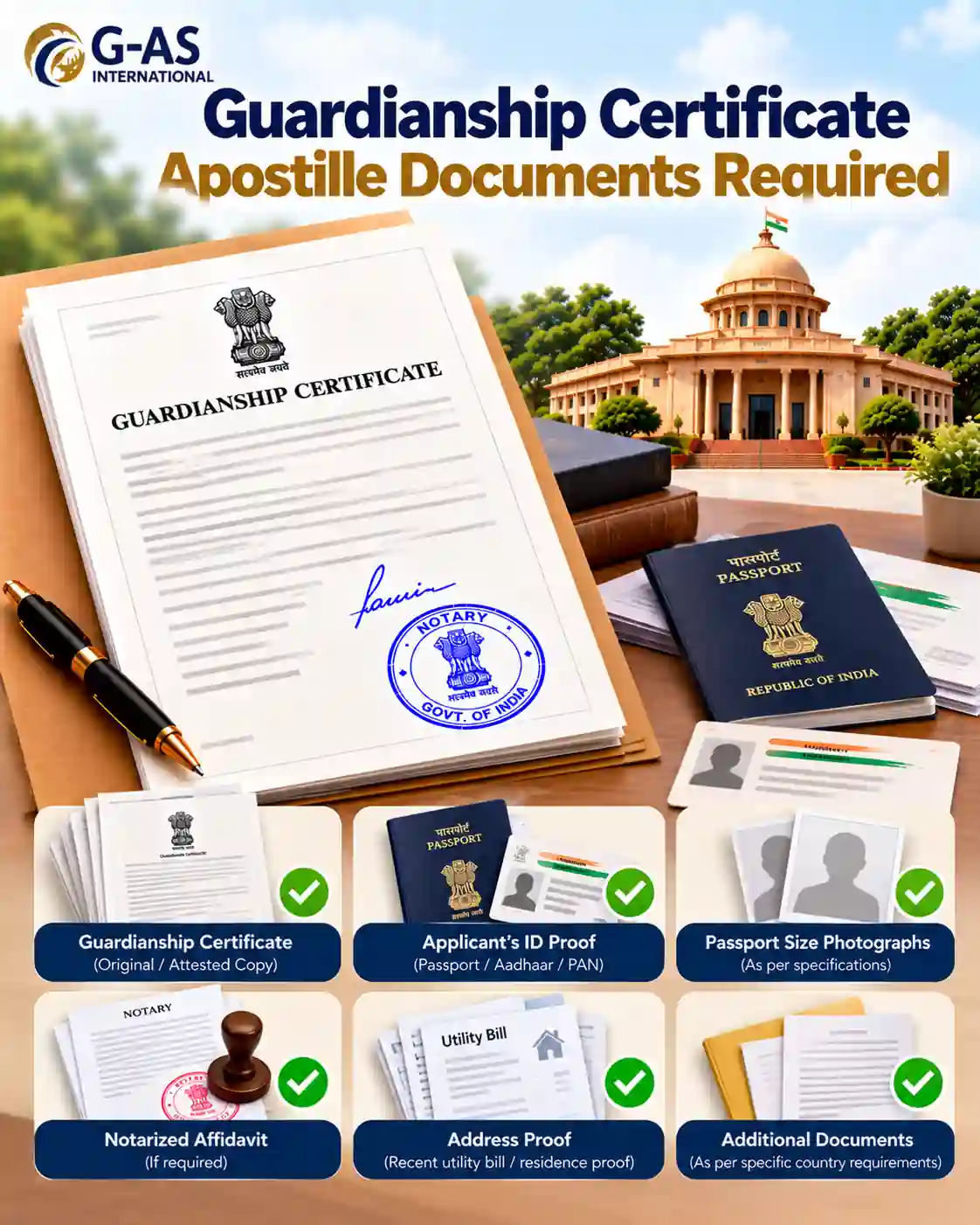
Guardianship Certificate Apostille Documents Required usually begin with the original guardianship certificate or an officially accepted true copy, along with a photocopy of the document and the applicant’s passport. Additional identity or supporting records may be requested depending on the issuing authority, authentication route, and document circumstances.
This post explains the core papers to prepare, when certified court copies or supporting family records may be relevant, and how state-level authentication can affect the Guardianship Certificate Apostille Requirements. It also covers when translation should include the final apostilled document and why checking the receiving authority’s requirements beforehand is important.
A guardianship certificate may need an apostille when it is being presented abroad as evidence of a guardian’s legally recognised authority and the receiving authority asks for apostilled public documents.
The document may be requested when a foreign authority needs formal proof that the named guardian is authorised to act for a minor or another person covered by the order.
Apostille may be relevant when guardianship records form part of a family, court, custody, immigration, residence, or other official file being submitted outside India.
If a separate consent document forms part of the case, check the apostille steps for an NOC affidavit. Such a document is not automatically required in every guardianship matter.
The exact papers depend on how the guardianship record was issued, the verification route, and any instructions from the authority receiving the document abroad.
Prepare the original guardianship certificate, court order, or other officially issued record in the form accepted for authentication. Signatures, seals, and issuing details should be clear and complete.
A clear passport or other accepted identity copy may be requested for application handling or identity verification. The exact identity-document requirement can differ by submission route.
Depending on the case, the authority may ask for related records such as the minor’s identity document, birth record, certified court copy, or another document connecting the parties named in the guardianship record.
Do not assume every supporting record is mandatory. Confirm whether the receiving authority needs an original, certified copy, translation, or any additional document before submission.
Once the Required Documents for Guardianship Certificate Apostille are ready, follow the correct overall apostille procedure for the document’s issuing authority and intended overseas use.
Confirm who issued the guardianship record and whether the document is an original, certified court copy, or another officially recognised form. This determines which authentication path can apply.
Where pre-authentication is required, the document is verified through the designated authority connected with the issuing state or document category. Review the verification route overview before choosing a submission path.
After the applicable verification is completed, the eligible public document proceeds for apostille through the competent Indian authority and the authorised submission channel in use for that document.
Verify that the apostille is attached to the correct guardianship record and that the name, seal, signature, document details, and any required translation are suitable for the receiving authority.
Timing can vary because the guardianship record may require different checks before the final apostille stage.
The issuing authority, pre-authentication requirement, document condition, verification response, submission route, holidays, and correction requests can all affect completion. For a more focused explanation, review the expected processing timeline.
Applicants comparing the complete submission requirements may also want to review separate cost guidance rather than relying on an assumed total for every document or route.
Most avoidable problems begin with an unsuitable document form, incomplete supporting papers, or a mismatch between the document and the required authentication route.
Missing seals, unreadable signatures, incomplete pages, or damaged records can prevent straightforward verification and may require a fresh or properly certified copy.
A photocopy or informal scan may not be sufficient when an original or officially certified version is required for the applicable authentication stage.
Differences in names, dates, court references, or guardian details across supporting records can trigger additional checks. Review common rejection causes before submission.
The receiving authority may have its own rules for translations, certified copies, accompanying records, or document recency. These should be confirmed separately from the apostille itself.
Use this short review to reduce avoidable corrections before the document enters authentication or apostille processing.
These answers clarify common questions about the Guardianship Certificate Apostille Documents Required and related supporting records.
Not necessarily in every route. Some cases may accept an officially certified court copy or another recognised version. Confirm the document form accepted for authentication before submitting anything.
An identity copy may be requested for application handling or verification, but it should not be treated as a universal rule for every guardianship record and every submission channel.
Yes, when they are relevant to the case or specifically requested. Examples can include identity, birth, court, or relationship records connected with the guardian or person covered by the guardianship order.
Translation depends on the receiving authority and language requirements. Confirm whether translation is required and whether it should cover the underlying document, the completed apostille, or both.
No. The issuing authority and pre-authentication route can vary, so the accepted document form and supporting checks should be confirmed for the state or authority connected with the record.
Check that the apostille relates to the correct guardianship record and confirm any destination-specific requirements for translation, certified copies, accompanying documents, or additional formalities.
Your Trust, Our Responsibility — That’s a G-AS Commitment.
Get Document Guidance