
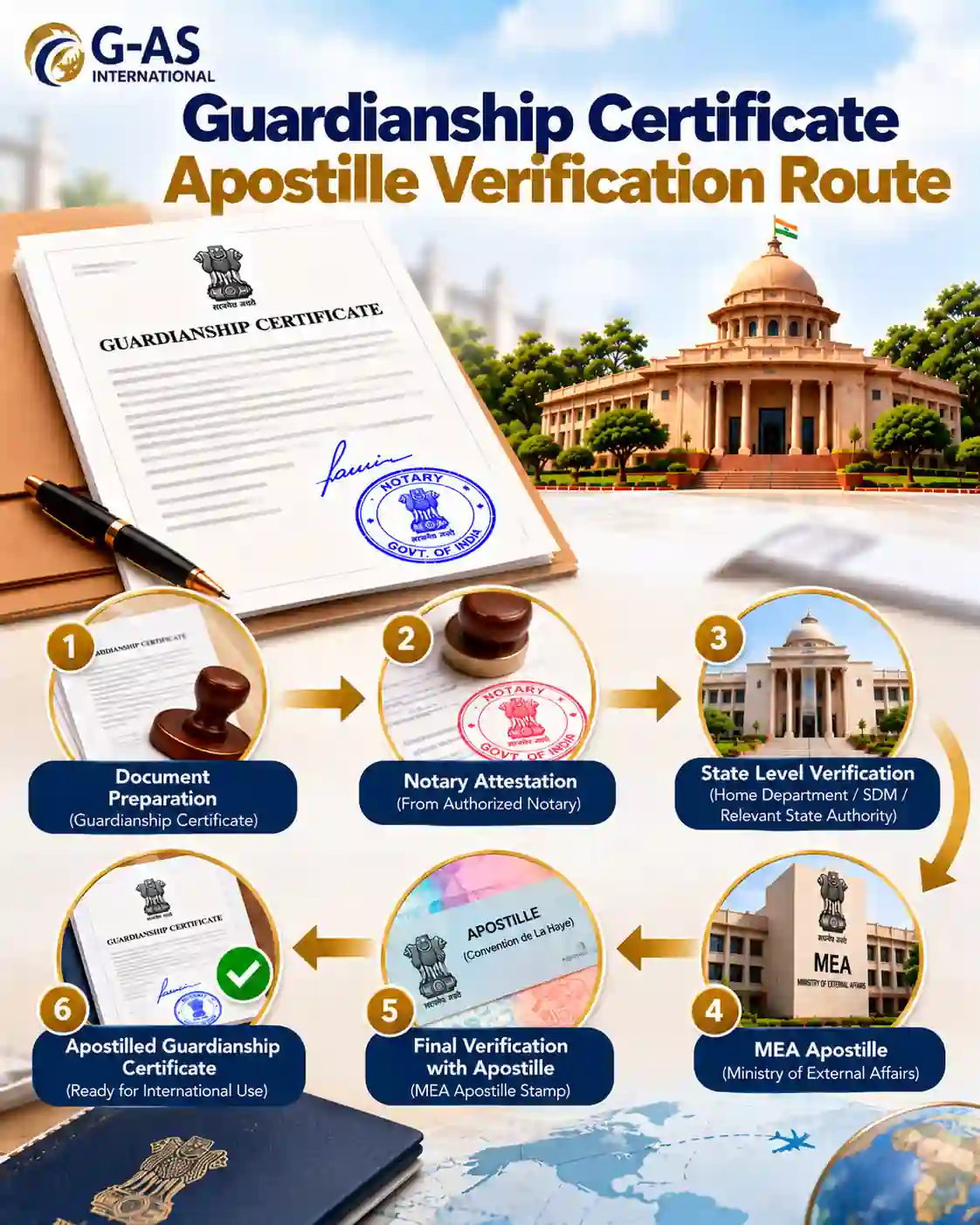
The Guardianship Certificate Apostille Verification Route explains how an Indian guardianship certificate or order is authenticated before it can receive an MEA apostille for use abroad. Because guardianship records are not educational documents, HRD is generally not the relevant pre-authentication authority; documents outside e-Sanad must first follow the applicable State or Union Territory authentication procedure.
This post explains how to identify the appropriate pre-authentication path, including State Home or General Administration Department verification, when an SDM-related route may apply, and where e-Sanad fits. It also clarifies how the issuing authority, destination requirements, and MEA procedure affect the correct sequence before apostille submission.
The verification route becomes important when an Indian guardianship record must be authenticated for official use in another country that accepts apostilled public documents.
A foreign authority may request an apostilled guardianship certificate or court order to confirm the legal status or authority of the guardian before accepting the record.
The issuing State, Union Territory, court, or document authority can affect where verification begins, making an authority check important before the document is submitted.
A guardianship certificate and a no-objection affidavit are different records. Where an affidavit is involved separately, review the related NOC affidavit procedure instead of assuming both documents follow an identical route.
Before starting verification, confirm that the document is complete, legible, and issued or certified by an authority whose signature or official seal can be authenticated.
Check the document intended for foreign use and make sure names, dates, case details, signatures, seals, and issuing particulars are clear and consistent.
The applicable submission channel may require identification and document copies in addition to the record being apostilled. Requirements should be checked before physical or online submission.
Custody records, relationship evidence, certified translations, or other supporting documents should be included only when the receiving authority or circumstances of the case genuinely require them.
Requirements can vary according to the issuing authority and intended foreign use. Review the supporting-document checklist before preparing the final submission set.
The pre-authentication route depends mainly on whether the record can be digitally verified through e-Sanad or must follow the applicable State or Union Territory authentication procedure.
First determine whether the document is a court-issued order, government certificate, or another guardianship-related public record. The issuing source helps identify the authority responsible for authenticating its signature or seal.
For documents outside e-Sanad, the relevant State or Union Territory authentication authority generally completes pre-authentication before the record proceeds to the Ministry of External Affairs apostille stage.
Where the document and issuing authority are integrated with an eligible digital repository, e-Sanad can support online verification. The concerned issuing authority verifies the record before MEA processing.
After valid pre-authentication, the document proceeds through the applicable MEA submission channel. For the wider sequence beyond verification, review the step-by-step apostille procedure.
Overall completion time depends on pre-authentication, authority response, document condition, digital verification availability, and the submission route being used.
The apostille stage follows successful document authentication, while verification before that stage can add additional time. Review the typical processing timeline for separate timing guidance.
The route can vary according to the issuing State or Union Territory, availability of e-Sanad verification, document corrections, submission method, and destination requirements. Separate document cost planning can be reviewed independently when preparing the application.
An authority check can prevent delays caused by selecting the wrong department, using an unsupported digital route, or submitting a document that needs correction.
HRD authentication is associated with educational documents. A guardianship certificate or court guardianship record should therefore not automatically be routed through an educational verification authority.
This phrase should not be interpreted as a universal choice between two authorities. The currently accepted pre-authentication route should be confirmed for the specific document.
Material inconsistencies in names, signatures, seals, or case information can require clarification or correction. Reviewing common rejection causes can help identify issues before verification begins.
e-Sanad depends on integration with the relevant document issuing authority or digital repository. If digital verification is unavailable, the document must follow the applicable non-e-Sanad authentication procedure.
Before starting verification, confirm the document condition, responsible authority, destination requirements, and correct submission channel.
These answers address important authority and routing questions that commonly arise before an Indian guardianship record is submitted for apostille.
Normally, HRD verification is associated with educational records. A guardianship certificate or court guardianship order is not an educational qualification, so its applicable State, Union Territory, or issuing-authority route should be checked instead.
Not in every case. e-Sanad requires the document or issuing authority to be supported by an integrated digital repository. Documents without suitable digital verification continue through the applicable pre-authentication procedure.
The competent authority depends on the State or Union Territory and the document's issuing source. The responsible authentication authority should therefore be confirmed before submission.
No single SDM route should be assumed for every guardianship record. The correct route depends on the document source, accepted pre-authentication authority, and current procedure.
The authentication process focuses on the relevant official signature or seal before apostille. It does not mean every factual statement contained in the guardianship record is independently investigated by MEA.
Confirm that apostille is appropriate for the destination, the guardianship document is acceptable to the receiving authority, and any translation or additional supporting-document requirement has been checked separately.
Your Trust, Our Responsibility — That’s a G-AS Commitment.
Get Document Guidance