
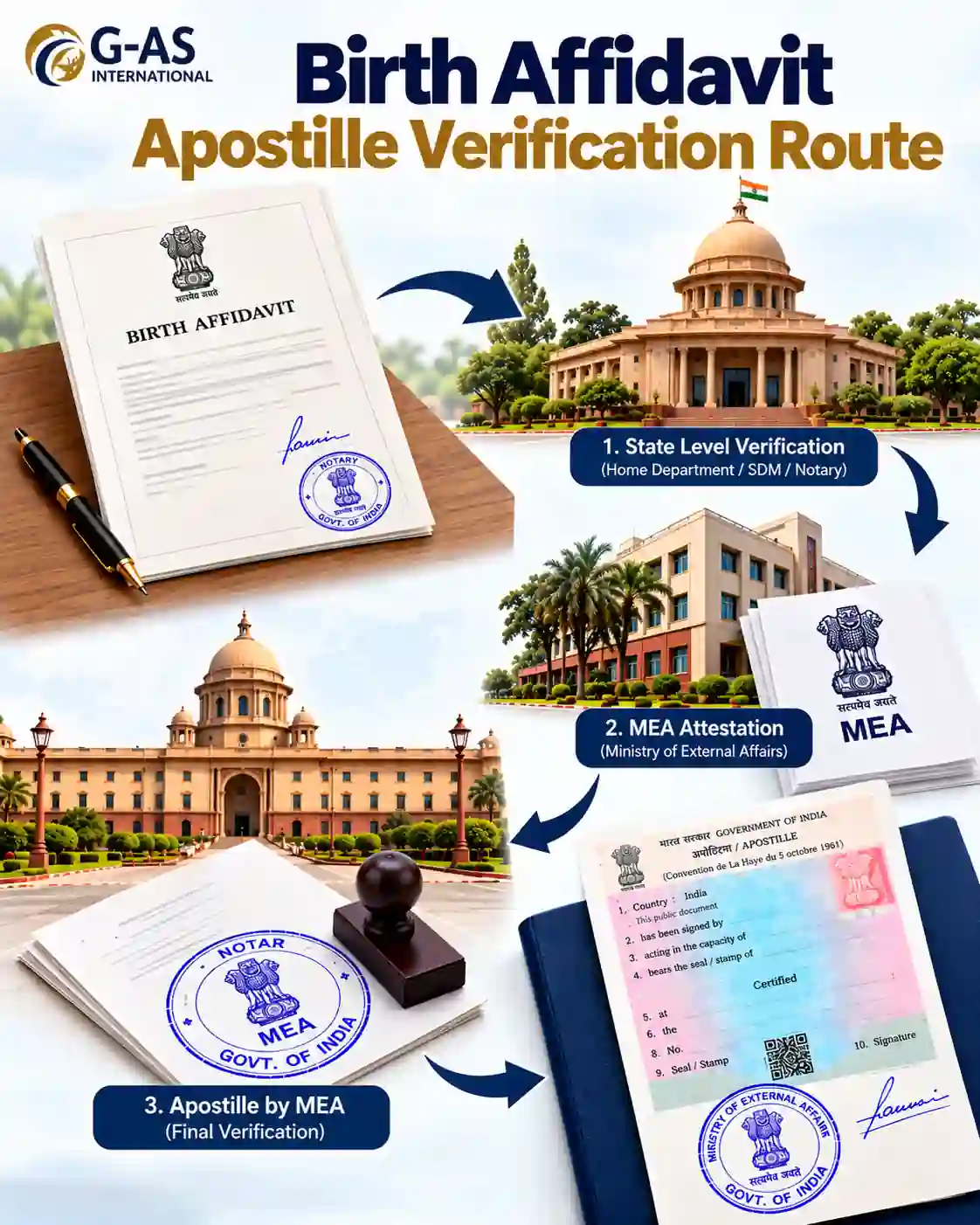
The Birth Affidavit Apostille Verification Route explains how a birth-related affidavit is checked before the Ministry of External Affairs issues an apostille. As an affidavit is a personal, non-educational document, its pre-authentication normally follows the applicable State/UT authority route rather than educational HRD verification.
This post explains how notarisation, State Home/GAD or authorised SDM-level verification may fit into the process, followed by MEA apostille. You will also learn how to identify the correct authority, avoid choosing the wrong verification route, and check any destination-specific requirements before submitting the document.
The Birth Affidavit Apostille Verification Route matters when a sworn birth declaration must be authenticated for use abroad and the receiving authority accepts that type of supporting evidence.
A foreign authority may request a birth affidavit when additional sworn evidence is needed for immigration, residence, nationality, family, or civil-status processing.
An affidavit may support an application where birth details require explanation, but it does not automatically replace an official birth certificate or other record required by the recipient.
The route becomes relevant when the destination accepts apostilles and specifically requires authentication of the affidavit's signature, seal, or official certification for overseas use.
The document set can vary by State or Union Territory, execution method, submission channel, and receiving authority, so the affidavit and supporting papers should be checked before authentication begins.
Use the final affidavit intended for overseas submission, with complete birth details and the required execution or notarisation appropriate to the document and local procedure.
Keep the identity and supporting records requested for the applicable route. Compare the exact papers needed with the supporting-document checklist before submission.
Names, dates, signatures, stamps, seals, and notarial particulars should be legible and internally consistent so the competent authority can authenticate the document without avoidable clarification.
A birth affidavit is supporting evidence rather than a universal substitute for a registered birth record. Confirm that the foreign recipient accepts the affidavit for the intended purpose.
The Birth Affidavit Apostille Verification Route should follow the document category, competent State or Union Territory authority, and the MEA submission channel that applies to the case.
First confirm that the destination uses the Hague Apostille Convention for the intended transaction and that the receiving authority will accept a birth affidavit instead of, or alongside, another civil record.
For documents outside an eligible digital workflow, the affidavit must follow the applicable authentication route through the designated State or Union Territory authority before MEA processing. The responsible office can vary by jurisdiction and document execution.
Eligible digitally verifiable documents may use e-Sanad where the relevant authority and repository are integrated. Other documents continue through the authorised offline route after required pre-authentication. See the full birth-affidavit procedure for the broader sequence.
After issuance, confirm that the apostille is attached to the correct affidavit and that the identifying details correspond with the submitted document. The official e-Register may be used when verification of the apostille itself is required.
The overall timeline includes pre-authentication, MEA handling, and any document correction or dispatch stages required for the individual case.
MEA's current Citizen's Charter states that apostille processing is usually completed within seven working days after the document is received by MEA. State or Union Territory verification, corrections, holidays, and movement of physical documents can extend the total duration. Review the separate turnaround guidance when planning submission.
Before dispatching the affidavit, confirm the verification authority, expected supporting papers, destination requirement, and return method. If financial planning is also relevant to the submission, review the separate apostille cost breakdown without mixing it with the verification sequence.
Most avoidable delays begin with inconsistent affidavit details, the wrong authentication authority, or an overseas requirement that was not checked before submission.
Differences in names, dates, places of birth, or parent details can trigger questions during verification or later acceptance by the foreign receiving authority.
Sending the affidavit through an authority that cannot authenticate the relevant signature or notarial act may lead to rework. Check common submission problems before resubmitting.
Missing signatures, unreadable seals, incomplete execution, or altered pages can make it difficult for the next authority to verify the document's origin.
If the affidavit is being used alongside evidence of a legal name change, review the related name-change document procedure instead of assuming one verification route covers both documents.
Use these checks before starting the Birth Affidavit Apostille Verification Route so the document enters the correct authentication channel.
These answers clarify authority, verification, digital processing, and overseas acceptance issues commonly associated with birth affidavits.
No. HRD authentication is associated with educational documents. A birth affidavit is a personal document, so its applicable pre-authentication normally follows the designated personal-document route for the relevant State or Union Territory.
No. e-Sanad depends on the document being available through an integrated digital repository or participating authority. Documents outside that coverage continue through the applicable physical authentication process.
No. Apostille authentication verifies the origin of the public document and the relevant signature, capacity, seal, or stamp. It does not independently certify every factual statement contained in the affidavit.
Not automatically. The receiving authority decides what evidence it accepts. Some applications may accept an affidavit as supporting evidence, while others still require an official civil birth record.
Different States and Union Territories may designate different competent authorities or verification arrangements. The correct route also depends on how the affidavit was executed and whether digital verification is available.
Your Trust, Our Responsibility — That’s a G-AS Commitment.
Get Document Guidance