
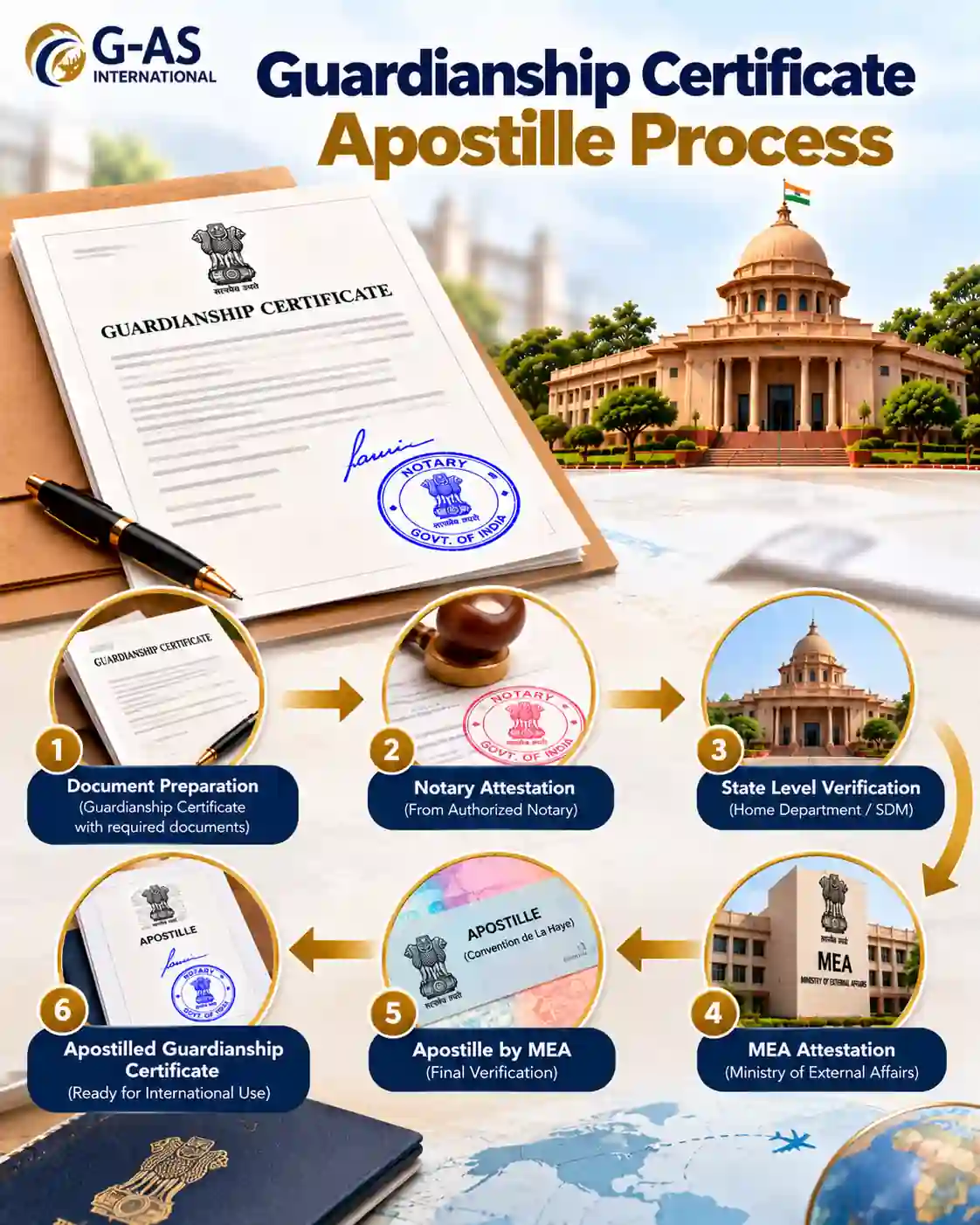
The Guardianship Certificate Apostille Process is the authentication route used when an Indian guardianship certificate must be presented in a country that accepts Hague apostilles. The document generally requires the prescribed Indian pre-authentication before the Ministry of External Affairs completes the apostille, while the exact verification route can vary by document type and issuing authority.
This post explains how to identify the correct verification route, prepare the certificate, complete pre-authentication, obtain the MEA apostille, and check any destination-specific requirements. It also covers important points such as original-versus-copy requirements, document verification, and the difference between apostille procedures for Hague destinations and legalization requirements for non-Hague countries.
The Guardianship Certificate Apostille Process is generally relevant when an Indian guardianship document must be presented to an authority in a Hague Apostille Convention destination.
An overseas school, immigration office, court, or welfare authority may request authenticated evidence showing who is legally authorised to act for a minor.
The document may be needed when guardianship status forms part of a residence, dependent, custody-related, or family documentation file abroad.
Apostille authenticates the origin of the public document for Convention use. The receiving authority still decides whether the certificate satisfies its substantive requirements.
Before beginning the procedure, confirm the document format, issuing authority, pre-authentication requirement, and any supporting identification required for submission.
Use the original or accepted true-copy format required by the applicable route. The certificate should be complete, legible, and carry the relevant signature, seal, or official endorsement.
For applicable offline submission routes, the document and supporting identity records may be required. Check the document preparation checklist before dispatch.
A foreign recipient may separately request a birth record, identity record, custody order, translation, or consent document. These should not be assumed to be universal apostille prerequisites.
Guardianship documents can originate from different courts or competent authorities. That difference can affect the correct pre-authentication path, so verify the state-level verification route before proceeding.
The Process for Guardianship Certificate Apostille depends on whether the document is eligible for an electronic route or must follow offline pre-authentication and authorised submission.
First confirm that the destination accepts apostilles under the Hague Convention and that the receiving authority wants the guardianship certificate apostilled rather than processed through another legalization route.
Where pre-authentication is required, the designated State or Union Territory authority verifies the relevant issuing signature or authentication chain before the document moves to the next stage.
After valid pre-authentication, the document proceeds through the applicable authorised submission channel for MEA processing. The correct route depends on document origin and current submission arrangements.
After apostille, verify the certificate details and confirm whether the receiving authority requires any separate translation, supporting document, or destination-specific formality before overseas use.
Overall completion can include pre-authentication, document submission, MEA processing, and return movement, so the total duration can vary from one case to another.
The overall timeline depends on the issuing authority, pre-authentication route, document condition, working days, and submission method. Review the timing factors and possible delays before planning overseas submission.
The total amount can vary according to the applicable government charge, authorised handling, document movement, translation requirements, and any supporting-document work. See the current cost factors for a more detailed breakdown.
Most avoidable problems arise from choosing the wrong route, submitting an unsuitable document, or overlooking destination-specific requirements.
Submitting the certificate through an authority that cannot authenticate the relevant issuing signature can stop the process and require a fresh verification step.
Missing pages, unclear seals, inconsistent names, damaged endorsements, or an unacceptable copy format can lead to additional checks or resubmission.
An apostille confirms document origin; it does not guarantee that a foreign authority will accept the certificate for every legal or administrative purpose.
Names, dates, signatures, or authority details should be checked early. The common rejection triggers can help identify issues before the document enters the authentication chain.
Use these checks before beginning the procedure to reduce avoidable verification problems, resubmission, and delays.
Confirm Hague use, identify the correct pre-authentication route, complete verification by the designated authority where required, and then submit through the applicable MEA channel for apostille.
No. The issuing authority, State or Union Territory, document format, and applicable MEA route can affect the procedure. Verify the document's origin before selecting the process.
An apostille authenticates the origin of the public document and the relevant official signature or seal. It does not independently validate every factual or legal statement in the certificate.
Not necessarily. They are different document types and can require different preliminary handling. If a separate consent document is involved, compare the NOC affidavit authentication flow rather than assuming both routes are identical.
For Convention use, an apostilled document generally does not require further legalization solely to authenticate its origin. Separate translation or recipient-specific requirements may still apply.
The acceptable format depends on the applicable route and authority requirements. Confirm whether the original or an accepted true-copy format is required before submission.
Your Trust, Our Responsibility — That’s a G-AS Commitment.
Get Document Guidance