
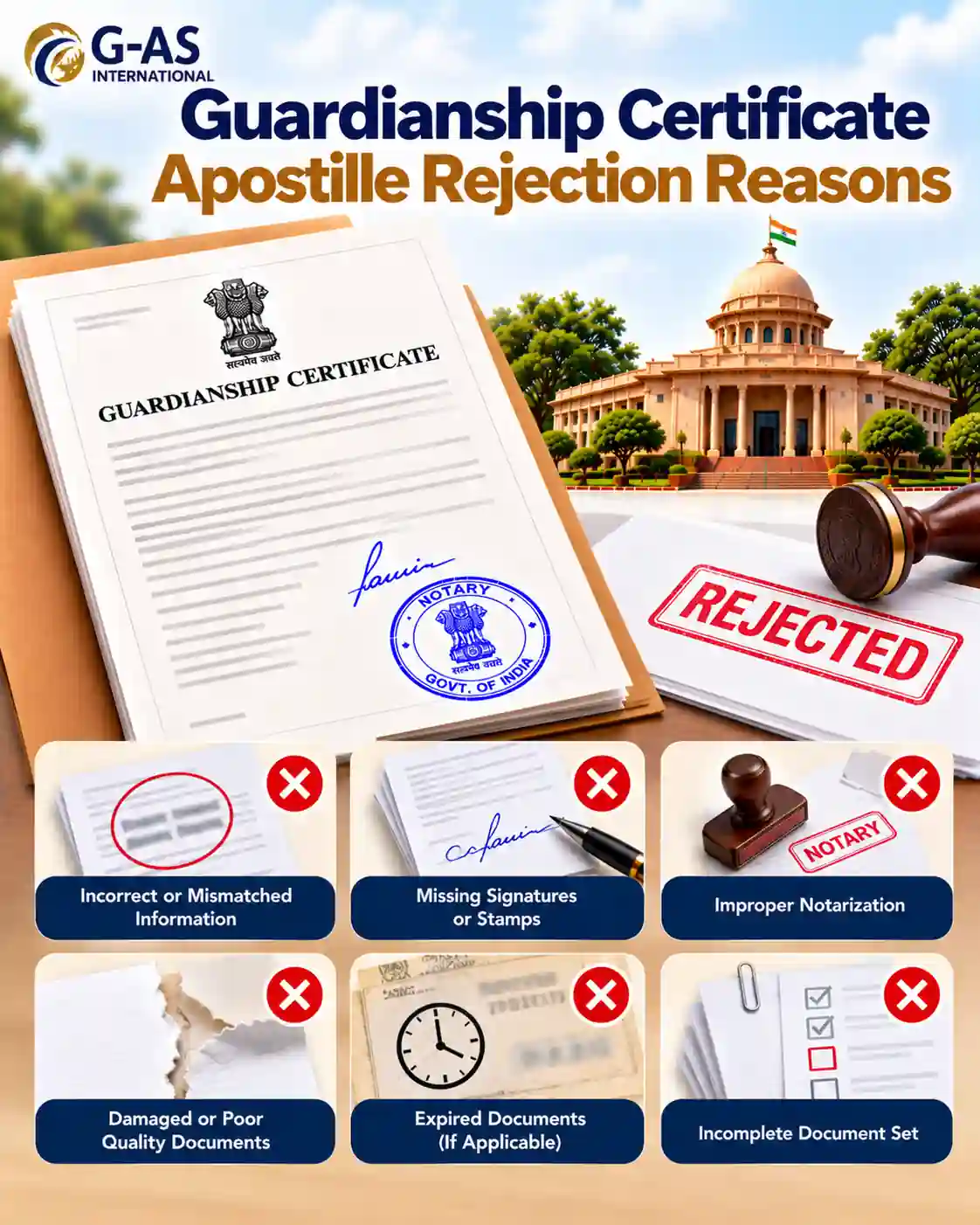
Guardianship Certificate Apostille Rejection Reasons usually relate to the underlying document or verification chain rather than the apostille alone. Rejection can occur when the certificate is not in an acceptable form, names or dates do not match, required signatures or seals are unclear, or the wrong authentication route is followed.
This article explains common guardianship certificate apostille problems, how to identify the actual cause of rejection, and what may need correction before resubmission. It also covers document verification, destination-country requirements, translation issues, document integrity, and practical checks that can help prevent repeated mistakes.
Guardianship Certificate Apostille Rejection Reasons matter most when a document is returned, verification cannot be completed, or a foreign authority questions whether the certificate is suitable for its intended use.
If the application is returned, read the objection carefully before resubmitting. Repeating the same submission without correcting the stated problem can lead to another delay.
Differences in names, dates, guardian details, or other identifying information should be checked against the supporting records and the issuing authority's document.
Apostille is intended for eligible public documents used between Apostille Convention countries. If the destination follows another route, the document may require different legalization steps.
Many Guardianship Certificate Apostille Rejection Reasons can be traced to the certificate itself, supporting records, or uncertainty about whether the document can be verified through the applicable route.
Check that every page is present and that official signatures, seals, stamps, registration details, and key entries remain clear enough for verification.
Compare the names of the guardian and minor, relevant dates, spellings, and other important particulars with the records that support the overseas application.
The exact supporting material can vary by issuing authority, state, purpose, and destination. Review the document preparation checklist before a corrected submission.
If a case also uses a separate consent or no-objection affidavit, its authentication should be handled according to that document's own requirements. See the NOC affidavit processing steps where relevant.
The safest response to Guardianship Certificate Apostille Rejection Reasons is to correct the specific objection first, then restart only the stages that actually need to be repeated.
Determine whether the problem arose during document verification, pre-authentication, MEA processing, or acceptance abroad. This prevents unnecessary corrections to parts of the file that were already acceptable.
Where the certificate contains an error, alteration, missing entry, or unreadable official element, obtain the appropriate correction or reissued document from the competent issuing authority before continuing.
The route can depend on the document's issuing authority and whether digital verification is available. Review the appropriate verification path before sending the document again.
Once the issue is fixed, follow the correct processing sequence for the document instead of assuming that every guardianship certificate follows one identical route.
Correcting Guardianship Certificate Apostille Rejection Reasons does not create one fixed completion period because the remaining work depends on the stage being repeated.
A simple submission correction may move faster than a case requiring reissue, fresh verification, or clarification from the document authority. For a broader explanation, review the processing-time factors.
Document reissue, translation, courier handling, verification requirements, and the service route can affect overall planning. A separate service charge overview can help when estimating the wider process.
These Guardianship Certificate Apostille Rejection Reasons are worth checking before resubmission because they can prevent verification or create doubts about the document's intended foreign use.
Damage, overwriting, missing pages, obscured seals, or unreadable signatures can interfere with authentication and may require a clean reissued document.
A document may be genuine yet still fail if it is sent through a route that cannot verify the relevant issuing authority or prior authentication.
Even minor inconsistencies can create verification questions when the guardianship certificate is compared with passports, court records, identity papers, or other supporting documents.
An apostille authenticates the origin of a public document, including the relevant signature or seal; it does not independently confirm every statement contained in the guardianship certificate.
Use these checks to reduce avoidable Guardianship Certificate Apostille Rejection Reasons before the corrected document is submitted again.
These answers cover common questions about Guardianship Certificate Apostille Rejection Reasons and what to check before trying again.
A genuine-looking document can still face rejection if its issuing details cannot be verified, required prior authentication is missing, information is inconsistent, or the destination does not use the apostille route for that document.
Yes. A material difference in names or other identifying details can trigger questions during verification. The appropriate correction depends on which record contains the error and which authority issued it.
No. Some Guardianship Certificate Apostille Rejection Reasons relate to routing, supporting papers, or destination requirements. Reissue is mainly relevant when the underlying certificate itself contains a problem that must be corrected.
They can when the receiving authority requires a translation or a particular translation format. Translation requirements are destination-specific, so they should be confirmed with the receiving authority before submission.
Review the rejection note, certificate condition, names and dates, issuing authority, verification path, supporting documents, destination-country requirements, and any translation requirement before starting the corrected submission.
Yes. Apostille authenticates the origin of the public document; the receiving authority can still assess the document's content, relevance, translation, validity for the intended purpose, or other local requirements.
Your Trust, Our Responsibility — That’s a G-AS Commitment.
Get Document Guidance