
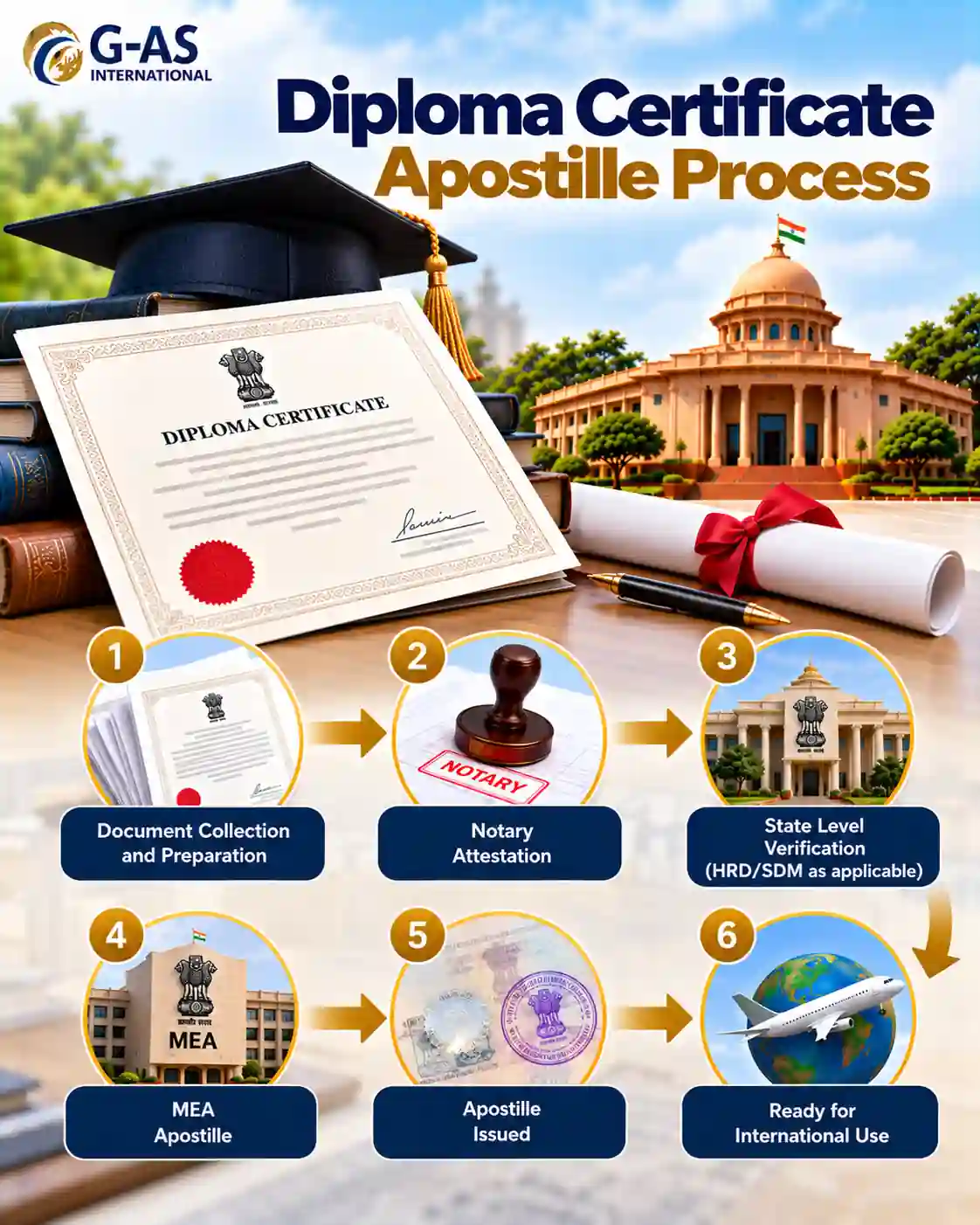
The Diploma Certificate Apostille Process is used to authenticate an Indian diploma for official use in a country that accepts Apostille under the Hague Convention. For educational documents, the route generally involves verification or pre-authentication by the appropriate State or Union Territory authority before the Ministry of External Affairs issues the Apostille.
This guide explains the preliminary authentication route, MEA processing, e-Sanad availability, document checks, and other practical steps involved. It also explains why the Diploma Certificate Apostille Procedure may vary depending on the issuing institution, State or Union Territory, available digital verification system, and the requirements for using the diploma abroad.
The Diploma Certificate Apostille Process is commonly relevant when an Indian diploma must be presented to an overseas authority that asks for authenticated educational records.
A foreign university, college, or credential evaluator may request an apostilled diploma when checking previous study, admission eligibility, or an applicant's academic background.
Employers, licensing bodies, or immigration authorities may ask for authenticated educational evidence when a diploma supports a job application, work permit, or professional registration.
Some residence, skilled migration, or dependent processes require verified academic documents. Applicants with degree-level qualifications can also review the degree certificate authentication workflow separately.
Before starting the Diploma Certificate Apostille Process, confirm that the diploma and supporting information match the requirements of the applicable verification and submission route.
Use the certificate that clearly shows the student's name, course or qualification, issuing institution, and official signatures or seals expected for verification.
Identity or application documents may be requested by the relevant authority or submission channel. Requirements should be checked before dispatch rather than assumed to be universal.
Where offline state verification applies, the educational document may need prior authentication. For a fuller preparation reference, review the document preparation checklist.
The Process for Diploma Certificate Apostille may differ where the issuing authority is digitally integrated with e-Sanad or where physical pre-authentication is still required. The route should therefore be checked against the actual issuing authority.
The procedure normally follows verification first and MEA Apostille afterward, but the preliminary route depends on the certificate and issuing authority.
Check whether the receiving country and organization accept an Apostille for the diploma. If the destination does not use the Hague Apostille system, a different legalization route may apply.
Educational documents may require verification through the designated State or Union Territory authority. The correct state-level verification routes depend on where and by whom the diploma was issued.
When the document-issuing authority is integrated with the digital system, verification and submission may follow the e-Sanad route. Eligibility should be checked rather than assuming every diploma can be processed digitally.
After the required verification is accepted, the Ministry of External Affairs completes the Apostille. Check the returned document carefully before sending it to the foreign university, employer, authority, or other recipient.
The total duration depends on preliminary verification, submission method, document condition, and authority-level processing.
State verification, institution confirmation, document corrections, submission mode, weekends, and authority workload can affect completion. Review the main factors affecting completion time before planning admission, employment, or travel deadlines.
Applicants should confirm current submission conditions before sending documents because related requirements may change between processing routes. A separate overview of diploma apostille cost considerations can help with advance planning without changing the authentication sequence.
Many delays arise before the final Apostille because the underlying document or verification route needs correction.
Differences in names, course details, institution information, or supporting identity records can trigger clarification or correction before the document is accepted.
Submitting a diploma through an unsuitable verification path can cause delay. The authority responsible for preliminary authentication depends on the document's origin and applicable procedure.
A damaged, unclear, altered, or unverifiable certificate may need additional confirmation from the issuing institution before the Diploma Certificate MEA Apostille Process can continue.
Some recipients ask for translations, transcripts, or supporting records in addition to an Apostille. Review the common causes of rejection before final submission.
A short review before submission can prevent avoidable corrections and keep the Diploma Certificate Apostille Steps aligned with the applicable route.
These questions cover practical points that commonly arise when planning diploma certificate authentication in India.
The Ministry of External Affairs is the competent authority for Apostille in India. Applicable educational document verification is completed before the final Apostille stage.
Yes. The route can differ according to the issuing institution, State or Union Territory, digital integration, and the document-verification mechanism available.
It may be possible when the relevant document-issuing authority and record are available through the supported digital system. Eligibility should therefore be checked before submission.
No. Apostille applies where the Hague Apostille Convention is applicable and the receiving authority requires it. Other destinations or specific recipients may follow different legalization requirements.
Confirm whether the recipient needs only the diploma, an Apostille, a translation, transcripts, or additional records before beginning the Process for Diploma Certificate Apostille.
Verify the document details, correct authentication route, digital eligibility, and destination requirement first. Following the appropriate Diploma Certificate Apostille Steps reduces avoidable resubmission and correction.
Your Trust, Our Responsibility — That’s a G-AS Commitment.
Get Document Guidance