
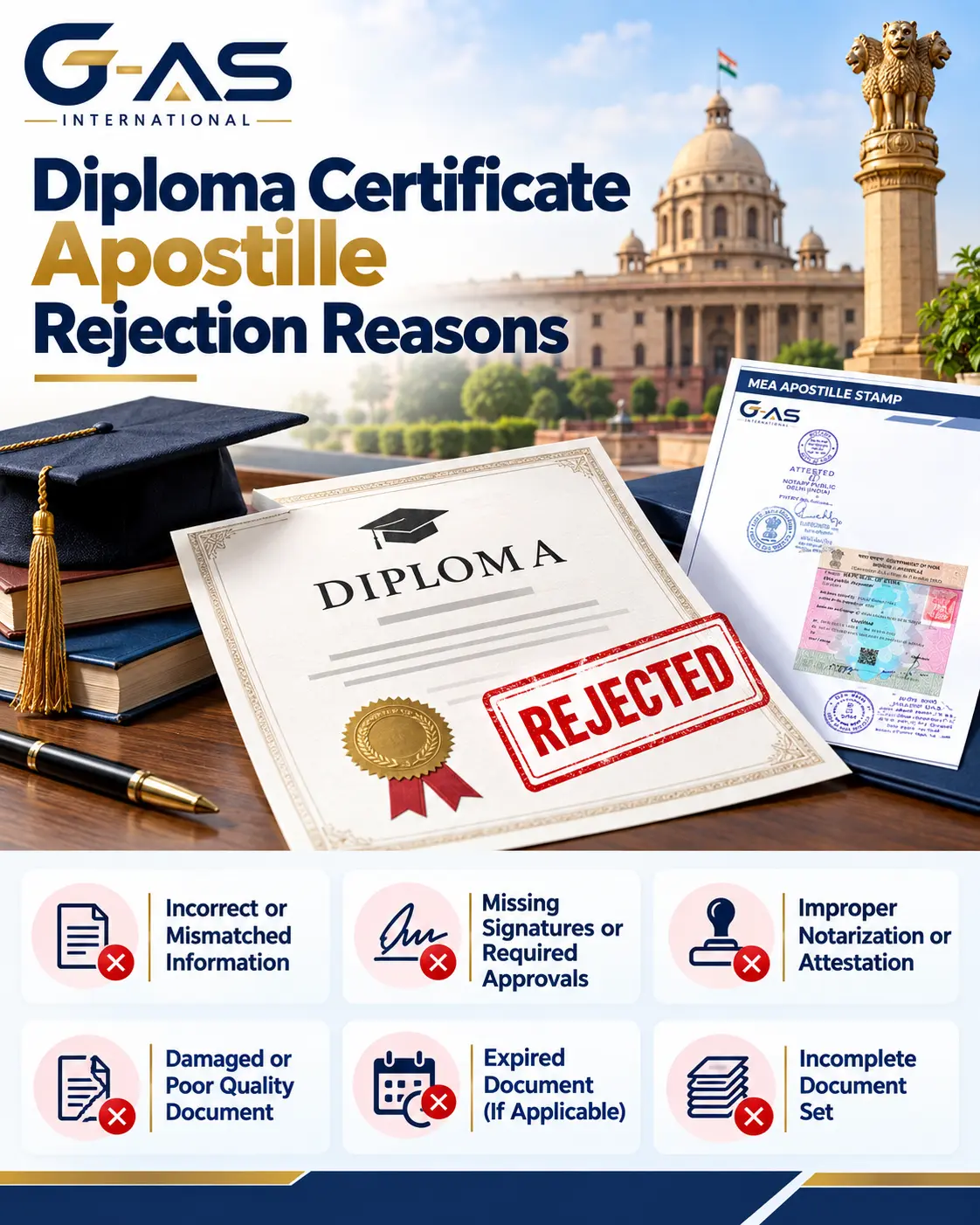
Diploma Certificate Apostille Rejection Reasons commonly involve missing or incorrect pre-authentication where required, mismatched names or certificate details, document-condition issues, or following the wrong legalization route for the destination country. In India, educational documents must follow the applicable verification route before MEA apostille processing.
A rejection can often be avoided by checking the diploma’s issuing details, personal information, document condition, required authentication, and the destination authority’s current rules before submission. This post explains common diploma certificate apostille problems, why applications may be returned, and practical checks that can help prevent errors and unnecessary resubmission.
A rejected or returned diploma application usually points to a problem with document details, verification, route selection, or destination requirements. Identifying the exact cause before resubmission helps prevent the same issue from recurring.
If the issuing university, board, or institute cannot confirm the diploma details, the application may stop before the final apostille stage. Older records or incomplete issuer information can require additional checking.
Differences in the holder's name, course title, award year, certificate number, or other identifying information can trigger a query when submitted details do not match the issuer's records.
Educational records do not always follow one identical path. A diploma may require a different pre-authentication route from another academic credential, so a degree verification route comparison can help clarify why document type matters.
Before correcting an application, review the diploma and supporting records for consistency, readability, and issuer-specific verification requirements. The required set can vary according to the route being used.
Check the holder's name, programme, issuing institution, certificate number, date, official signature, and seal. Do not overwrite, erase, or manually alter the certificate to correct a mismatch.
Confirm that any identity copy or academic supporting record requested for the applicable route matches the diploma. Review the submission document checklist before sending a corrected file.
Make sure the correct university, technical board, institute, state, or Union Territory is identified. The authority that issued the diploma influences how the academic record can be authenticated.
Unclear seals, damaged areas, missing pages, illegible signatures, or suspicious alterations can prevent reliable verification. If the original record contains an error, correction should normally be handled through the issuing institution rather than by changing the document manually.
The safest response to a rejection is to correct the specific cause first and then restart from the appropriate verification stage rather than simply submitting the same documents again.
Review any note, query, email, or verification response connected with the rejected application. Separate document-detail errors from route, issuer-verification, destination, or supporting-record problems before taking corrective action.
Check how the issuing authority can authenticate the diploma. Depending on the issuing authority and available verification method, the record may follow a digital or physical pre-authentication route. Review the issuer-based verification path before resubmission.
Resolve spelling differences, incomplete issuer details, missing verification, or other documented discrepancies through the appropriate source. Avoid making informal changes to an original academic certificate.
Once the problem is corrected, follow the step-by-step diploma authentication route from the stage relevant to the corrected document. Repeating an incorrect route can lead to another query or return.
There is no single correction period because the delay depends on what caused the rejection and which authority must verify or amend the academic record.
Simple document-check issues may be resolved faster than problems requiring a university, board, institute, or state-level response. Older academic records, unavailable digital records, or formal corrections can add time before the application is ready again.
The total timeline depends on the verification route and whether further clarification is requested. For broader scheduling context, review the typical turnaround factors before setting an overseas submission deadline.
Many rejection cases relate to verification accuracy, document condition, route selection, or a mismatch between the apostille procedure and the recipient's actual requirement.
A spelling difference, changed name, incorrect course detail, or inconsistent certificate number can prevent the submitted diploma from matching the issuing authority's record.
Where the applicable route requires prior educational or state-level authentication, submitting the diploma without that completed verification can stop the application before further processing.
Verification becomes difficult when essential seals, signatures, numbers, or text cannot be read clearly. Manual alterations can also create authenticity concerns that require issuer confirmation.
An apostille is intended for use where the Apostille Convention applies and the receiving authority requires it. A recipient may request another legalization route or additional records instead.
A practical Diploma Certificate Apostille Error Guide should focus on checks that prevent correctable errors without repeating the same rejection information already covered above.
A genuine diploma can still face a query if its details cannot be verified, the wrong pre-authentication route was used, supporting information does not match, or the destination requirement was misunderstood.
Yes. A mismatch between the diploma and the issuer's record or supporting identity details can require clarification. If the diploma itself is wrong, request correction from the issuing institution rather than editing it manually.
No. The route can differ according to the issuing university, technical board, institute, state or Union Territory, and the verification method available for that academic record.
Yes. An apostille authenticates the origin of the public document, relevant signature, official capacity, and seal or stamp. It does not guarantee academic recognition, equivalence, admission, employment, or acceptance by a particular recipient.
Identify the exact reason for the return, confirm the correct authority and route, correct only the documented issue, and verify the destination requirement before submitting the diploma again.
Not always. Both are educational documents, but their issuing authorities and verification routes may differ. Check the document type and issuer rather than assuming one academic process applies universally.
Your Trust, Our Responsibility — That’s a G-AS Commitment.
Get Document Guidance