
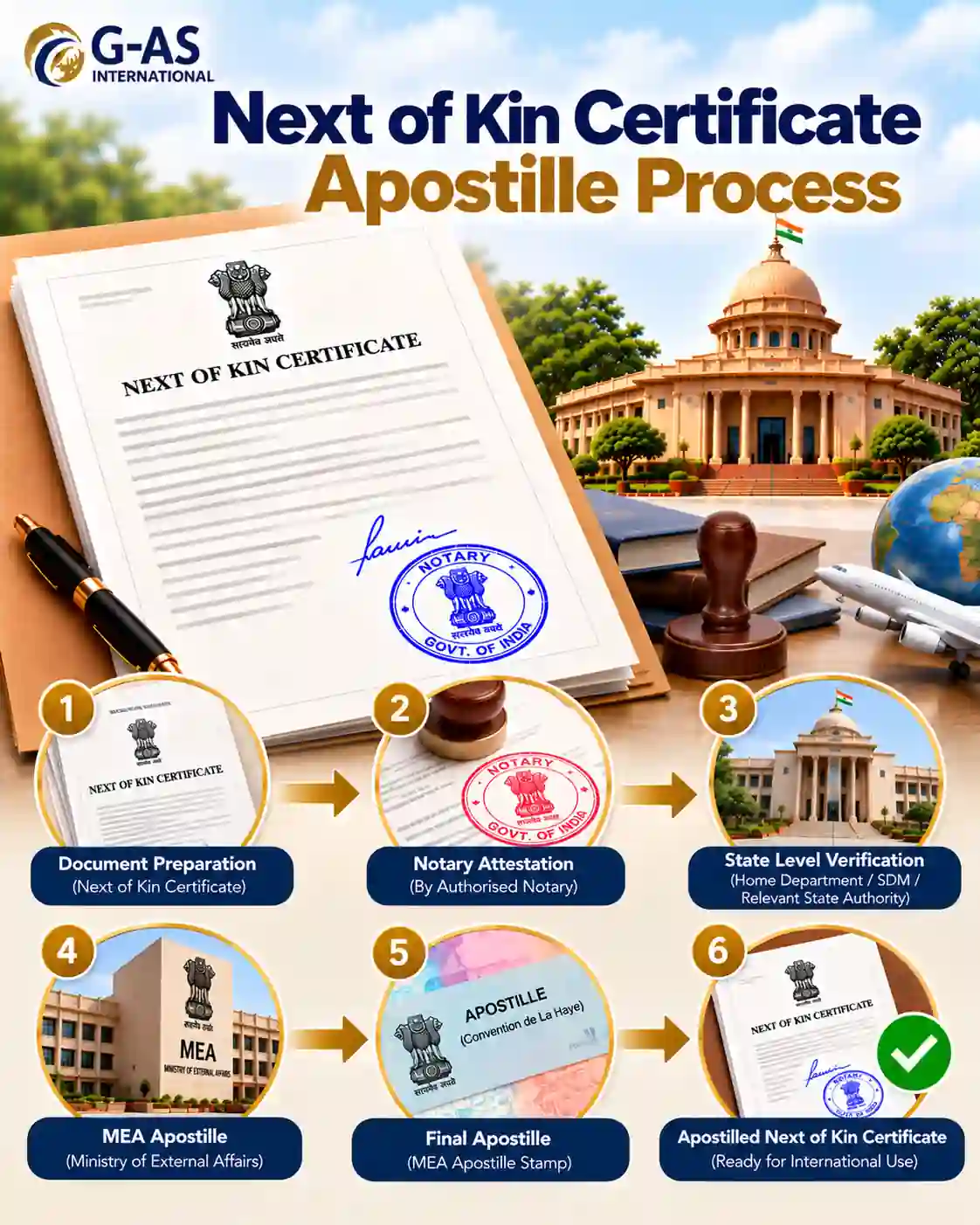
The Next of Kin Certificate Apostille Process is used to authenticate a qualifying Indian next-of-kin certificate or affidavit for presentation in a country that accepts Apostilles. The exact route can depend on how the document was issued, but it generally involves the required pre-authentication followed by apostille through the Ministry of External Affairs.
This article explains how to apostille a Next of Kin Certificate, which authority may verify it first, and how the MEA stage fits into the procedure. It also covers destination-country eligibility, document checks, important apostille steps, and practical issues that can affect a smooth submission.
This process is relevant when an Indian next-of-kin document must be presented to an overseas authority in a country that accepts apostilles under the Hague Convention.
An overseas authority, insurer, employer, bank, or administrator may request authenticated proof identifying a deceased person's close family member before handling a claim or family-related record.
Where a death occurs abroad, a mission, hospital, employer, or local authority may ask for relationship evidence or consent from the next of kin as part of its own procedure.
If the foreign request concerns legal authority over a minor rather than proof of kinship after a death, review the related guardianship authentication route instead of assuming the same document applies.
The exact submission set depends on the issuing authority, document format, authentication route, and receiving authority, so confirm the applicable requirements before dispatch.
Use the document format accepted for the applicable route. It should be complete, legible, and contain the relevant official signature, seal, stamp, or verifiable digital record.
Depending on the case, supporting records may include identity proof, a death certificate, and documents showing the claimed relationship. Review the document preparation checklist for a focused pre-submission review.
Keep any written instruction from the foreign authority available. It can clarify whether the recipient wants the certificate itself, an affidavit, a translation, or additional relationship evidence.
A government-issued Next of Kin Certificate and a privately executed next-of-kin affidavit are not automatically processed identically. Their issuing signatures and pre-authentication requirements can differ.
The Process for Next of Kin Certificate Apostille should follow the route applicable to the actual document rather than a fixed sequence assumed for every case.
First confirm that the receiving country accepts apostilles and that the foreign authority wants this particular document. Also identify whether the record is a government certificate, affidavit, or another family-status document.
For documents not processed through an eligible e-Sanad route, the relevant State or Union Territory authentication authority may need to verify the designated signature before MEA processing. Check the pre-authentication route guide before submission.
After valid verification, the document proceeds through the applicable MEA channel. Depending on current eligibility and document availability, this may involve e-Sanad or an authorised outsourced submission route.
Verify names, document references, seals, and apostille details after return. The apostille authenticates the document's origin; the receiving authority still decides whether the record meets its substantive purpose.
The overall duration is not identical for every file because pre-authentication, MEA submission, document movement, and corrections can add separate stages.
The timing depends on document origin, verification availability, working days, submission channel, and whether any mismatch needs correction. For planning purposes, review the timing factors and delay points rather than relying on one fixed completion period.
Before dispatch, account for the applicable authentication route, authorised handling method, return movement, translation needs, and document-specific arrangements. A separate review of service planning variables can help organise the file without mixing them into the procedural steps.
Most avoidable problems come from using the wrong document route, submitting inconsistent records, or overlooking the receiving authority's instructions.
Submitting the document to an authority that cannot authenticate the relevant signature can stop the file before it reaches the MEA stage.
Differences in names, spellings, dates, or stated relationships across the certificate and supporting records can lead to clarification, correction, or resubmission.
A missing page, unclear seal, damaged endorsement, or copy format that the selected route does not accept can prevent authentication from moving forward.
An apostille does not replace recipient-specific requirements. Review the common rejection triggers before dispatch if the foreign authority has strict document or translation rules.
A short pre-submission review can prevent the most common route, document, and recipient-related problems.
These answers address common practical questions that arise before beginning the procedure.
Identify the document type and destination first, complete the applicable State or Union Territory verification when required, and then use the current MEA apostille channel that applies to the document.
No. The Next of Kin Certificate Apostille Procedure can change according to the issuing authority, State or Union Territory, document format, e-Sanad eligibility, and the signature that requires authentication.
Not automatically. An affidavit and a government-issued certificate can have different execution and authentication requirements, so the exact document requested by the receiving authority should be confirmed first.
No. Apostille is intended for use between countries covered by the Hague Apostille Convention. A non-Hague destination may require a different attestation or legalization route.
It authenticates the origin of the public document, including the relevant signature or seal. It does not independently prove every statement contained in the document or guarantee acceptance.
Confirm the requested document, applicable verification route, destination requirements, translation expectations, and supporting records before submission to reduce avoidable corrections or repeat processing.
Your Trust, Our Responsibility — That’s a G-AS Commitment.
Get Document Guidance