
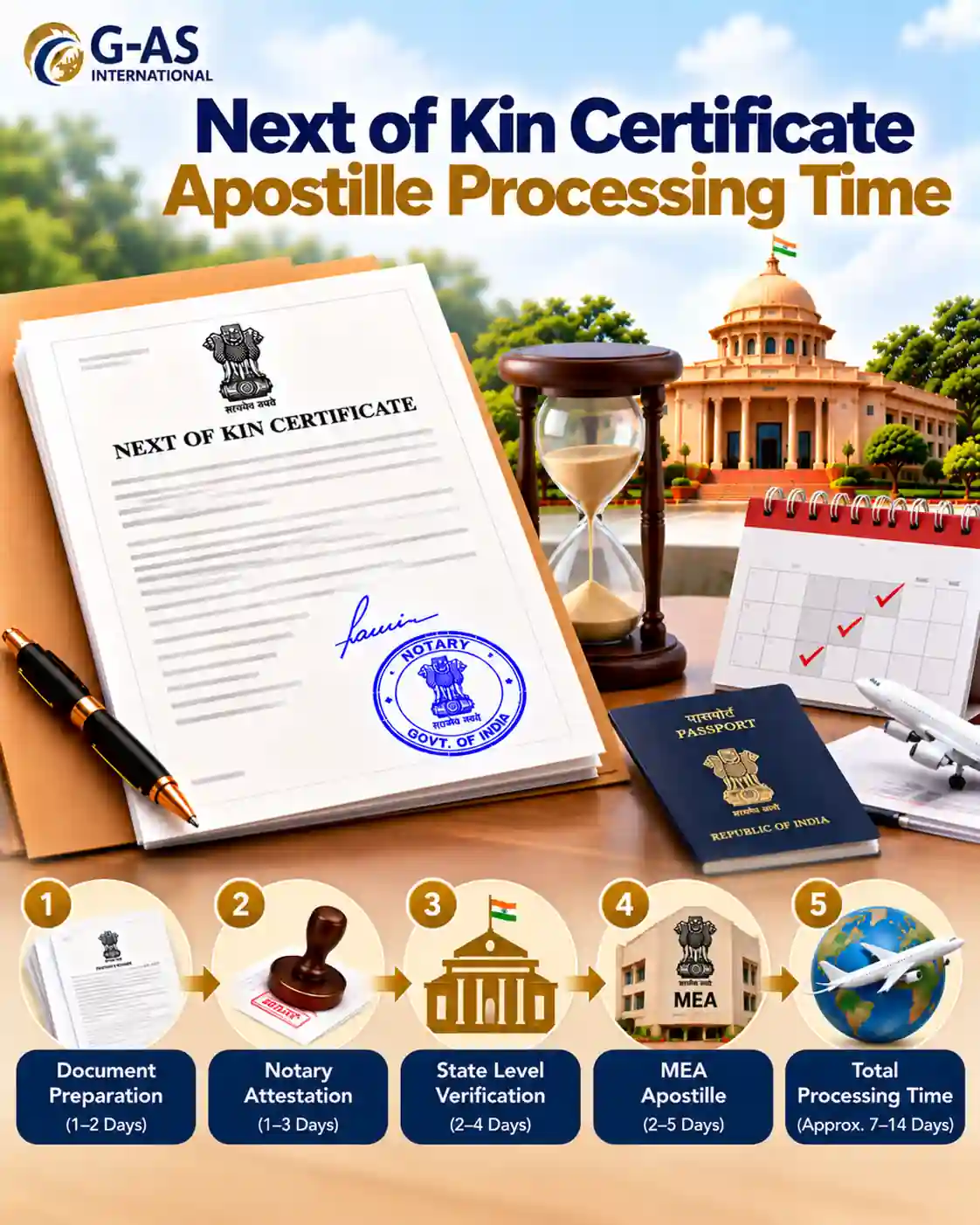
The Next of Kin Certificate Apostille Processing Time depends on the document’s readiness, required pre-authentication, and the verification route followed before submission to the Ministry of External Affairs. The total turnaround can therefore be longer than the apostille stage alone, particularly when state-level authentication or document corrections are required.
Understanding the Next of Kin Certificate Apostille Timeline helps applicants plan documents for overseas legal, family, inheritance, or administrative purposes. This post explains the usual processing stages, factors that can extend the duration, possible verification delays, and practical points that influence how quickly an apostilled document can be completed.
Timing becomes important when an Indian next of kin record must be presented abroad by a fixed filing, estate, family, or administrative deadline.
A foreign authority, court, bank, or estate administrator may request an apostilled next of kin record before accepting it as supporting evidence in succession-related formalities.
The certificate may form part of a family-status or administrative file where the receiving authority needs authenticated evidence of the declared next of kin relationship.
Applicants with a filing date should plan beyond the MEA stage because preliminary authentication, document movement, corrections, and non-working days can affect the overall schedule.
The Time Required for Next of Kin Certificate Apostille can increase when the document or supporting records are incomplete, unclear, or unsuitable for the applicable route.
The certificate should be complete, legible, and carry the relevant official signature, seal, or endorsement needed for the applicable authentication route.
Where the applicable channel requests identity or submission records, prepare them before dispatch. Review the document preparation checklist for the related document page.
The overseas recipient may separately request translations, identity records, relationship evidence, or other supporting material. These should not be assumed to be universal apostille prerequisites.
Name differences, incomplete pages, unclear seals, damaged endorsements, or an unacceptable document format can trigger clarification and extend the Next of Kin Certificate Apostille Duration.
The Next of Kin Certificate Apostille Processing Time is easier to estimate when the complete authentication chain is considered rather than only the final MEA action. See the full apostille procedure for a process-focused explanation.
First confirm that the receiving country accepts apostilles under the Hague Apostille Convention and that the foreign recipient specifically requires the next of kin certificate in apostilled form.
Documents not covered by an eligible electronic route generally require authentication by the designated State or Union Territory authority before MEA processing. The correct pre-authentication route depends on document origin and current procedure.
After valid preliminary authentication, the document proceeds through the applicable authorised submission channel. If the document is eligible for e-Sanad, the route may differ from an offline submission.
After MEA processing, allow time for collection, dispatch, or delivery. The end-to-end Next of Kin Certificate Apostille Timeline therefore includes more than the period spent with MEA.
There is no single guaranteed end-to-end duration because preliminary verification and return movement can vary between cases.
The Ministry of External Affairs Citizen’s Charter states that apostille is usually completed within seven working days after the document is received by MEA. This does not include the time that may be needed beforehand for State or Union Territory authentication, document correction, submission movement, or delivery after processing.
The practical Next of Kin Certificate Apostille Processing Time should be planned from document preparation through final return. Applicants should avoid treating the published MEA stage as a guarantee for the complete case. For broader planning information, review the related service details.
Most avoidable delays occur before final apostille when the document, verification route, or submission details need correction.
Using an authority that cannot verify the relevant issuing signature or document origin can stop the file and require the authentication stage to be repeated.
Missing pages, unreadable seals, inconsistent particulars, damaged endorsements, or an unsuitable copy format can lead to extra checking or resubmission.
Differences in names, dates, spellings, signatures, or official particulars should be resolved before submission. Review the common rejection triggers for related checks.
An apostille authenticates the origin of the public document, but the receiving authority may still require a specific format, translation, or additional supporting record.
A short review before submission can reduce avoidable corrections and make the overall schedule easier to plan.
MEA’s published service timeline is usually within seven working days after receipt by MEA. The complete case may take longer because preliminary authentication, corrections, submission movement, and return delivery are separate stages.
No. The published MEA timeline starts after receipt by MEA. Any required State or Union Territory authentication occurs earlier and can add time to the overall process.
Yes. Unclear seals, incomplete pages, incorrect particulars, unsuitable formats, or authentication through the wrong authority can require clarification or resubmission and extend the schedule.
Yes. The document’s issuing authority, State or Union Territory, available electronic integration, and current submission procedure can affect the route used before final apostille.
Not automatically. They are different document types, so their issuing authorities and preliminary verification can differ. Compare the guardianship document procedure rather than assuming the same route applies.
Confirm the destination requirement, prepare a legible and complete certificate, verify the correct authentication route, check all names and dates, and allow time for document movement before any overseas deadline.
Your Trust, Our Responsibility — That’s a G-AS Commitment.
Get Document Guidance