
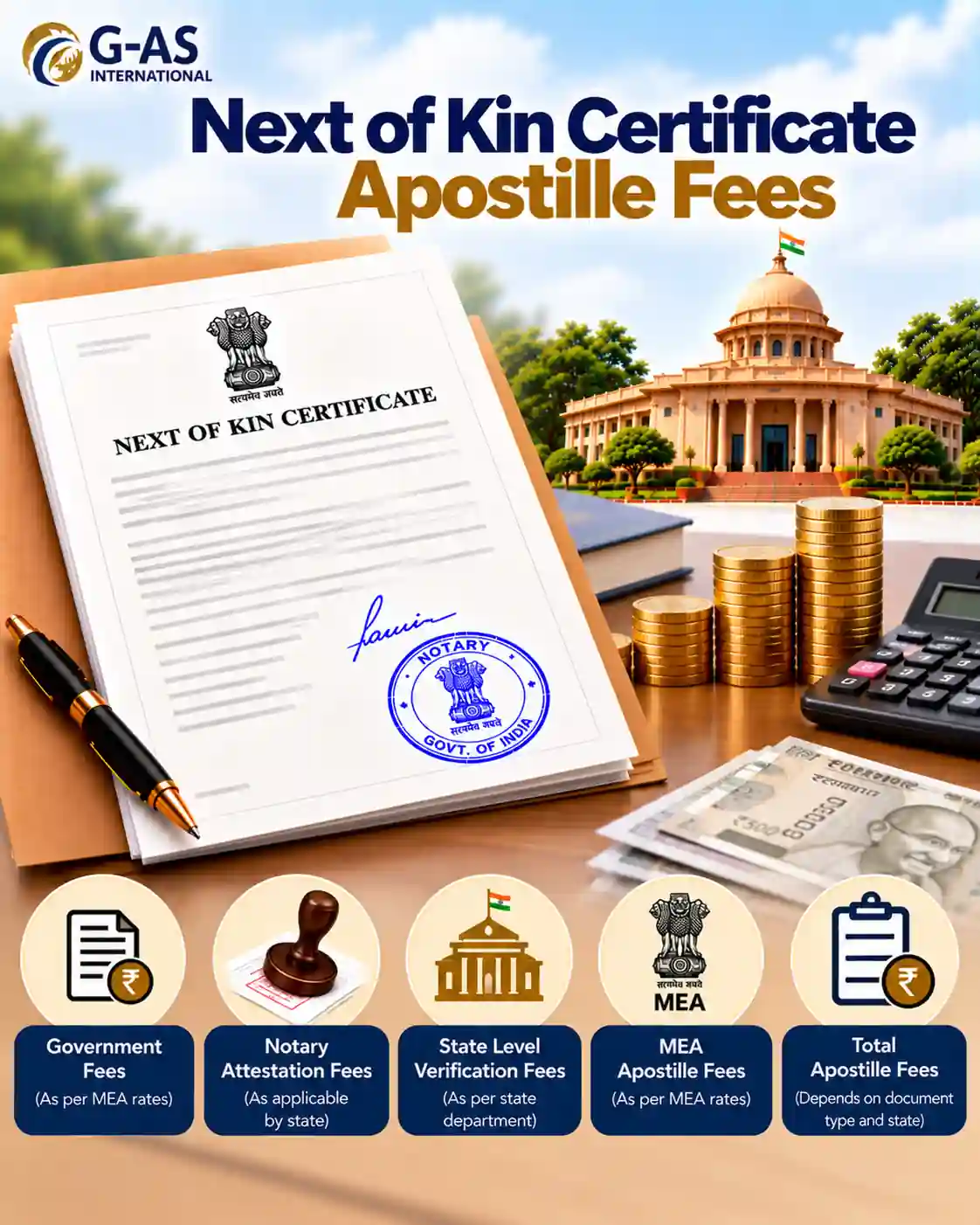
Next of Kin Certificate Apostille Fees can vary depending on the verification route, document condition, processing requirements, and additional services involved. Understanding the possible cost components in advance can help applicants avoid confusion and compare the overall requirements more clearly.
This article explains the factors that may influence the Next of Kin Certificate Apostille Cost, including pre-authentication, document verification, processing, and optional handling services. It will also help readers understand why Next of Kin Certificate Apostille Charges may differ between individual cases.
A Next of Kin Certificate may need apostille when it must be presented abroad as evidence of a legally recognized family relationship. The exact route depends on the issuing authority, state of issue, destination country, and purpose for which the document will be used.
Foreign authorities, banks, courts, or estate administrators may ask for authenticated relationship evidence before processing inheritance, succession, asset transfer, or estate-related formalities.
The certificate may be requested when a claimant needs to establish a family connection for insurance, compensation, pension, or other benefit-related procedures outside India.
Some overseas procedures require proof that a person is the recognized relative or representative of another individual. Where guardianship is involved instead, review the guardianship document apostille procedure because the document type and verification path can differ.
Requirements should be checked against the certificate’s issuing authority and intended overseas use. A document accepted in one case may need additional supporting evidence in another.
Use the certificate in the form required for authentication. Names, dates, issuing details, seals, signatures, and other identifying information should be clear and consistent.
Supporting records may be requested when the issuing or verifying authority needs additional evidence to confirm the applicant, relationship, or certificate details.
The receiving organization abroad may ask for a translation, copy, covering document, or another supporting record. Confirm these conditions before starting authentication.
For a focused preparation list, review the document checklist for this certificate before arranging verification or submission.
The route generally involves checking the certificate, completing any required pre-authentication, and then moving to the competent apostille stage. The exact sequence can vary by document origin and current authority requirements.
First identify how the Next of Kin Certificate was issued and where it will be used. This helps determine whether apostille is appropriate and whether any preliminary verification is required.
The certificate may need verification by the authority responsible for the relevant personal-document route. Because the route is not identical in every case, consult the pre-authentication and verification route before submission.
After any required preliminary verification is complete, the document can proceed to the apostille stage through the applicable submission channel. Details should match the authenticated record.
After completion, verify that the apostille is attached to the correct certificate and that the identifying information is consistent before sending the document to the overseas recipient.
For the sequence in one place, see the step-by-step apostille procedure.
There is no single timeline that fits every Next of Kin Certificate because verification requirements and authority processing can vary.
Timing may depend on document condition, issuing-state verification, the submission route, corrections, holidays, authority workload, and whether additional supporting evidence is requested. Check the processing timeline factors when planning an overseas deadline.
Many avoidable problems begin with inconsistent details, unsuitable documents, or use of the wrong verification path.
Differences in names, dates, relationship details, or other identifying information can lead to additional checks or a request for correction.
A damaged, altered, incomplete, or poorly legible certificate may be difficult to verify and can prevent the application from moving smoothly.
Using a route that does not match the issuing authority or document category can cause delay and may require the process to be restarted correctly.
Apostille should be confirmed with the receiving authority before submission. For additional preparation, review the common rejection and correction issues.
A short document check before submission can reduce preventable corrections and repeated verification.
These answers cover practical points that often arise before a Next of Kin Certificate is submitted for overseas use.
No. The requirement depends on the destination country, the receiving authority, and the purpose of submission. Confirm the required legalization route before starting.
Yes. The relevant pre-authentication route can depend on where and how the certificate was issued, so the issuing authority and state should be checked first.
It is usually better to correct material errors before authentication. A mismatch can trigger additional verification or make the document unsuitable for the receiving authority.
No. Apostille applies where the relevant international convention is in force between the issuing and destination countries. Other destinations may require a different legalization route.
The overall requirement can vary according to document verification, issuing authority, supporting records, submission route, and the conditions set by the overseas receiving organization.
Your Trust, Our Responsibility — That’s a G-AS Commitment.
Get Document Guidance