
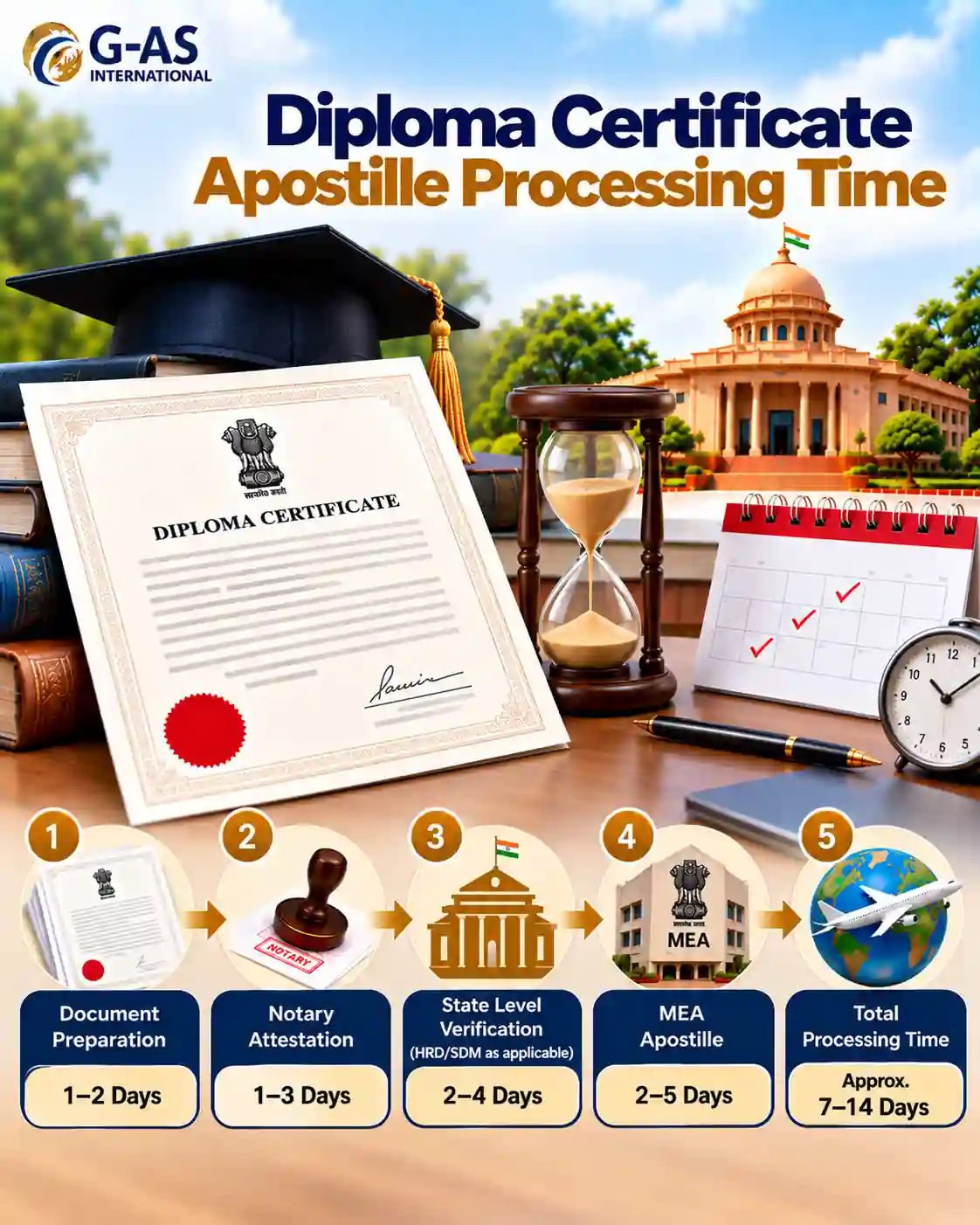
Understanding Diploma Certificate Apostille Processing Time is important when planning overseas study, employment, immigration, or other official use of an Indian diploma. The Ministry of External Affairs states that apostille processing is usually completed within 7 working days after the document reaches MEA.
The complete Diploma Certificate Apostille Timeline can take longer because educational documents may involve preliminary State or UT authentication, institutional verification, submission handling, and return delivery. This post explains realistic time factors, the stages that affect duration, common causes of delays, and what applicants should consider when planning their submission.
Diploma Certificate Apostille Processing Time matters when an overseas authority has a fixed deadline. The total period depends heavily on how the diploma is verified before it reaches the Ministry of External Affairs.
Universities or credential evaluators may request an apostilled diploma before enrolment, admission confirmation, or qualification assessment. Starting verification early can reduce deadline pressure.
An employer or overseas authority may require authenticated proof of a qualification. Planning should include both preliminary verification and the final apostille stage.
Professional and migration cases can have document-specific deadlines. Confirm whether the recipient needs the diploma itself, another academic record, or additional verification.
A correct document set helps prevent avoidable pauses. Requirements can vary by issuing authority, verification route, document format, and overseas recipient.
The diploma should be complete, readable, and suitable for the applicable route. Review the document preparation checklist before submission.
The holder's name, institution, course details, certificate number, seals, and other identifying information should be clear and consistent with verification records.
Educational documents outside an eligible digital route generally need the applicable State or Union Territory authentication before MEA apostille submission.
The issuing institution, State or Union Territory, and availability of a digital record can change the verification stage, so not every diploma follows the same path.
The Diploma Certificate Apostille Timeline is easier to estimate when verification, submission, MEA processing, and completion checks are considered separately.
Identify whether the diploma came from a university, technical board, polytechnic, institute, or another recognised authority. This determines the correct issuer-based verification pathway.
Documents outside the applicable e-Sanad route need the relevant State or Union Territory pre-authentication. Supported digital records may follow e-Sanad when eligibility conditions are met.
After verification, the document proceeds through the authorised submission route for MEA processing. The step-by-step diploma apostille procedure explains the sequence in more detail.
MEA issues the apostille after the document reaches the final eligible stage. The issued apostille can be checked through the official e-Register. Degree holders can review the degree certificate workflow.
Diploma Certificate Apostille Processing Time has two practical parts: the final MEA stage and the earlier verification period required before eligible submission.
MEA's published Citizen's Charter states that apostille processing is usually completed within seven working days after receipt by MEA. This period does not include earlier State, Union Territory, institutional, or digital verification.
The complete Diploma Certificate Apostille Duration can be longer because pre-verification has no single nationwide turnaround. Issuer response, record availability, corrections, holidays, and delivery can affect completion. Keep timing separate from separate pricing guidance.
Delays often arise during verification. The following issues can extend Diploma Certificate Apostille Processing Time before final completion.
A document that has not completed required authentication may need to return through the correct authority before it can continue.
Older diplomas, archived records, or slow institutional responses can lengthen the Diploma Certificate Apostille Time before further processing becomes possible.
Spelling differences, unclear seals, damaged text, or inconsistent academic details may require clarification. Review the common rejection causes before dispatching an original.
An apostille is intended for Hague Apostille Convention use. Starting the wrong legalisation route can create delays when the destination or receiving authority requires something different.
Before starting, verify the points that most directly influence Diploma Certificate Apostille Processing Time.
MEA states that its apostille stage is usually completed within seven working days after receipt. Total time can be longer when pre-authentication, institutional verification, correction, or delivery is required.
No. The published MEA period starts after receipt by the Ministry. Diploma Certificate Apostille Processing Time can also include State, Union Territory, issuer, or digital verification.
It can simplify verification when the issuing authority is supported and the document is available in the required digital repository. Eligibility should be confirmed first.
Diplomas come from different institutions, States, boards, and record systems. Verification response times can therefore differ, so another applicant's turnaround is not a guaranteed timeline.
Start early enough to cover verification before the MEA stage, not just the published seven-working-day period. Allow additional margin for older records or fixed foreign deadlines.
Your Trust, Our Responsibility — That’s a G-AS Commitment.
Get Document Guidance