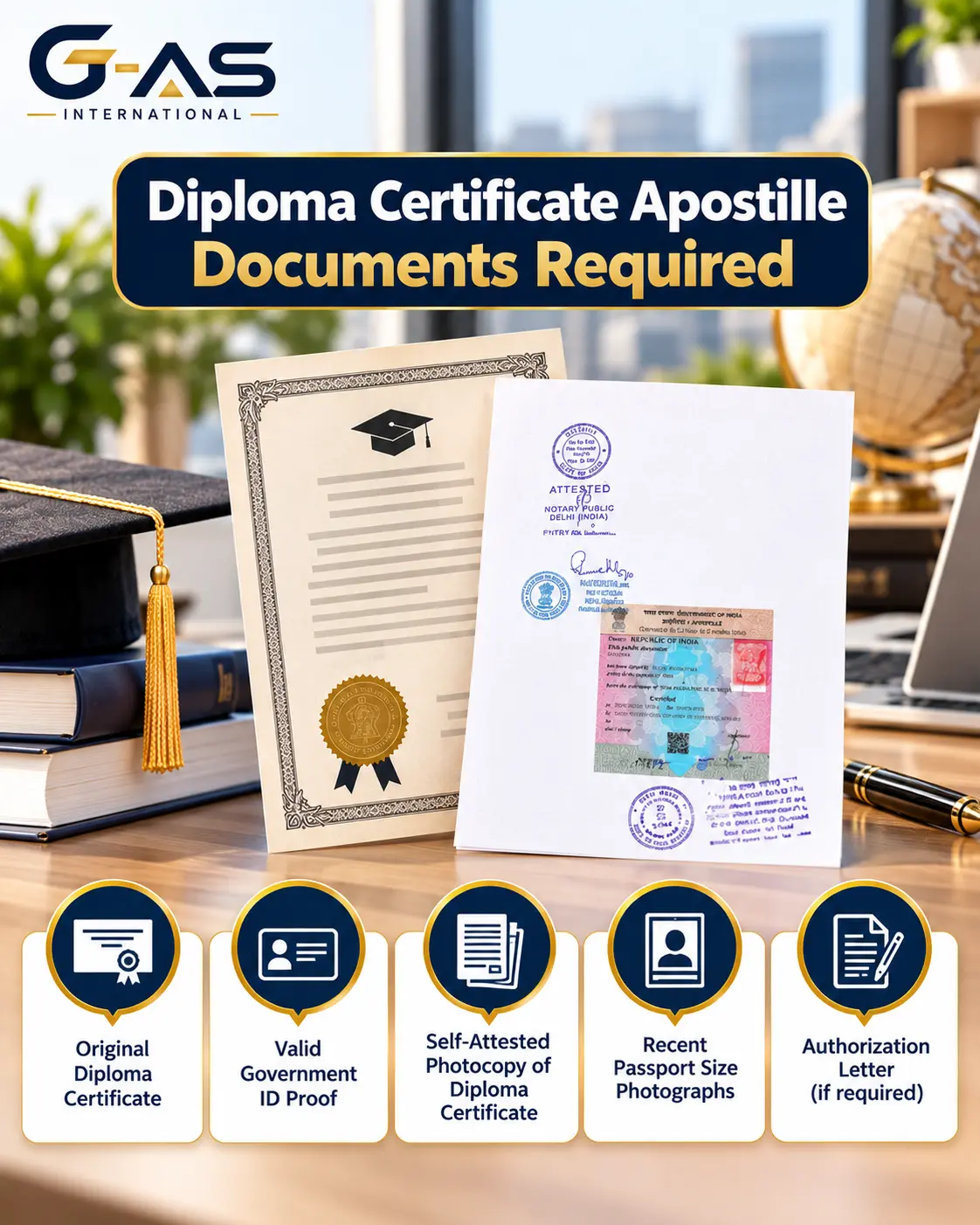
For an Indian diploma certificate, the Diploma Certificate Apostille Documents Required generally include the original diploma certificate, a clear document copy, and a photocopy of the applicant’s passport. Depending on the verification route and issuing authority, marksheets, transcripts, authorization details, or other supporting educational records may also be requested.
Preparing the correct paperwork in advance can help prevent avoidable verification issues and submission delays. This article explains the essential document checklist, when additional records may be needed, how requirements can vary by issuing authority, and what details should be checked before starting the apostille process.
Diploma documents may need apostille when an overseas institution, employer, immigration authority, licensing body, or other receiving organization asks for authenticated proof of an educational qualification issued in India.
Universities or educational institutions abroad may request an apostilled diploma when evaluating previous qualifications for admission, credit assessment, further study, or academic recognition.
An overseas employer or professional authority may request authenticated educational evidence before accepting a diploma as proof of technical, vocational, or professional study.
Some visa, residency, migration, or credential-assessment procedures may require educational documents to be authenticated before they are accepted for official use abroad.
The exact Diploma Certificate Apostille Requirements can vary according to the issuing institution, verification route, state, submission method, and requirements of the authority receiving the document.
The original diploma is generally the primary educational document presented for authentication. It should be complete, readable, undamaged, and issued by the recognized educational institution or awarding authority.
A clear passport or other accepted identity-document copy may be requested by the submission channel for applicant identification and record matching. Requirements should be confirmed before submission.
Marksheets, transcripts, enrollment details, institution verification, or another supporting academic record may sometimes be requested when the diploma requires additional verification by the relevant authority.
If another person or an authorized representative handles the submission, an authorization document may be requested depending on the applicable submission procedure and document-handling requirements.
Documents for Diploma Certificate Apostille should match the credential actually being submitted. If your educational document is a degree instead, review the authentication workflow for degree credentials because its verification requirements may differ.
Preparing the Papers Required for Diploma Certificate Apostille is only one part of the procedure. The document may also need verification before the apostille stage. A detailed step-by-step apostille procedure can help explain the complete sequence.
The diploma should first be checked for the applicant's name, institution details, signatures, seals, course information, and overall document condition. Supporting records should also correspond with the main certificate where required.
Depending on the document and applicable procedure, verification may involve the appropriate educational or state-level authority before further authentication. Review the state verification path before MEA processing for a focused explanation.
After the applicable prior authentication has been completed, the eligible educational document proceeds through the Ministry of External Affairs apostille system for use in countries where the Hague Apostille Convention applies.
After completion, the applicant should check that the apostille corresponds to the submitted diploma and that the receiving organization has not requested any separate supporting academic or destination-specific documentation.
Having the Required Documents for Diploma Certificate Apostille prepared correctly can reduce avoidable document-related delays, although the overall timeline can still vary.
Timing can depend on the issuing institution, required educational verification, state-level authentication, document condition, submission channel, holidays, authority workload, and whether any discrepancy needs clarification. See the typical diploma apostille turnaround factors for additional timeline guidance.
Applicants should confirm the current submission route and supporting paperwork before handing over the original document. Additional diploma apostille planning information can also be reviewed before starting the application.
Even when the Diploma Certificate Apostille Documents Required are available, inconsistencies or missing verification can interrupt processing. Review these common causes of apostille rejection for related checks.
A difference between the diploma and supporting identity records can require clarification or additional evidence before the document can proceed through the applicable verification route.
Torn sections, unreadable text, missing seals, unclear signatures, heavy lamination issues, or other physical problems can make document verification more difficult.
If the applicable pre-authentication or institution-level verification has not been completed correctly, the diploma may need additional processing before it can move forward.
Submitting unrelated, inconsistent, incomplete, or poor-quality supporting records can lead to additional document checks and may require corrected paperwork to be provided.
Use this short preparation check to make sure the main diploma and supporting records are ready before beginning authentication.
The diploma itself is the primary document. Depending on the submission and verification route, an identity copy, supporting academic records, authorization, or additional verification material may also be requested.
The applicable requirement depends on the authentication route and submission system being used. Applicants should confirm whether an original, digitally verifiable record, or another accepted document format is required before submission.
Not necessarily. Marksheets or other academic records may be requested when they are needed for institution verification, clarification, or a particular authentication procedure rather than as a universal requirement in every case.
Yes. Educational-document authentication can involve different designated authorities or verification arrangements depending on where and by whom the diploma was issued, so applicants should verify the applicable route beforehand.
Yes. Names, course information, institution details, signatures, seals, document condition, and supporting records should be reviewed before submission because discrepancies can result in additional verification or correction requests.
Yes. An issuing institution, verification authority, submission channel, or receiving organization may request additional records when further confirmation is necessary for the specific diploma or intended overseas use.
Your Trust, Our Responsibility — That’s a G-AS Commitment.
Get Document Guidance