
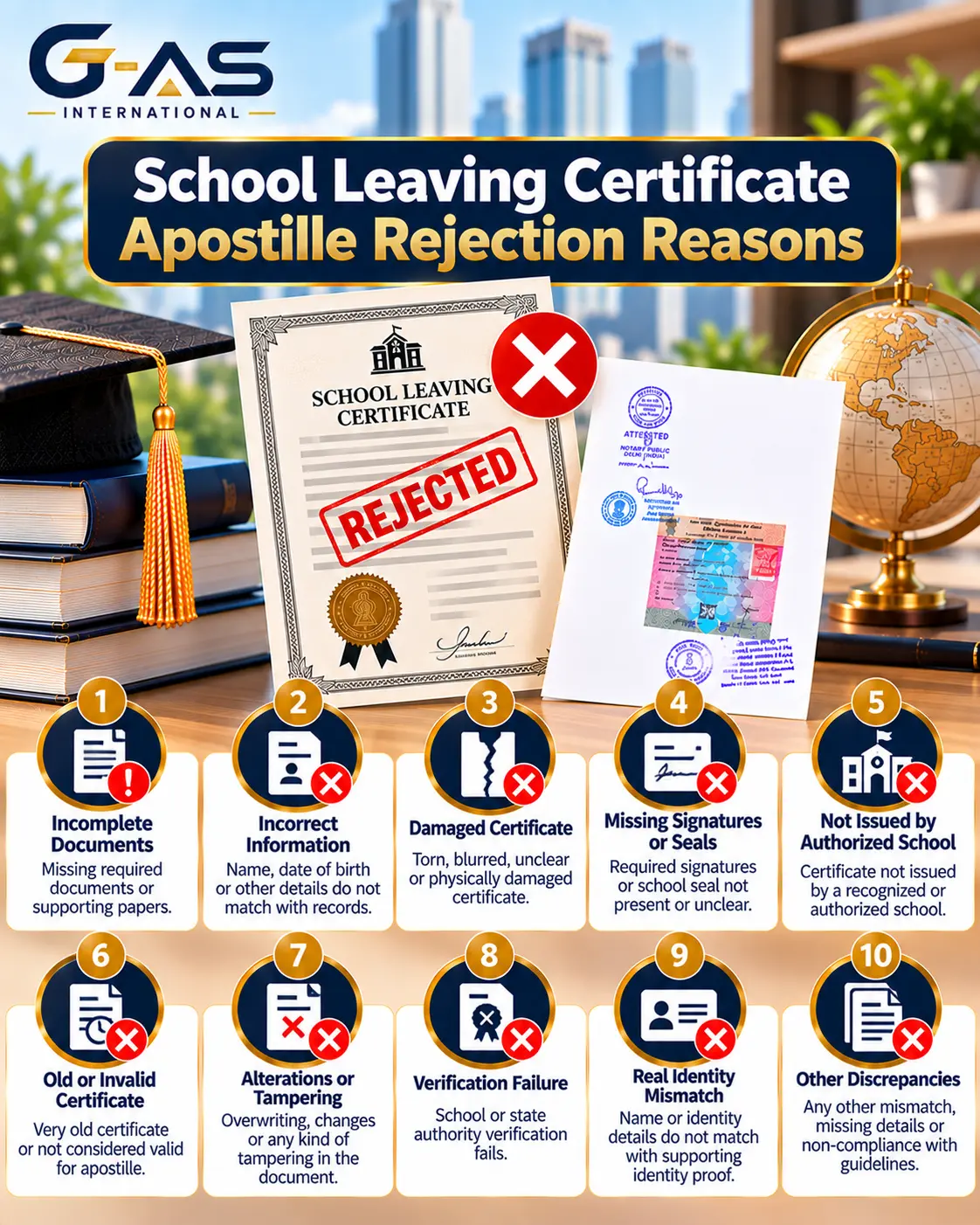
School Leaving Certificate Apostille Rejection Reasons commonly involve incorrect document routing, mismatched personal details, unclear seals or signatures, unsuitable document condition, or problems during verification. A School Leaving Certificate must meet the applicable authentication requirements before it can proceed successfully for apostille.
Understanding why School Leaving Certificate apostille gets rejected can help applicants identify errors before submission. This guide explains the common mistakes, verification problems, document-detail issues, and practical corrections that can reduce delays and help prepare the certificate properly for overseas use.
School Leaving Certificate Apostille Rejection Reasons usually involve document authenticity, incorrect details, unsuitable verification, or a processing route that does not match the certificate.
A School Leaving Certificate, Transfer Certificate, marksheet, migration certificate, and degree serve different purposes. Submission may fail when the receiving authority has requested a different academic document.
Unclear school details, missing signatures, unreadable seals, unexplained corrections, or incomplete records can prevent the issuing institution or authentication authority from confirming the certificate.
The applicable route can depend on the issuing authority, state, document category, and current government procedure. Using an unsuitable route can result in return or additional verification.
Before submission, check whether the certificate is complete, legible, genuine, and consistent with the applicant's supporting identification and overseas requirement.
The certificate should clearly show the student's details, issuing school information, authorized signature, seal where applicable, and other identifying particulars used for verification.
Check the spelling of the name, date of birth, school details, admission information, and other relevant entries against the supporting records requested for the case.
If an overseas institution also requests academic results, review the separate marksheet document checklist rather than assuming the School Leaving Certificate alone will satisfy the requirement.
Do not assume that a School Leaving Certificate, Transfer Certificate, marksheet, and degree are interchangeable. Confirm the exact document requested by the foreign authority before starting authentication.
A correct sequence helps prevent avoidable returns. The exact pre-authentication stage should be confirmed from the issuing state and applicable document procedure.
First confirm that the receiving institution actually requires the School Leaving Certificate. If a degree is also part of the academic file, its degree apostille workflow should be checked separately because document routes can differ.
Documents not handled entirely through the applicable electronic system generally require authentication through the competent state or Union Territory channel before the Ministry of External Affairs stage. The correct authority can depend on the document and issuing jurisdiction.
After the required verification is complete, the document proceeds through the authorized submission mechanism for apostille by the Ministry of External Affairs. Unverified or incorrectly authenticated documents may be returned before completion.
Apostille is intended for use under the Hague Apostille Convention framework. Applicants should confirm whether the destination and receiving organization require an apostille or another legalization procedure.
Correction time varies according to the problem, verification authority, issuing institution, state procedure, and whether a fresh certificate is required.
A minor submission issue may be resolved after corrected information is provided, while an authenticity query or certificate reissue can take longer. For comparison with another educational record, see the separate marksheet timeline guide.
School documents and higher-education records should not automatically be sent through identical channels. When a marksheet is included in the same overseas file, review its academic verification pathway independently.
Most preventable problems arise before final submission, so checking document identity, condition, routing, and overseas instructions is important.
A different spelling, incomplete name, or inconsistent personal detail may trigger additional verification when it conflicts with the records supporting the application.
Heavy damage, unreadable entries, unclear seals, overwriting, or unexplained corrections can make authenticity checks difficult and may require clarification or reissue.
Do not assume one academic procedure applies to every record. A separate marksheet authentication process may apply when academic result sheets are requested alongside the School Leaving Certificate.
A correctly apostilled certificate can still be unsuitable for an application if the overseas institution requested a different document, translation, supporting record, or legalization route.
A brief pre-submission review can identify errors before the certificate enters formal verification and reduce the chance of avoidable reprocessing.
These answers address practical questions about rejection, correction, verification, and related academic documents.
It can cause a query when the certificate details do not correspond with the supporting records. The correct solution depends on whether the difference is an actual certificate error or a documented name variation.
Minor physical wear does not automatically determine the result, but essential information, signatures, seals, and identifying details must remain verifiable. A seriously damaged or altered document may need replacement.
Treat it as a separate document requirement and verify its procedure independently. Applicants preparing multiple academic records can also review marksheet service considerations before arranging the complete document set.
Yes. When the required pre-authentication has not been completed through the applicable channel, the document may need to be redirected or verified again before proceeding to the apostille stage.
Normal differences in apostille design, size, or colour are not themselves grounds for refusal. A foreign authority may question an apostille if its origin cannot be verified or its formal elements fundamentally differ from the prescribed model.
Yes, when the issuing school confirms that the certificate itself contains an error. Correcting genuine record problems before authentication is generally safer than allowing inconsistent information to proceed into official verification.
Your Trust, Our Responsibility — That’s a G-AS Commitment.
Get Document Guidance