
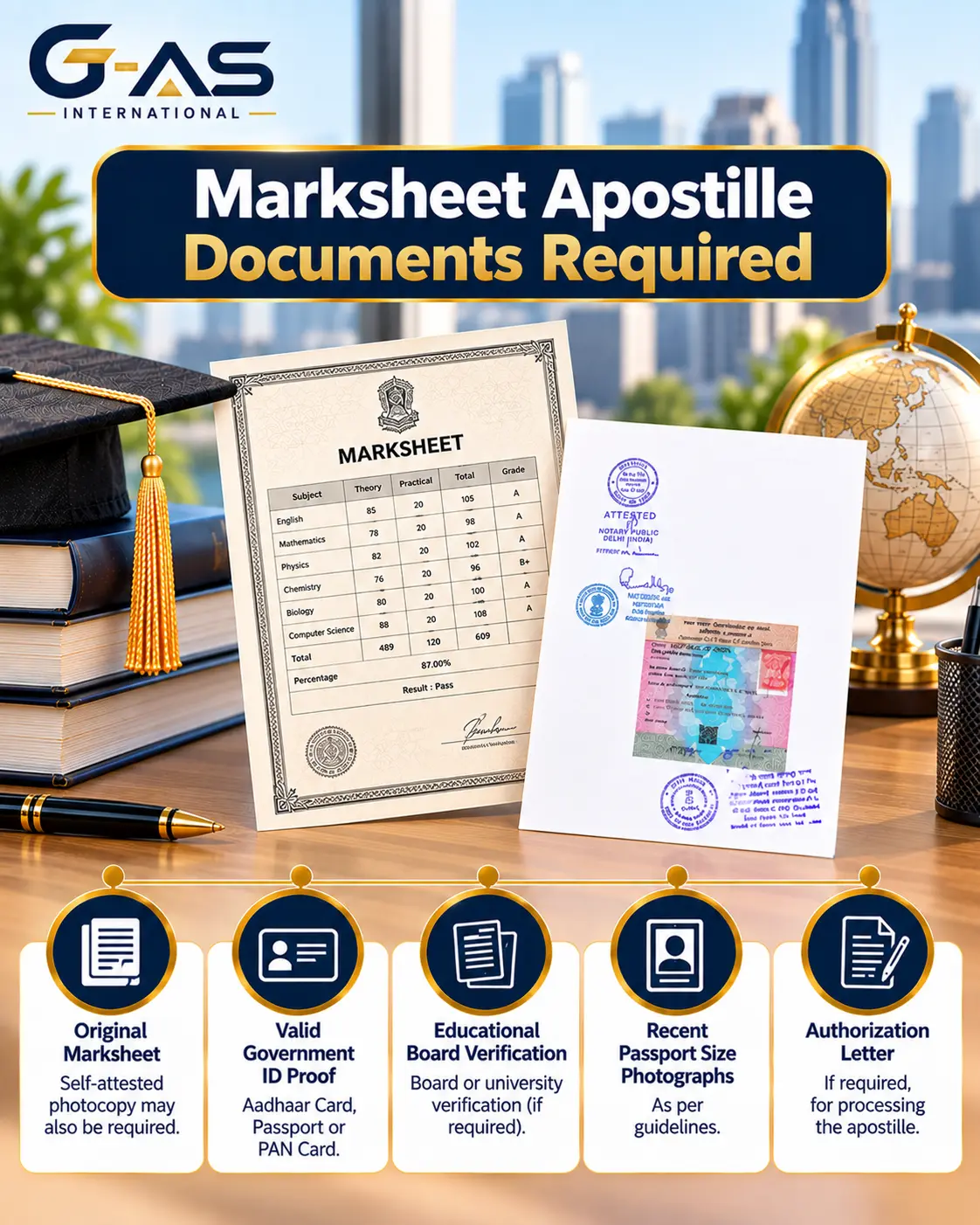
For anyone checking Marksheet Apostille Documents Required, the key documents generally include the relevant original marksheet, a photocopy of the educational document, and a copy of the applicant’s passport. Depending on the verification route, additional academic or identity records may also be requested before the Ministry of External Affairs completes the apostille.
This post explains which marksheets may be needed, such as semester-wise or consolidated records, along with supporting documents that can apply during university, state, or other authorized verification. It also covers practical checks such as matching names, document condition, and recipient-specific requirements so applicants can prepare the correct paperwork before submission.
The documents you prepare should match the purpose of overseas use and the receiving authority’s written checklist. Requirements can differ for university admissions, employment screening, credential evaluation, or immigration-related submissions.
Universities may ask for semester-wise marksheets, a consolidated marksheet, or selected academic records. Check whether the institution wants only the academic record or supporting degree documentation as well.
Employers and professional bodies may request authenticated marksheets when they need subject-level or semester-level evidence in addition to the final qualification certificate.
Evaluation bodies and immigration authorities can have their own document lists. The safest approach is to follow the recipient’s instructions before deciding which marksheets and supporting records to prepare.
A practical Marksheet Apostille Checklist starts with the exact academic record requested abroad, then adds identity and supporting documents only when the applicable route or recipient requires them.
Prepare the semester-wise, final-semester, consolidated, school-board, or university marksheet specified by the receiving authority. Do not assume that every semester must be apostilled unless the recipient asks for the complete set.
A clear passport copy is commonly requested for applicant identification and record matching. The name, date of birth, and other details should be consistent with the academic document wherever applicable.
A degree or provisional certificate may be required by the receiving institution even when the marksheet is the document being apostilled. Where a degree must also be authenticated, review the separate degree authentication sequence before preparing both records.
Papers Required for Marksheet Apostille are not identical in every case. Keep the recipient’s written checklist because issuing authority, state or union territory, digital availability, destination country, and purpose can change the supporting-document requirement.
Document preparation and authentication are connected. Review the step-by-step marksheet authentication workflow before submission so the paperwork matches the route being followed.
Confirm that an apostille is appropriate for the country where the document will be used and ask the receiving organization which marksheets it expects. This prevents unnecessary authentication of records the recipient does not need.
Educational documents generally require verification or pre-authentication through the applicable state or union-territory mechanism before MEA apostille. Where the issuing authority is integrated with e-Sanad, digital verification may be available. See the verification-route explanation for the route-selection factors.
The marksheet is checked through the relevant educational or document-issuing authority route. If the record is digitally available through an integrated issuing authority, online verification can replace parts of the physical workflow.
After the required pre-authentication is complete, the eligible document proceeds to the Ministry of External Affairs for apostille. The apostille authenticates the origin of the public document, not the academic grades or statements contained in it.
Timing depends on the verification route, issuing authority response, e-Sanad availability, and whether corrections are needed before the document reaches MEA.
There is no single universal turnaround for every marksheet. State or university verification may add time before MEA receives the document, while digitally integrated records can follow a different path. Review the turnaround factors and expected timing when planning a submission deadline.
The amount payable can vary with the submission channel, document count, verification route, delivery method, and any extra work requested outside the apostille itself. A separate service amount factors guide can be checked without mixing those details into the document checklist.
Most preventable problems come from document mismatch, incomplete academic records, unclear copies, or using a route that does not match the issuing authority.
Differences between the marksheet and identity record can trigger additional clarification. Check spelling, initials, date of birth, and other identifying details before starting verification.
Submitting only one semester when the recipient requires all semesters, or submitting all semesters when only a consolidated record is requested, can create avoidable delay and repeat work.
Faded, damaged, altered, or difficult-to-read academic records may need clarification or reissue before verification. The issuing institution should be contacted when authenticity details cannot be clearly established.
Different states, boards, universities, and digital repositories can follow different pre-authentication paths. Review the common causes of return or refusal before sending originals.
Use this final check to make sure the file matches both the receiving authority’s request and the applicable Indian verification route.
These answers clarify common doubts about Marksheet Apostille Documents Required and how the supporting paperwork can vary.
Not always. Apostille the records specifically requested by the receiving authority. Some institutions ask for every semester, while others accept a consolidated marksheet, final record, or a combination with the degree certificate.
A passport copy is commonly used for identity matching and application handling, but supporting-document requirements can vary by submission channel. Confirm the current checklist for the route you are using.
It may be possible when the document-issuing authority is integrated with the e-Sanad system and the record is available through the required digital repository or verification arrangement.
No. An apostille authenticates the origin of the public document, including the relevant signature, seal, or official capacity. It does not certify that the academic content or grades are substantively correct.
Translation is not a universal requirement for every Indian marksheet apostille. It may be needed when the receiving institution or destination authority specifically requires a translated version in an accepted language.
Only when the receiving authority requests both. A marksheet records academic performance, while a degree certificate confirms the qualification awarded, so institutions may ask for one or both depending on purpose.
Your Trust, Our Responsibility — That’s a G-AS Commitment.
Get Document Guidance