
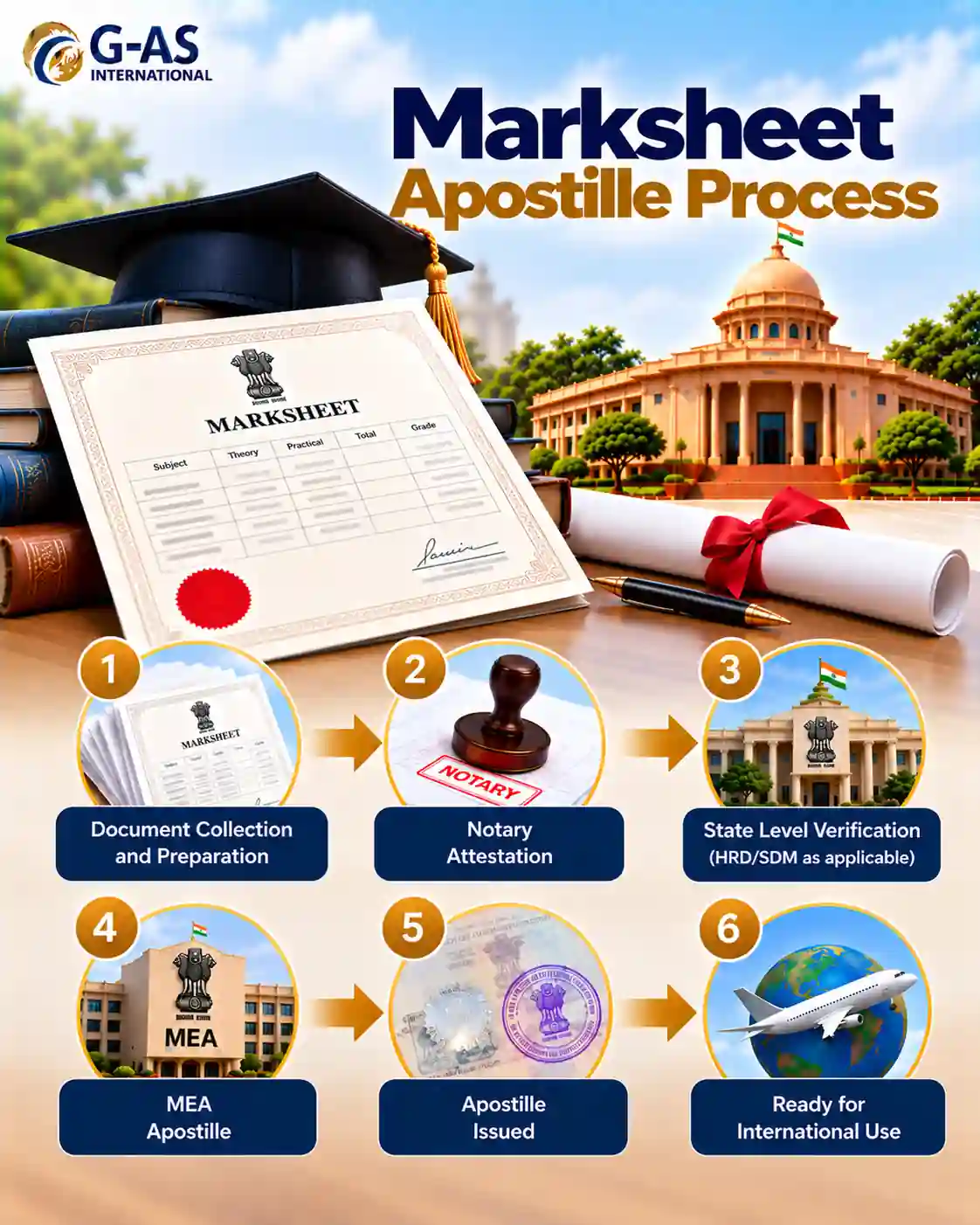
The Marksheet Apostille Process is used to authenticate an Indian academic marksheet for submission in a country that accepts apostilles under the Hague Convention. Depending on the document, issuing authority, and applicable route, pre-authentication or verification may be required before the Ministry of External Affairs (MEA) completes the apostille.
This article explains how to apostille a marksheet, including the main verification stages, possible HRD or SDM routes, and the final MEA step. It will also help readers understand why the correct route can vary and what should be checked before starting the Marksheet Apostille Procedure.
The Marksheet Apostille Process may be required when an Indian academic marksheet must be presented to an overseas authority in a country where the Hague Apostille Convention applies.
A foreign university may ask for semester-wise, year-wise, or consolidated marksheets to confirm academic history. Always follow the receiving institution’s written document list.
Credential evaluators, licensing bodies, or education authorities may request authenticated academic records when assessing qualifications obtained from an Indian board, college, or university.
Some employers and public authorities request verified educational records. The Marksheet Apostille Process should be started only after confirming that an apostille is the required legalization route.
Document requirements depend on the submission route and receiving authority, so prepare the specific marksheet set requested rather than assuming every academic record is needed.
Prepare the marksheet or marksheets that must be authenticated, ensuring the candidate name, institution, examination details, signatures, seals, and result information are legible.
For the physical MEA route, the submission normally includes the eligible document, its photocopy, and a photocopy of the applicant’s passport after required pre-authentication.
Keep the foreign recipient’s checklist available, especially when it specifies every semester, a consolidated marksheet, a degree certificate, transcript, translation, or another supporting record.
Requirements can differ by issuer and recipient. Review the supporting-document checklist before sending originals for the Marksheet Apostille Process.
The Marksheet Apostille Process depends on whether the academic record is supported through e-Sanad or must follow the applicable physical pre-authentication and authorized-submission route.
First confirm that the destination accepts apostilles and that the receiving organisation wants the marksheet apostilled. A different legalization route may apply where the Apostille Convention does not govern the document’s use.
For records not covered through e-Sanad, the Marksheet Apostille Process requires authentication by the applicable State or Union Territory authority before MEA processing. The responsible educational or authentication authority can vary by issuing jurisdiction.
After the required authentication, eligible physical documents are deposited through an authorized outsourced service provider. Individual applicants should not assume that documents can be submitted directly at an MEA counter.
MEA checks the authenticated signature of the designated authority and issues the apostille. The completed document is then collected or returned through the applicable channel. See the route-selection guidance when the pre-authentication path is uncertain.
Timing for the Marksheet Apostille Process is influenced mainly by verification before MEA submission and the route available for the academic record.
Processing after MEA receives an eligible document is separate from earlier university, board, State, or Union Territory verification. These earlier stages can materially affect the overall timeline. Review the typical turnaround factors that can influence completion.
The overall amount can vary with pre-authentication, document quantity, authorized submission, scanning, handling, and courier requirements. Instead of assuming one universal total, review the cost components for a marksheet request that may apply to the chosen route.
Most avoidable problems arise from document inconsistencies, missing authentication, or starting the wrong route for the destination or academic record.
An apostille should not be assumed for every country. Confirm the destination and receiving authority’s requirement before beginning the Marksheet Apostille Process.
Name differences, unreadable seals, missing pages, damaged records, or unclear institution details can lead to additional verification or correction before authentication moves forward.
A physical document that is not covered by the relevant e-Sanad route may require State or Union Territory authentication before it can proceed for MEA apostille.
A recipient may require semester-wise records instead of only a consolidated result, or vice versa. Check the common rejection causes before resubmitting a returned file.
A short pre-submission review can prevent avoidable corrections and help keep the selected route aligned with the recipient’s requirement.
These answers clarify common questions about the Marksheet Apostille Process and related academic-document authentication.
No. The Marksheet Apostille Process can vary according to the issuing board or university, State or Union Territory authentication arrangements, e-Sanad availability, and the overseas recipient’s requirements.
Not automatically. During the Marksheet Apostille Process, authenticate the academic records specifically requested by the receiving authority. Some recipients accept a consolidated marksheet, while others request individual semester or year-wise records.
No single pre-authentication route should be assumed for every record. The applicable authority depends on the document, issuing jurisdiction, digital availability, and current authentication route used before MEA processing.
They are both educational documents, but each should be checked separately against the recipient’s instructions. For comparison, review the degree certificate authentication sequence before assuming both records need identical handling.
MEA legalizes the document based on the signature of the designated authenticated authority. It does not take responsibility for the academic content recorded on the marksheet.
After the Marksheet Apostille Process, check that the returned marksheet is the same document submitted, the apostille details are legible, and the receiving institution does not require another document, translation, or separate credential evaluation.
Your Trust, Our Responsibility — That’s a G-AS Commitment.
Get Document Guidance