
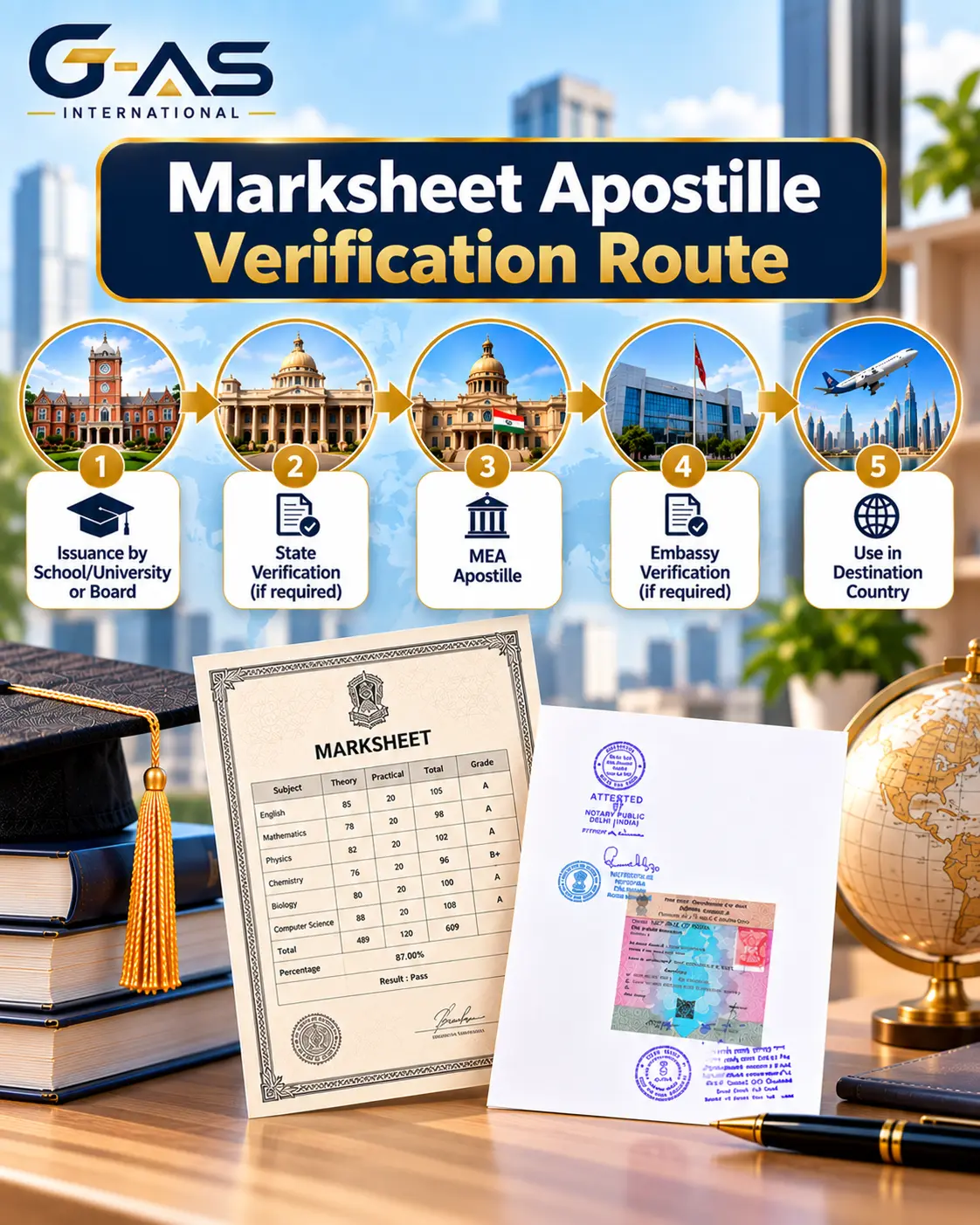
The Marksheet Apostille Verification Route explains how an Indian marksheet is authenticated before it can be apostilled for use abroad. For educational documents not covered through e-Sanad, MEA guidance provides for prior authentication by the designated State or Union Territory authority before the document proceeds for apostille.
This article explains how the Marksheet Apostille Verification Process can vary according to the issuing state, document type, and receiving authority. You will learn where state education or HRD authentication may apply, how to identify the appropriate pre-authentication authority, and what happens before the final MEA apostille stage.
The Marksheet Apostille Verification Route matters when an Indian academic record must be authenticated for overseas use and the receiving authority expects an apostille or appropriately verified educational document.
Universities and credential evaluators may request authenticated marksheets to confirm the origin of academic records. The required verification path should be checked against the institution's written requirements before processing.
Foreign employers or professional bodies may ask for authenticated academic evidence. Whether a marksheet is required separately from a degree depends on the receiving organisation and intended purpose.
When both academic records are requested, their verification paths should be checked individually. A degree may involve related authentication, but its degree-document processing route should not automatically be assumed to match every marksheet.
Document requirements can vary according to the issuing board or university, State or Union Territory, e-Sanad availability, and the authority responsible for authentication.
Names, examination details, institution name, roll or enrolment number, seals, and signatures should remain readable and consistent with the academic record originally issued.
Depending on the applicable submission channel, supporting identification or document copies may be required. State-level or issuing-authority verification can also involve additional records under its current procedure.
Some authorities may request related educational proof or issuer verification. Check the marksheet document-preparation guide before submitting original or supporting records.
The applicable route should be confirmed before submission because e-Sanad and offline pre-authentication do not apply identically to every academic issuing authority.
The route begins by identifying the marksheet issuer and determining whether the academic record can use digital verification or requires authentication through the relevant State or Union Territory channel.
First confirm that the receiving country and organisation require an apostille for the marksheet. Overseas use does not automatically mean every academic document requires identical processing.
Where the issuing authority is integrated with e-Sanad and the record is available through a supported digital repository, electronic verification can form part of the authentication route.
For records not processed through an applicable digital route, authentication may need to be completed through the designated State or Union Territory authority responsible for educational documents.
After accepted pre-authentication, the document proceeds through the authorised submission channel for MEA processing. For the wider sequence, see the complete marksheet processing sequence.
The overall timeline depends largely on how quickly the required verification is completed before the document reaches the MEA apostille stage.
Processing may take longer when a State authority, board, university, or digital repository must confirm the academic record first. Older, reissued, incomplete, or difficult-to-verify records can require additional checking.
The MEA stage begins after the required authentication has been accepted. Total turnaround can still be longer because verification, document movement, submission, and dispatch may occur outside that stage. Review the detailed timing factors when planning the submission.
For separate planning information related to overall document processing, refer to the marksheet pricing overview.
Avoidable problems commonly arise when the wrong authentication route is selected or the academic record cannot be verified cleanly against its issuing authority.
Educational authentication is linked to the recognised authority for the document and jurisdiction. Selecting an unrelated authority can lead to further verification or resubmission.
Differences in names, course titles, examination years, institution details, signatures, or seals can trigger additional verification before the document is accepted for the next stage.
HRD and SDM terminology should not be treated as automatically interchangeable for every educational record. The applicable authentication path depends on the recognised authority for the State, document, and procedure.
Unreadable seals, damaged pages, overwriting, inconsistent details, or uncertain issuer information can interrupt processing. Review the common rejection and correction causes before submission.
Use these checks before beginning authentication so the academic record enters the appropriate verification channel and avoidable routing problems are reduced.
Not in every case. The appropriate route depends on the issuing authority, State or Union Territory procedure, availability through e-Sanad, and the recognised authentication channel for that academic record.
Not as a universal rule. The authority used for authentication must be appropriate for the document and applicable procedure, so the correct route should be confirmed before submission.
It may be used when the relevant issuing authority and academic record are supported through the applicable digital repository or integration. Otherwise, an offline authentication route may be required.
An apostille authenticates the origin of a public document, such as the recognised signature, official capacity, or seal. It does not evaluate grades, academic merit, or qualification equivalency.
They can sometimes involve related educational authorities, but each document should still be checked separately because issuer, document type, digital availability, and receiving-organisation requirements can differ.
Your Trust, Our Responsibility — That’s a G-AS Commitment.
Get Document Guidance