
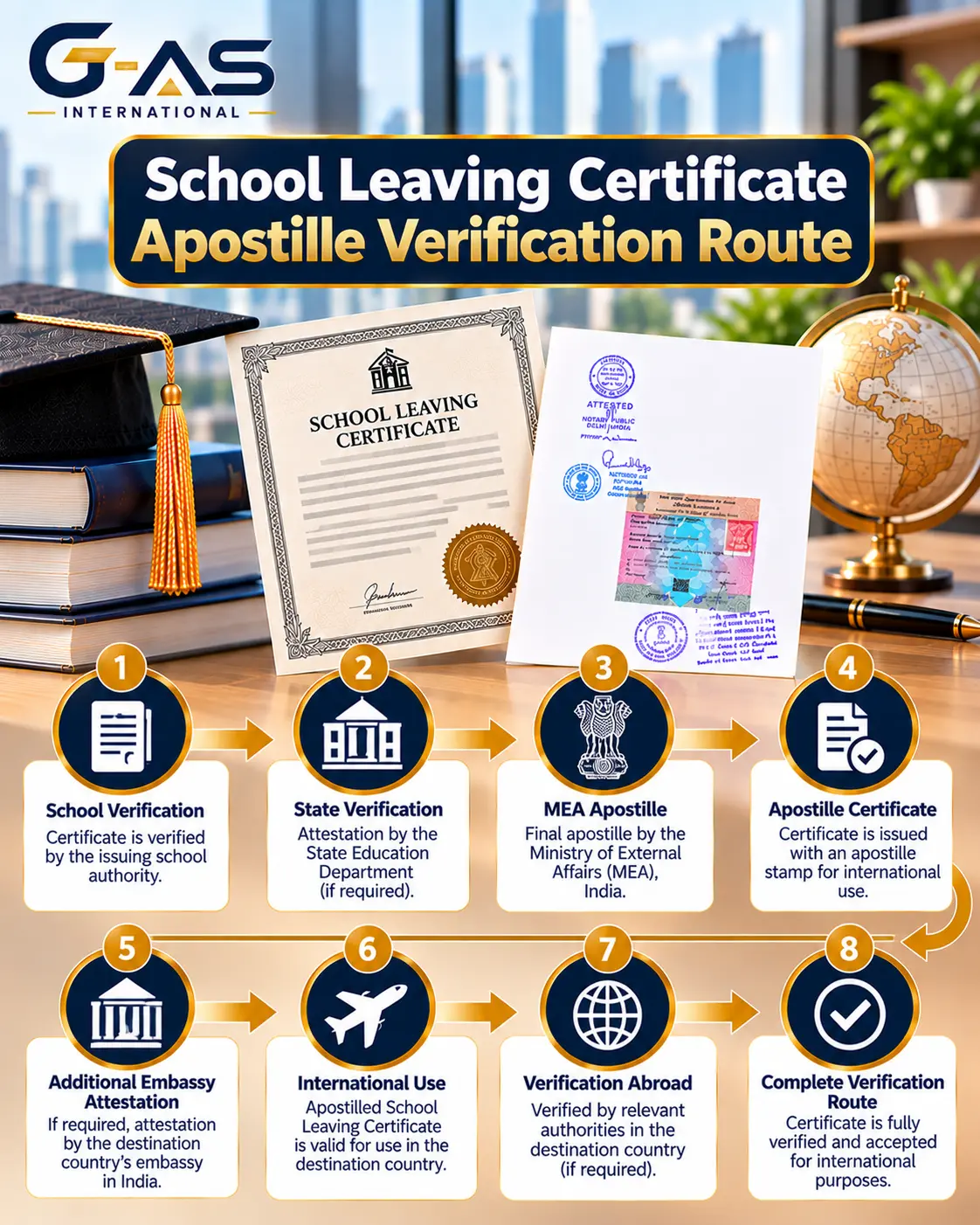
The School Leaving Certificate Apostille Verification Route explains how an Indian school leaving or transfer certificate is authenticated before it can receive an apostille for use abroad. Depending on the issuing authority and document availability, verification may involve the concerned education authority, an eligible digital verification route, or another applicable pre-authentication process before MEA apostille.
This guide explains how the School Leaving Certificate Apostille Verification Process works, when state-level or issuing-authority verification may be involved, and how HRD or other applicable authentication routes can differ. It will also help readers understand the authority checks that should be confirmed before submitting the certificate for apostille.
The School Leaving Certificate Apostille Verification Route depends on how the certificate was issued, which authority can verify it, and the authentication path applicable before the final apostille stage.
A foreign educational institution may request an authenticated school leaving certificate when checking previous study records, transfer history, or eligibility for admission.
Verification helps establish that the certificate originated from the stated educational authority before it proceeds through the applicable authentication and apostille route.
Applicants handling several academic records should remember that different documents can follow different checks. For comparison, review the degree authentication sequence before assuming one route applies to every educational certificate.
The document should be checked carefully before submission so the issuing source, certificate details, and applicable verification authority can be identified correctly.
The school or issuing authority details, student name, certificate particulars, signatures, seals, and other identifying information should remain clear and readable.
Confirm whether the document was issued by a school, education board, department, or another authorised educational body because this can affect verification.
Additional academic records should be prepared only when required by the relevant authority or overseas recipient. A separate mark sheet submission checklist can help when mark sheets are also part of the file.
Requirements can vary according to the issuing authority, available verification channel, state-level procedure, document format, and instructions of the organisation receiving the certificate abroad.
The verification sequence should be determined from the certificate's issuing source rather than assuming that every educational document follows an identical route.
First confirm which school, board, department, or educational authority issued the certificate. This establishes where its origin and authorised signature can be verified.
The next step is to establish whether the certificate can use an available digital verification channel or requires authentication through the appropriate educational or state-level authority.
The responsible authority checks the relevant document details and confirms the certificate through the route applicable to its issuing source before further authentication proceeds.
Once the required preceding verification has been completed, the eligible document can proceed through the applicable Ministry of External Affairs apostille channel. Educational records such as mark sheets may follow their own authentication workflow.
Completion can vary because verification depends on the issuing authority, document condition, record availability, and response required from the relevant department.
Processing may take longer when older school records must be located, certificate details require clarification, the issuing authority must respond manually, or an incorrect verification channel was initially selected. Similar variables are explained in the mark sheet turnaround factors for related academic records.
The overall route can differ according to the certificate issuer, the state involved, digital record availability, required pre-authentication, and whether additional verification is requested before the final stage.
Verification problems usually arise when document details cannot be matched confidently with the issuing authority or the wrong authentication route is followed.
Sending the certificate through an unsuitable authority can result in additional checks or require the verification stage to be restarted correctly.
Differences in names, dates, institution details, certificate references, signatures, or seals can lead to clarification requests before verification can continue.
Damaged, overwritten, incomplete, or difficult-to-read details can interfere with verification because the authority must be able to identify the document reliably.
Similar problems can affect other educational documents. The common mark sheet verification errors provide useful context when several academic records are being prepared together.
Review the certificate and receiving requirements before submission so avoidable route errors can be identified at the beginning.
No. The appropriate route can depend on the issuing authority, state-level procedure, document format, available verification system, and the authentication required before apostille.
Not as a universal rule. The applicable pre-authentication route should be determined from the issuing authority and current procedure rather than selecting an authority only by document category.
They should not automatically be treated as one document. Each academic record may need to satisfy the verification and authentication requirements applicable to its own issuing source.
Yes. Different educational records can involve different requirements, timelines, and administrative considerations. When mark sheets are included, the mark sheet planning details can be reviewed separately.
Confirm the issuer, document condition, student details, signatures, seals, destination requirements, and applicable verification authority before starting the School Leaving Certificate State Verification for Apostille.
Correct routing helps ensure that the certificate is presented to an authority capable of verifying its origin before the document moves to the next authentication stage.
Your Trust, Our Responsibility — That’s a G-AS Commitment.
Get Document Guidance