
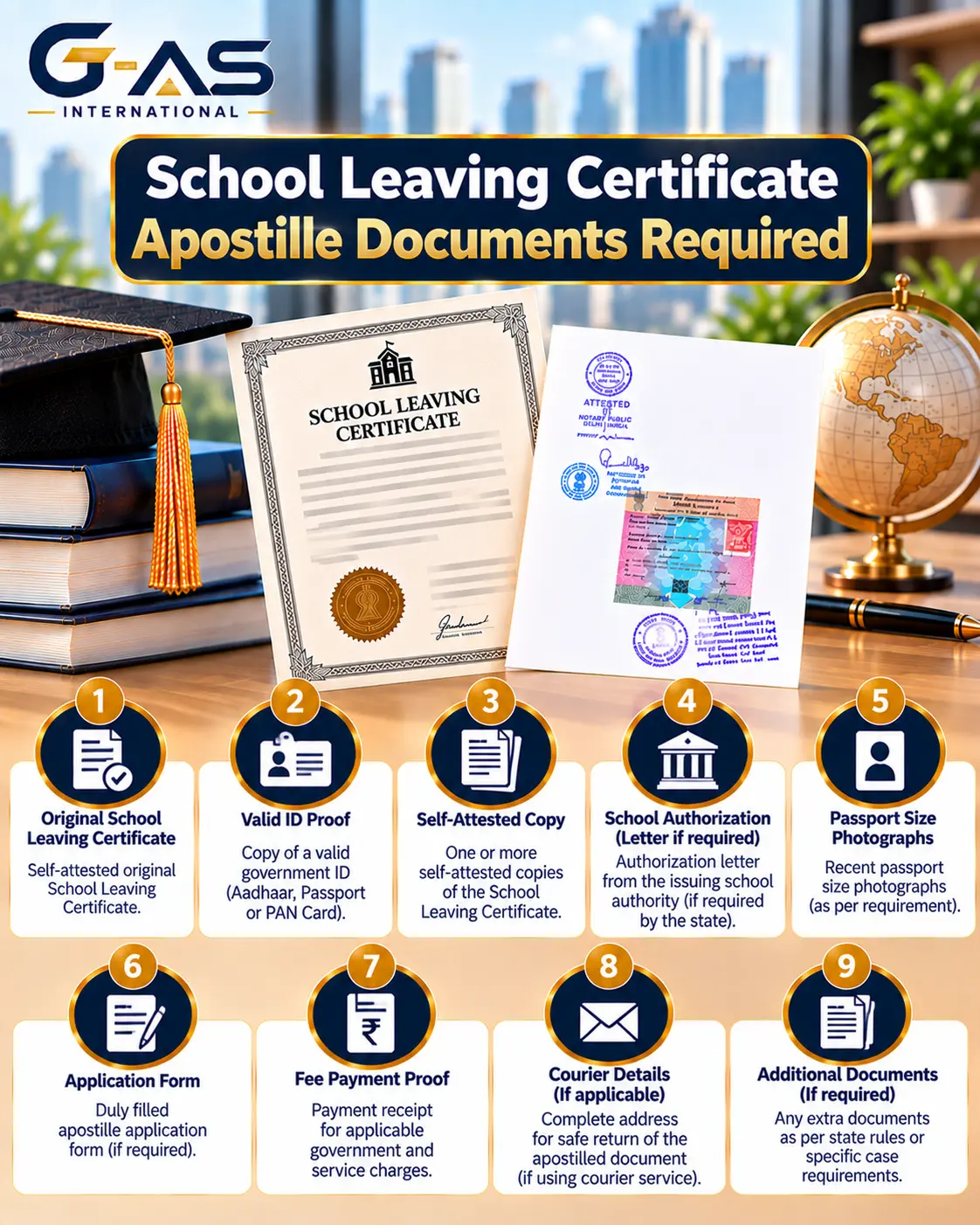
Understanding Bonafide Certificate Apostille Documents Required helps you prepare the correct paperwork before beginning the apostille process in India. A bonafide certificate generally confirms a person’s association with a school, college, university, or workplace, while supporting identity documents may also be required during verification.
This post explains the key documents for Bonafide Certificate Apostille, how requirements can differ depending on whether the certificate is educational or employment-related, and what to check before submission. It will also help you understand supporting-document requirements and avoid delays caused by incomplete paperwork.
Preparing the correct supporting papers before submission helps prevent avoidable verification questions. Requirements can vary according to the certificate issuer, purpose, processing route, and destination where the document will be used.
A bonafide certificate issued by a school, college, or university may be requested as supporting evidence of current or previous association with an educational institution.
Some applicants use a bonafide certificate as supporting documentation for overseas applications. The receiving authority should be checked first because acceptance requirements can differ by country and purpose.
If other academic records are being prepared at the same time, remember that each document may follow its own verification procedure. For example, review the process used for a transfer certificate separately rather than assuming both records follow an identical route.
For an offline Indian apostille submission, the core papers generally include the eligible certificate and supporting copies required for identification and processing.
The certificate should be properly issued by the relevant institution or organisation and be suitable for the applicable authentication route. Plain photocopies are not themselves legalised by MEA.
Keep a clear photocopy of the submitted document available with the application papers, especially when using the physical submission procedure.
A photocopy of the applicant's passport is part of the supporting documentation specified for the physical MEA apostille and attestation submission route.
Additional supporting records may be requested depending on the issuing authority, verification method, purpose, or destination. Confirm the applicable route before sending original documents.
Having the correct papers is only one part of the procedure. The certificate must also follow the verification and submission route applicable to that document.
Check the holder's details, issuing institution, signatures, seals, and legibility before starting. A document that contains errors or cannot be linked to a verifiable issuing authority may require correction first.
The route depends on how the bonafide certificate is classified and issued. Documents not processed through an eligible digital workflow may require authentication through the appropriate State or Union Territory channel before MEA processing. See the certificate verification route for a more focused explanation.
Where pre-authentication is required, the competent authority verifies the document or the signature of the issuing official before it proceeds to the Ministry of External Affairs apostille stage.
After applicable verification is complete, the document proceeds through the authorised submission channel for apostille. The step-by-step processing sequence explains the procedure in more detail.
Document preparation and verification stages can influence how smoothly an application moves through the overall procedure.
Overall turnaround can depend on document verification, State or Union Territory authentication where applicable, record availability, submission method, holidays, and movement between authorities. Review the turnaround factors for this certificate when planning a deadline-sensitive submission.
The required-document checklist should remain focused on paperwork and verification. Other administrative considerations are better reviewed independently through the separate application-planning guide.
Most document-preparation problems can be identified before submission by checking the certificate and supporting papers carefully.
Differences in names or other important details between the certificate and supporting identification can create verification questions and should be resolved before submission where necessary.
A certificate with missing, unreadable, or difficult-to-verify signatures, seals, institutional details, or issuance information may require clarification or correction before it can proceed.
Submitting the certificate through an unsuitable verification channel can interrupt processing. The route should be identified from the document type, issuer, and applicable authority requirements.
Incomplete copies or identification papers can cause avoidable problems. The dedicated guide to common filing problems and corrections explains related issues in greater detail.
Use this final check to confirm that the certificate and supporting papers are ready for the applicable submission route.
For the physical MEA route, the principal submission generally includes the original document or eligible true copy, a photocopy of the document, and a photocopy of the applicant's passport.
MEA states that it does not legalise ordinary photocopies. The applicable procedure uses the original document or an eligible true copy, together with supporting photocopies required for submission.
No. The supporting papers and verification route can vary according to the issuing institution, document classification, available verification method, intended purpose, and receiving authority abroad.
Not necessarily. Applicants should first identify how the certificate was issued and which authority can verify it rather than assuming one State, HRD, SDM, or digital route applies universally.
Yes. Apostille is intended for use under the Hague Apostille Convention framework, while other destinations or receiving authorities may have different document legalisation or supporting-document requirements.
Review the certificate for accuracy and legibility, retain a clear scan or copy, confirm the applicable verification route, and make sure all required supporting papers are ready before dispatch.
Your Trust, Our Responsibility — That’s a G-AS Commitment.
Get Document Guidance