
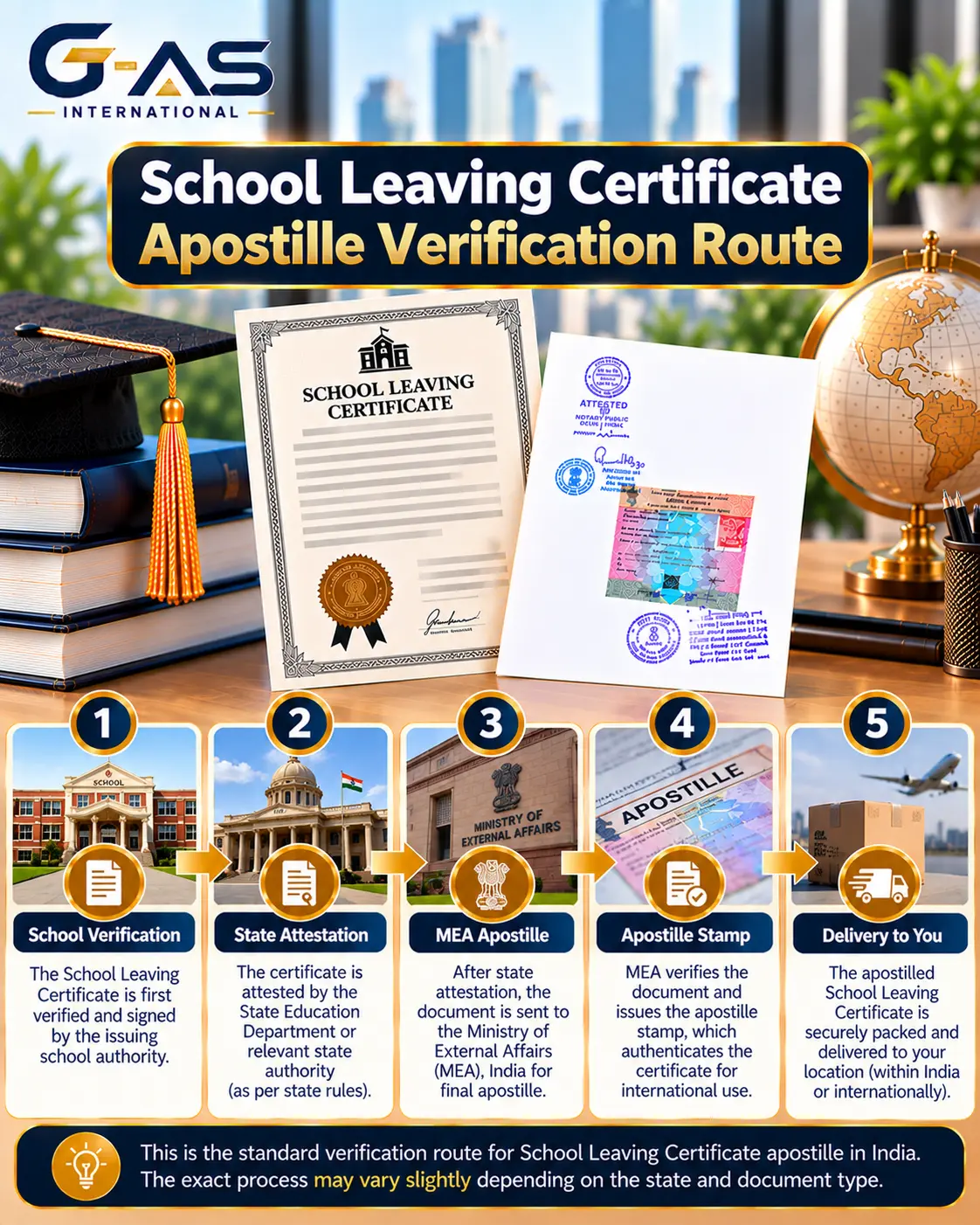
The Bonafide Certificate Apostille Verification Route explains how a bonafide certificate is authenticated before receiving an apostille for overseas use. In India, educational documents generally require pre-authentication by the designated education authority of the State or Union Territory where the document was issued before submission for MEA apostille.
This article explains how to identify the appropriate verification authority, how state/HRD and SDM-related routes differ, what pre-authentication checks may apply, and how the document proceeds to MEA apostille. It will also clarify the Bonafide Certificate Apostille Verification Process so applicants can understand the route before submitting their documents.
The Bonafide Certificate Apostille Verification Route becomes relevant when a bonafide certificate issued in India must be authenticated for use in a country where an apostille is accepted.
A bonafide certificate issued by a school, college, university, or other educational institution may require authentication through the designated State or Union Territory education authority before apostille processing.
A foreign university, employer, immigration authority, or another receiving organisation may request an apostilled bonafide certificate to establish the authenticity of the Indian document.
Applicants should confirm whether the receiving authority actually requires the bonafide certificate or another educational record. For a different certificate type, review the related transfer-certificate procedure.
The verification authority can depend on how the certificate is classified, where it was issued, and the authentication arrangements available in the relevant State or Union Territory.
The certificate should contain clear issuing-institution details and be suitable for verification by the authority responsible for authenticating the document.
Supporting documents can vary by submission route and authority. Check the applicable document checklist for bonafide certificate apostille before submitting the certificate.
Names, institution details, signatures, seals, and other identifying information should be clear enough for the relevant authority to verify the certificate's origin.
The official MEA framework requires documents to be pre-authenticated by the designated authority of the State or Union Territory concerned. The exact submission route can therefore vary instead of following one universal procedure.
The Bonafide Certificate Apostille Verification Process generally moves from document classification and State-level authentication to final apostille processing by the Ministry of External Affairs.
First identify who issued the bonafide certificate and whether it is being treated as an educational document. This determines which State or Union Territory authority should handle pre-authentication.
For educational documents, the MEA framework requires authentication by the designated education authority of the State or Union Territory from which the document originates before it proceeds for apostille.
Where the relevant issuing authority or State system is integrated with e-Sanad and the document is available for digital verification, the authentication and apostille workflow may be handled electronically through the supported system.
After the required pre-authentication or supported digital verification is completed, the document can proceed for MEA apostille. For a broader sequence of these stages, see the step-by-step apostille procedure.
The terms HRD and SDM are frequently encountered when applicants research pre-authentication, but they should not automatically be treated as interchangeable routes for every bonafide certificate.
For an educational bonafide certificate, the official MEA procedure identifies the designated State or Union Territory education authority as the pre-authentication authority. The department name and practical procedure may vary between jurisdictions.
Some processing channels describe SDM authentication as an alternative route in particular circumstances. Before using it, confirm that the route is appropriate for the document, issuing authority, apostille channel, and intended foreign use.
Processing depends on both the pre-authentication stage and the final apostille stage, so the complete duration should not be estimated from MEA processing alone.
State-level verification can add time before the document reaches MEA. The MEA Citizen's Charter states that apostille processing is usually completed within seven working days after the document is received by MEA, subject to proper submission and verification. See the separate processing-time guide for further planning information.
The Bonafide Certificate Apostille Verification Route is primarily about identifying the correct authentication authorities and sequence. For separate current charging information, refer to the bonafide apostille fee information page.
Verification problems usually arise when the document, authority, or chosen authentication route does not match the requirements of the actual certificate.
Submitting an educational bonafide certificate through an unsuitable authentication route can result in additional verification or a request to complete the correct pre-authentication first.
If the issuing institution, signature, seal, or other certificate details cannot be verified properly, the authority may require clarification or supporting verification.
The appropriate pre-authentication route should be confirmed before submission rather than assuming that every educational certificate can automatically follow the same alternative route.
Differences in names, institution information, dates, or supporting records can interrupt verification. Review these and other common rejection and correction issues before submission.
A short authority and document check before submission can prevent the certificate from being routed through an unsuitable verification process.
For an educational document, the MEA framework requires pre-authentication by the designated education authority of the State or Union Territory concerned before final apostille processing.
Not necessarily under a department specifically named “HRD.” The competent office and department name vary by State or Union Territory, so applicants should identify the designated authority responsible for educational-document authentication.
An SDM-based route may be described for some cases, but it should not be assumed to replace the designated State or UT education authority in every situation. Confirm acceptance before proceeding.
It may be possible where the issuing authority or relevant State system supports digital verification through e-Sanad. Availability depends on integration and the document's accessibility through an eligible digital workflow.
No. Although the MEA requires appropriate pre-authentication, the responsible department, verification procedure, and submission arrangements can differ between States and Union Territories.
Once the required pre-authentication is complete, the certificate can proceed through the applicable submission channel for MEA apostille, provided the document and verification satisfy the required processing conditions.
Your Trust, Our Responsibility — That’s a G-AS Commitment.
Get Document Guidance