
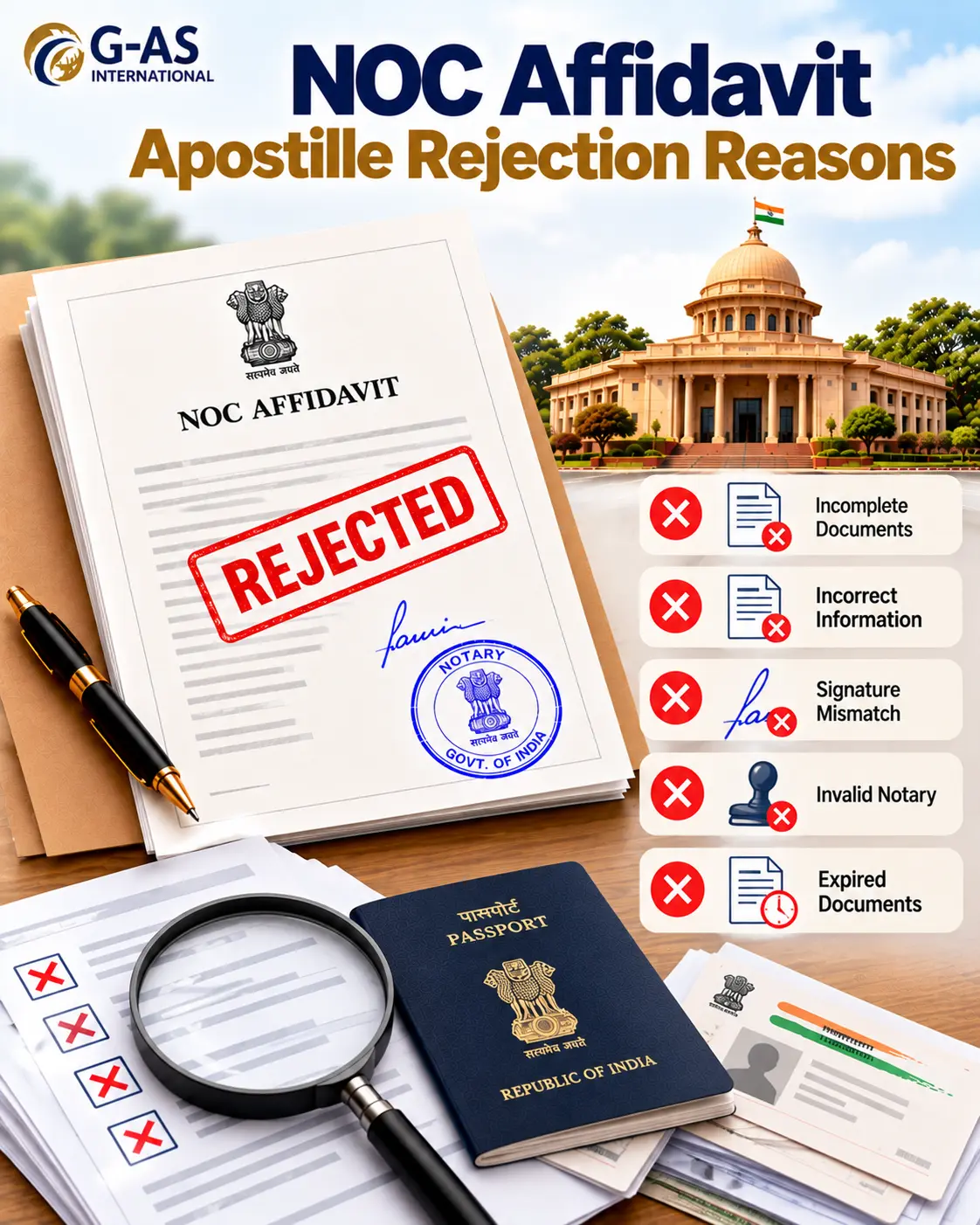
NOC Affidavit Apostille Rejection Reasons often relate to document inconsistencies, incorrect authentication, missing supporting records, improper document format, or using the wrong legalization route. Because affidavits can be apostilled for use in Hague Convention countries, the document must follow the applicable authentication requirements before submission.
This guide explains why NOC affidavit apostille applications can face objections, the common mistakes applicants should check, and practical ways to reduce avoidable problems. It will also clarify issues involving names, signatures, document completeness, authentication sequence, originals versus copies, and destination-country requirements.
Understanding NOC Affidavit Apostille Rejection Reasons is especially important when a no-objection declaration will support an overseas application where the receiving authority expects precise consent, consistent identity details and a properly authenticated document.
Parental, spousal or family consent declarations may face objections when the person giving consent, the purpose of the NOC or supporting relationship details are unclear.
Property, inheritance or legal submissions can require the affidavit to identify exactly who is giving consent, their connection to the matter and what action they do not oppose.
Using the wrong affidavit category can create avoidable questions. A birth-related affidavit workflow, for example, serves a different documentary purpose and may require different supporting evidence.
Many NOC Affidavit Apostille Rejection Reasons can be identified before submission by checking the affidavit and records supporting the declaration.
The affidavit should clearly identify the declarant, person receiving consent, specific purpose, relevant dates and scope of the no-objection statement, with the required execution or notarisation completed correctly.
Names, dates, passport details, relationships and other material information should be consistent with supporting records. Unexplained differences can lead to additional checking or correction.
Supporting papers depend on the purpose and overseas recipient. Review the relevant document preparation checklist instead of assuming the same papers apply to every NOC affidavit.
An apostille authenticates the origin of the relevant public or officially authenticated document; it does not independently confirm that the NOC wording or supporting evidence satisfies every overseas authority.
Choosing the wrong sequence is one of the practical NOC Affidavit Apostille Rejection Reasons. The applicable route should be confirmed before the document reaches the final apostille stage.
Confirm who must give the no-objection declaration, what action is being permitted and whether the foreign recipient requires particular wording, supporting records or a prescribed format before signing.
The affidavit should be signed and authenticated in the manner applicable to the document. For broader context, review the general affidavit authentication sequence before proceeding.
Indian personal documents may require the applicable State or Union Territory authentication route, while eligible records can follow supported digital verification channels. Check the pre-authentication route guide for the relevant pathway.
Once the required prior verification is complete, the eligible document can proceed through the authorised channel for Ministry of External Affairs apostille processing. The correct NOC affidavit workflow explains the sequence in more detail.
A correction or repeat verification can extend the overall timeline even when the final apostille stage itself is straightforward.
Incorrect wording, identity differences, unclear notarisation, missing prior verification or a document that cannot be readily authenticated may require correction before processing continues. Review the separate turnaround stages and delay factors when planning an overseas deadline.
If the affidavit must be prepared again or sent through another verification stage, additional submission arrangements may apply. The page covering submission-related service variables can be reviewed separately without mixing those details with rejection checks.
Most preventable NOC Affidavit Apostille Problems involve the document itself, inconsistent supporting information or an unsuitable authentication route.
Different spellings, initials, dates, passport information or relationship details can create uncertainty about the parties involved and may require documentary clarification before the application proceeds.
A vague NOC that does not identify the declarant’s capacity, the person concerned, the specific action or the intended purpose may be questioned by the receiving authority.
Missing signatures, unreadable official seals or sending the document through an unsuitable verification route can interrupt authentication before the affidavit becomes eligible for the required final stage.
An apostilled affidavit can still be unsuitable if the overseas recipient requires different wording, additional evidence, translation or another document instead of the NOC submitted.
A short pre-check can address many NOC Affidavit Apostille Rejection Reasons before the original enters the authentication process.
These answers address practical questions about NOC Affidavit Apostille Rejection Reasons and correcting preventable submission errors.
Common causes include incomplete execution, inconsistent identity information, unclear seals or signatures, missing applicable pre-authentication, or use of a verification route that does not match the document.
Yes. A material difference between the affidavit and passport or supporting records may require correction or supporting evidence, particularly when the difference makes the identity of a party uncertain.
No. Apostille authentication concerns the origin of the public document or authenticated signature and official capacity. The receiving authority separately evaluates the declaration’s contents and suitability.
Depending on the error, the affidavit may need correction, fresh execution or notarisation and repetition of the applicable authentication stages. Altering an already authenticated original should be avoided.
No. The route can depend on how the document was executed, the applicable State or Union Territory procedure, available digital verification and the requirements of the receiving authority.
Confirm the destination requirement first, prepare precise consent wording, verify identity details, use the correct supporting records and determine the applicable authentication route before submitting the document.
Your Trust, Our Responsibility — That’s a G-AS Commitment.
Get Document Guidance