
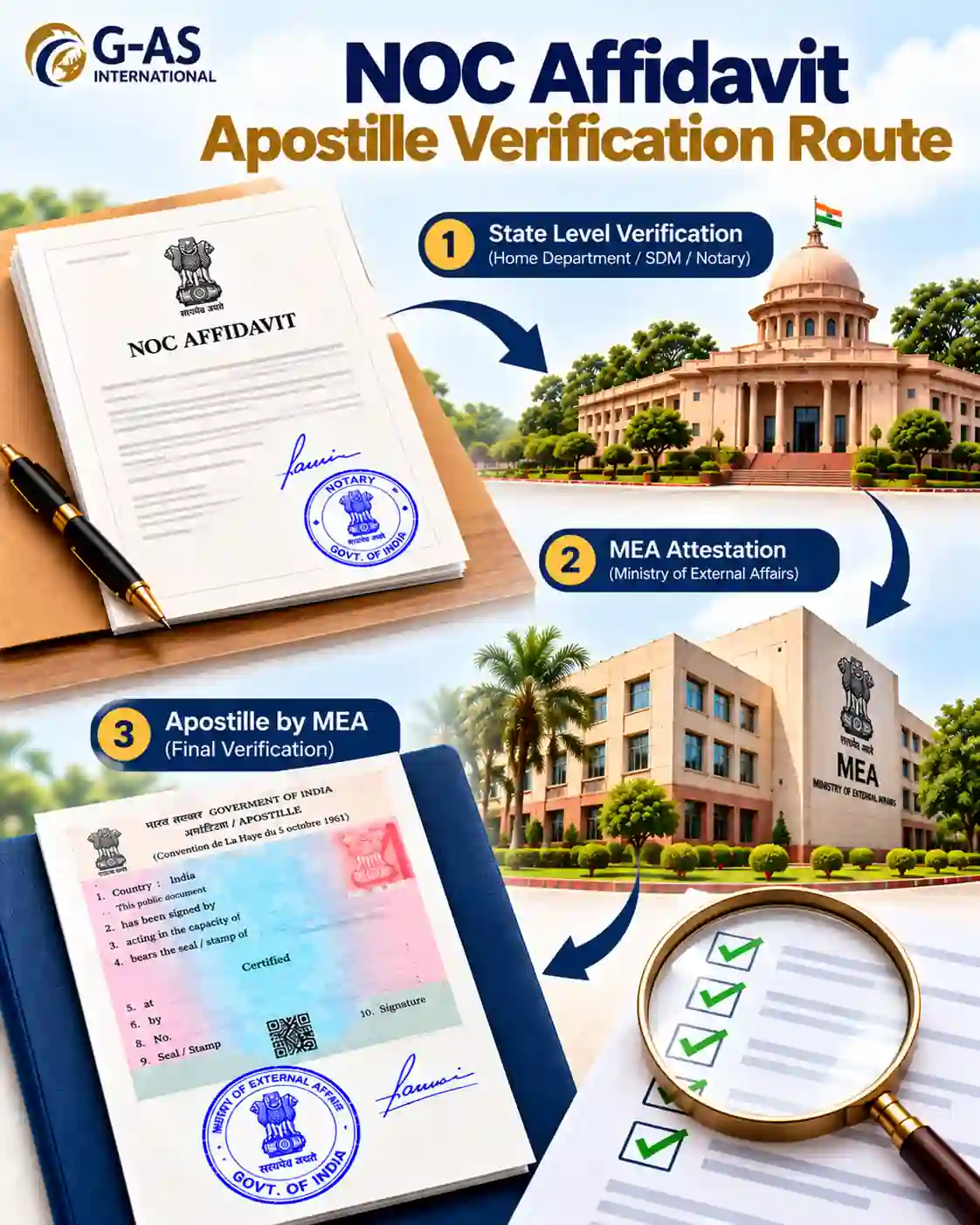
The NOC Affidavit Apostille Verification Route explains how a notarized no-objection affidavit is authenticated in India before receiving an MEA apostille for use in a Hague Convention country. As an affidavit is treated as a personal document, pre-authentication generally goes through the designated State/UT authority, such as the Home/GAD or an applicable SDM route, rather than the HRD route used for educational records.
This article explains why notarization comes first, how state verification fits into the process, when SDM or Home Department authentication may apply, and how the document proceeds to MEA apostille. It will also help readers understand the authority checks involved and why the correct verification route can depend on the document and destination requirements.
The NOC Affidavit Apostille Verification Route matters when a notarised no-objection declaration from India must be authenticated for use before a foreign authority that accepts apostilles.
A foreign authority may request a notarised NOC for parental consent, relocation, family documentation, property matters, or another declared permission. The recipient should confirm the exact document format before authentication begins.
For a personal document outside an eligible digital route, the competent State or Union Territory authority may need to authenticate the relevant official signature before the document can move to MEA processing.
The correct verification path should be matched to the document’s execution and jurisdiction. For broader context, compare the general affidavit authentication workflow before assuming every affidavit follows the same path.
Document readiness can affect the NOC Affidavit Apostille Verification Route, so the affidavit and supporting submission papers should be checked before pre-authentication.
Check the deponent’s name, declaration, signatures, date, notarial seal, and other execution details. Avoid unclear corrections or incomplete notarisation that could interrupt verification.
The physical MEA route can require the document being processed plus supporting copies used by the authorised submission channel. Review the document readiness checklist before dispatch.
Confirm which authority can pre-authenticate the affidavit for the applicable jurisdiction. HRD authentication is associated with educational documents, not the ordinary personal-document route for a notarised NOC affidavit.
Within the NOC Affidavit Apostille Verification Route, apostille authenticates the relevant public or official signature and seal; it does not confirm that every statement inside the NOC is true or sufficient for the foreign procedure.
The NOC Affidavit Apostille Verification Route normally moves from document preparation to the applicable pre-authentication stage and then to MEA apostille processing.
Before execution, confirm that the destination uses the Hague Apostille Convention and that the receiving authority accepts a notarised NOC affidavit for the intended purpose. Also check any wording or translation requirement.
Execute and notarise the affidavit correctly, then identify the competent pre-authentication authority. For documents not covered by e-Sanad, MEA guidance requires prior authentication through the designated State or Union Territory channel.
HRD is generally relevant to educational records. A personal affidavit should instead follow its applicable personal-document verification route; an SDM-based route should be used only where it is accepted for that document and submission channel.
Once the required verification is complete, the NOC Affidavit Apostille Verification Route proceeds through the authorised MEA channel. The step-by-step NOC affidavit procedure explains the wider sequence around notarisation, verification, and final apostille.
Timing for the NOC Affidavit Apostille Verification Route depends on document readiness, the pre-authentication authority, submission channel, and whether additional checks are required.
The MEA stage is only one part of the overall timeline. Notarisation, State or Union Territory verification, corrections, authorised submission, and return delivery can add time. Review the detailed timing factors when planning submission.
The jurisdiction, affidavit purpose, authentication method, delivery method, and need for supporting records can change the practical handling of a case. For separate budgeting information, see the overall cost factors.
Most avoidable problems in the NOC Affidavit Apostille Verification Route arise before MEA processing, when document details or the pre-authentication path are incorrect.
Sending a personal affidavit through an educational-document route or an unaccepted local channel can stop processing and require the document to return to an earlier stage.
Name differences, vague consent wording, missing signatures, unclear notarial particulars, or unsupported corrections can create verification questions before the document reaches the apostille stage.
In the NOC Affidavit Apostille Verification Route, an apostille confirms the origin of the relevant public or official act, not the truth or legal sufficiency of the NOC. The foreign recipient may still assess the declaration separately.
Unreadable seals, unsuitable copies, missing prior authentication, or destination mismatches can create rework. Check the common correction and rejection issues before submission.
A short pre-check can keep the NOC Affidavit Apostille Verification Route aligned with the document, jurisdiction, and overseas purpose.
These answers clarify common questions about authority selection, verification, e-Sanad, and related affidavit routes.
No. The NOC Affidavit Apostille Verification Route can vary with the affidavit’s execution, jurisdiction, available digital verification, and the requirements of the competent authority or authorised submission channel.
Only where the relevant document and verifying or issuing authority are supported through an integrated digital repository. Otherwise, the applicable physical pre-authentication and authorised submission process continues.
Not necessarily. Both are affidavits, but their purpose and supporting evidence differ. Compare the birth-declaration apostille workflow when dealing with a birth-related sworn statement.
No. MEA legalises on the basis of the authenticated signature of the designated authority and does not take responsibility for the document’s contents. The receiving authority decides how the declaration is evaluated.
Check that the apostille details are readable and correspond to the document. Where needed, the apostille or attestation number can be checked through the official MEA e-Register.
Your Trust, Our Responsibility — That’s a G-AS Commitment.
Get Document Guidance