
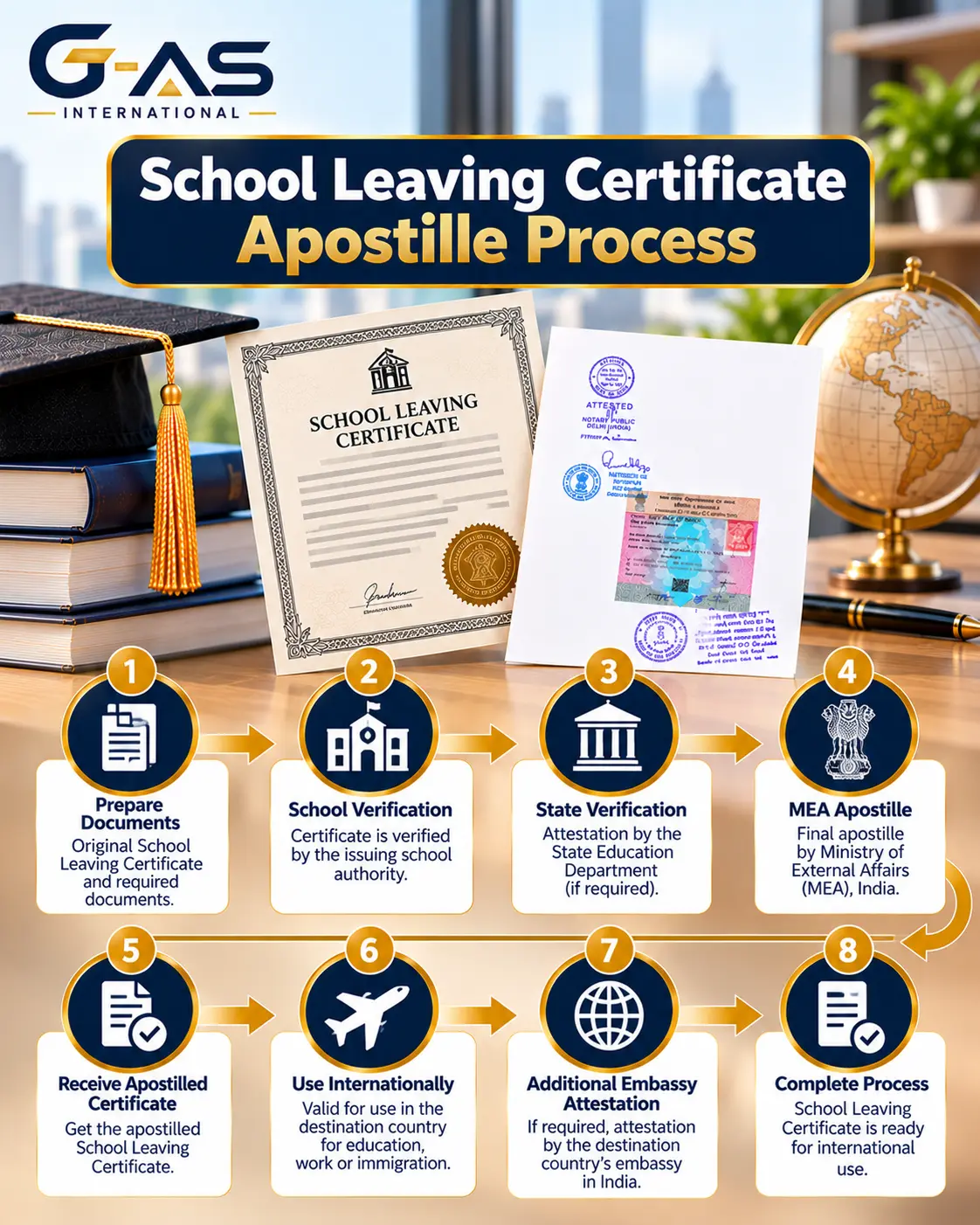
The School Leaving Certificate Apostille Process authenticates an Indian school leaving certificate for use in a country that accepts apostilles under the Hague Convention. The procedure generally involves the required document authentication route followed by apostille certification from India’s Ministry of External Affairs (MEA).
The exact route can depend on the certificate’s issuing authority, state-level requirements, and the destination where it will be submitted. This guide explains the School Leaving Certificate Apostille Procedure, document checks, authentication stages, MEA apostille steps, and practical points to verify before starting.
A school leaving certificate may need apostille when it must be presented abroad as an authenticated school record. The receiving organisation decides whether an apostille is required.
A foreign school may request an authenticated leaving certificate when checking a student’s previous institution, completion status, or eligibility for admission.
Some overseas applications may ask for supporting educational records. Confirm whether the school leaving certificate itself requires apostille before beginning the process.
The certificate may also be requested with marksheets or other educational records. Related academic documents should be treated separately when the receiving authority asks for them.
Requirements can vary by issuing authority, verification route, and destination. Check the certificate and any supporting papers before submission.
Use the certificate issued by the authorised school or educational institution, with the student details, issuing authority, seal, and signature clearly readable.
Prepare any identity or document copy required by the applicable submission route. Requirements should be confirmed before sending the original certificate.
If marksheets are also required, review the supporting documents commonly checked for marksheets because each academic record can have its own submission requirements.
Names, dates, school details, seals, and signatures should be clear and consistent. Correct significant errors with the issuing authority before starting authentication.
The School Leaving Certificate Apostille Process should follow the verification route applicable to the document before final apostille processing.
Confirm that the destination accepts apostille and that the receiving organisation specifically needs the school leaving certificate. Check the document for readable student details, school information, seal, and authorised signature.
The correct pre-authentication route can depend on the issuing state, authority, and available verification method. Compare this with the verification route used for related marksheet records when both documents are being prepared.
Where the applicable route requires prior educational or state-level authentication, complete that stage before the document proceeds for apostille. Do not assume that every certificate follows an identical path.
After the required verification is complete, the eligible certificate can proceed for apostille through the applicable Ministry of External Affairs channel. The authentication sequence used for degree certificates can help readers understand how separate educational records are handled independently.
There is no single turnaround that applies to every School Leaving Certificate Apostille Process because verification can vary before the final stage.
Completion depends on how quickly the issuing or designated authority can verify the certificate, whether corrections are needed, the applicable submission route, and document movement. For comparison with another academic record, see the factors that affect marksheet processing time.
If a school, university, or foreign authority also asks for marksheets, prepare those records as separate documents. Reviewing marksheet apostille planning factors can help organise the broader academic-document submission without mixing requirements between documents.
Most avoidable problems arise from document inconsistencies, an unsuitable route, or missing verification before the certificate reaches the final stage.
Differences in names, dates, school information, or certificate details can lead to additional checks and may need correction by the issuing authority.
Using a route that does not match the certificate’s issuing authority or state can delay processing. Confirm the applicable authentication path before submission.
Unclear seals, signatures, overwriting, damage, or missing information can make verification difficult and may require clarification or a corrected certificate.
When marksheets accompany the certificate, check them independently. The common problems that can interrupt marksheet processing are useful to review before submitting a combined academic file.
Use this short checklist to reduce avoidable questions before the certificate enters verification.
These answers cover practical questions that commonly arise before starting the School Leaving Certificate Apostille Process.
First confirm that apostille is required for the destination and receiving authority. Then identify the applicable document-verification route, complete any required pre-authentication, and proceed through the authorised apostille channel.
No. The route can vary according to the issuing authority, state, document format, and verification method. Confirm the applicable process rather than assuming one universal sequence.
An apostille applies to the specific document being authenticated. If the receiving authority requests marksheets as well, they should be reviewed and processed according to their own requirements.
Verify the student name, school details, issue information, seal, signature, certificate condition, destination requirement, and applicable verification route before submitting the document.
Delays can result from document corrections, unclear signatures or seals, pending verification, an incorrect route, or additional clarification requested by the responsible authority.
Yes. A leaving certificate, marksheet, degree, transcript, or other educational record can have different verification requirements, so each requested document should be checked on its own.
Your Trust, Our Responsibility — That’s a G-AS Commitment.
Get Document Guidance