
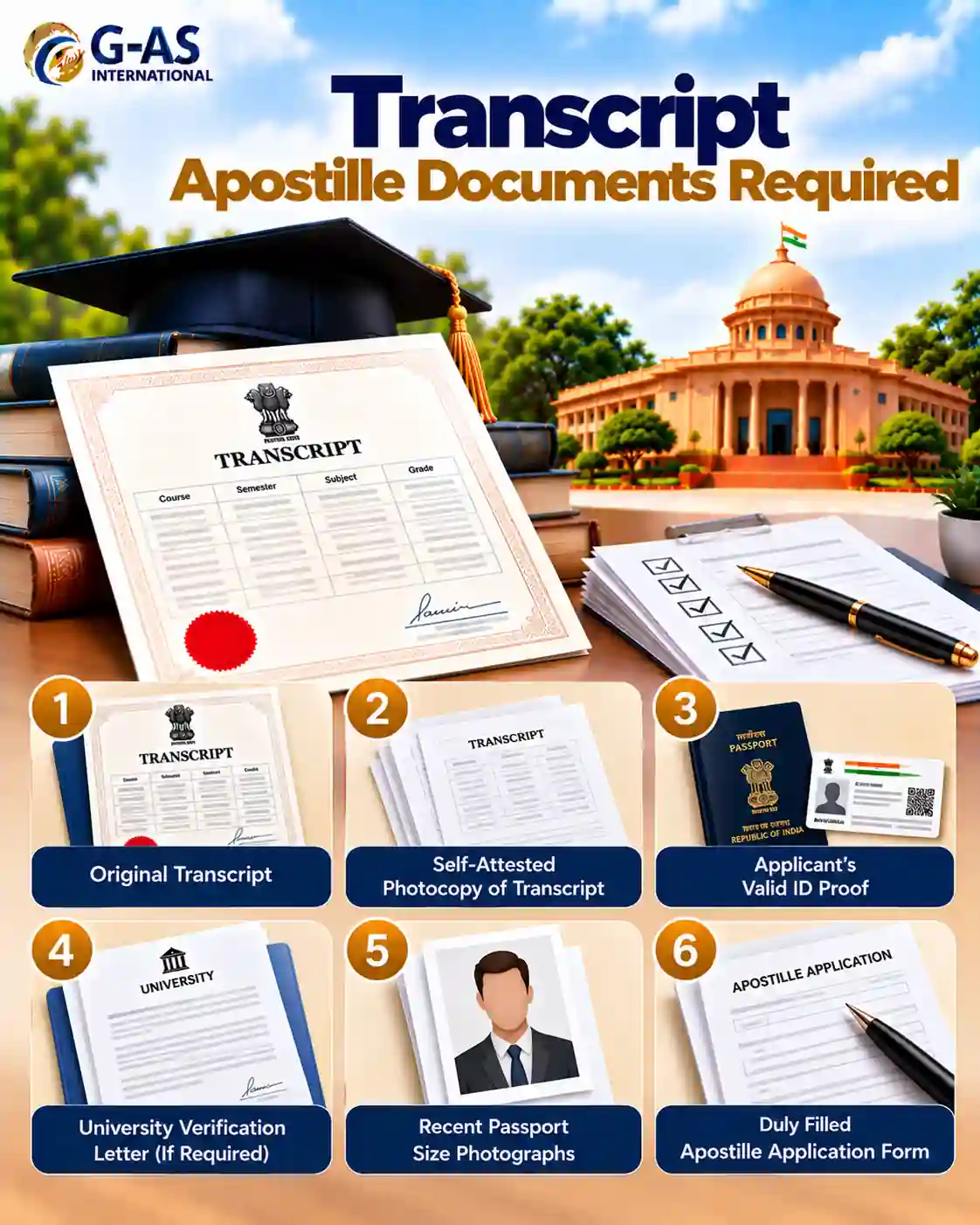
Understanding the Transcript Apostille Documents Required helps you prepare an academic transcript correctly before authentication in India. The core submission generally includes the eligible transcript, identity documentation, and supporting academic records, while additional requirements can vary according to the verification route, issuing institution, and State or UT process.
This guide explains the documents for transcript apostille, including transcript copies, passport or identity proof, semester or yearly marksheets, authorization documents, and other supporting records that may be requested. It will also help you understand which papers are routinely needed and which may depend on university verification or the applicable authentication route.
Academic transcripts may require an apostille when they are submitted to an overseas authority that asks for authenticated educational records issued in India.
A foreign university may request an apostilled transcript to authenticate the origin of academic records submitted for admission, credit assessment, or qualification review.
Credential evaluators, licensing bodies, or academic institutions may ask for authenticated transcripts when checking subjects studied, academic history, or qualification records.
Some employers or immigration authorities request authenticated educational records. Confirm whether the transcript itself needs apostille or whether the degree certificate is also required separately.
The exact papers can differ by university and verification route, so applicants should prepare the main academic record first and keep relevant supporting documents available.
The transcript should be issued or officially certified by the relevant university or educational institution and contain readable academic details, signatures, seals, or other identifying information.
A clear photocopy or scan may be needed for document review, verification records, or submission alongside the eligible academic document, depending on the selected route.
A readable passport copy or other accepted identity record may be requested so that the applicant's name and identifying details can be matched with the academic document.
Semester marksheets, a degree or provisional certificate, enrolment details, or registration information may be requested when the issuing institution needs additional records for verification.
An authorization document may be needed where another person handles verification. Name-change evidence can also be relevant when identity and academic records contain material differences.
Supporting papers do not automatically require separate apostilles. Their purpose may only be to establish identity or assist university verification. Check the foreign recipient's document list before processing additional academic records.
After preparing the required records, the transcript must follow the verification route applicable to its issuing institution and document format.
Review the student's name, university name, programme information, transcript reference details, official seal, and authorized signature. Supporting records should be consistent with the transcript before verification begins.
The verification path depends on the issuing institution and available authentication system. For a broader explanation of these stages, see the academic transcript authentication process.
The issuing university or designated authority may need to confirm the transcript before final authentication. The applicable path can differ between institutions, states, and records available through supported digital systems.
Once the required prior verification is accepted, the eligible document can proceed to the Ministry of External Affairs apostille stage for use in an applicable Hague Convention destination.
The supporting records needed for a transcript often depend on how the university record can be authenticated and which authority must confirm it.
Some transcripts require confirmation of the university seal, registrar or authorized signature, student record, or document reference before later authentication. The verification route for academic transcripts explains why the required supporting records can differ between institutions.
A transcript and degree certificate serve different academic purposes. If a foreign recipient requests both, each document should be reviewed separately. The degree certificate authentication stages provide useful context when both records are part of the same overseas submission.
Document discrepancies can lead to additional verification or correction requests, so the transcript and supporting records should be checked carefully before submission.
Differences between the passport, transcript, marksheets, or degree may require clarification or supporting evidence before the academic record can be verified.
A damaged, faint, incomplete, or difficult-to-identify seal or authorized signature can make institutional verification more difficult and may require additional confirmation.
Missing academic details, inconsistent semester records, or an incorrect supporting document can interrupt verification. Review the common transcript submission problems when preparing records.
University records do not all follow an identical route. Choosing a process that does not match the issuing institution can result in additional checks or resubmission.
A short final review can help identify document mismatches before the academic verification process starts.
Not in every situation. The acceptable document format depends on the issuing institution, verification route, and applicable authentication procedure. Confirm the route before sending an original document.
Not always. They may be requested when the university or verifying authority needs supporting academic evidence, but they should not be treated as a universal requirement for every transcript.
Only when it is required for verification or separately requested by the receiving authority. A degree certificate and academic transcript are distinct documents and may have separate authentication requirements.
Yes. Material differences between academic and identity records can require clarification. Keep appropriate supporting evidence available when a legal name change or genuine record variation exists.
Timing depends on the issuing institution, record availability, verification response, and authentication route. For a dedicated explanation, review the factors that influence transcript processing time.
No. Supporting records may only assist verification. A separate apostille is generally relevant only when the receiving authority specifically requires that additional document to be authenticated for overseas use.
Your Trust, Our Responsibility — That’s a G-AS Commitment.
Get Document Guidance