
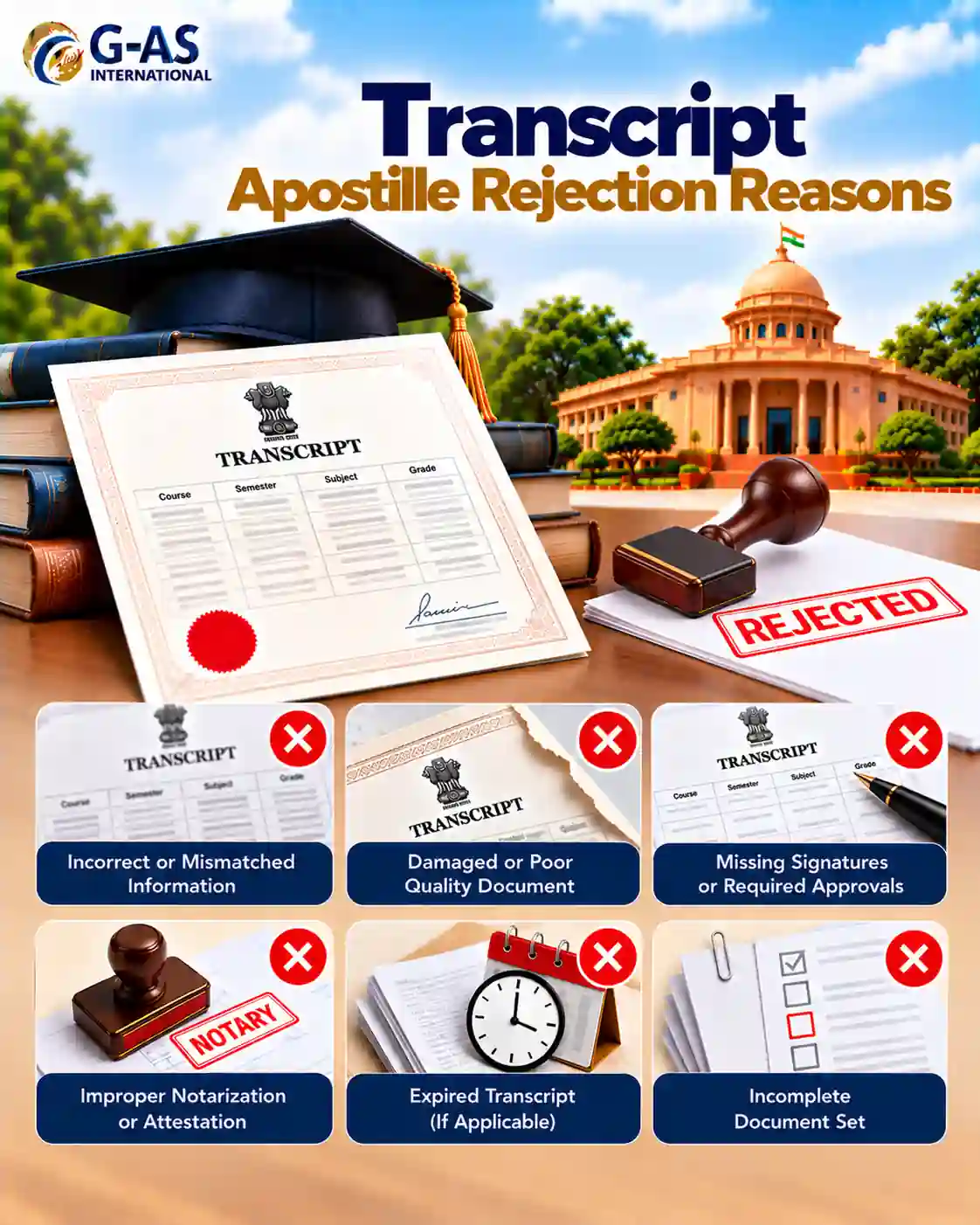
Transcript apostille applications may be rejected when the academic record contains inconsistent details, unclear or incomplete information, missing institutional seals or signatures, or problems with prior authentication. Understanding the main Transcript Apostille Rejection Reasons can help applicants identify issues before submitting their documents.
This guide explains common transcript apostille mistakes, document-related problems, verification issues, and practical ways to correct or prevent them. It will help readers understand what to check on a transcript and why accurate institutional details and proper authentication matter during the apostille process.
Transcript Apostille Rejection Reasons usually relate to document authenticity, institutional verification, incorrect authentication routes, inconsistent academic details, or unsuitable submission records.
A transcript may be returned when the issuing university cannot confirm the record, registrar's signature, official seal, enrollment details, or other information required during institutional verification.
Name variations, incorrect registration numbers, inconsistent course information, or differences between the transcript and supporting academic records can create Transcript Apostille Problems that require clarification.
Educational documents must follow the verification route applicable to their issuing institution and State or Union Territory. Using an unsuitable route can stop processing before final apostille authentication.
Many Transcript Apostille Rejection Reasons can be identified before submission by reviewing the transcript and supporting records for consistency, authenticity, and verification readiness.
Check that the transcript is issued or certified through the appropriate institution and contains clear university details, authorised signatures, seals, and readable academic information.
Depending on the university or verification route, additional academic records may be requested. Review the supporting document checklist before submission.
If an overseas institution also requests the qualification certificate, check the degree document authentication sequence separately rather than assuming both documents follow identical verification requirements.
Do not alter, overwrite, laminate, obscure, or manually correct important transcript details before verification. Any existing discrepancy should be resolved through the issuing institution where necessary.
Understanding where an application can stop helps distinguish university verification problems from State authentication, e-Sanad eligibility, or final MEA processing issues.
First confirm that the receiving organisation actually requires an apostille and that the transcript is the correct academic record. Non-Hague destinations or different institutional requirements may require another legalization route.
The university or applicable educational authority may need to confirm the transcript, recognised signature, official seal, registration details, or source record. Failed institutional confirmation is one of the important Transcript Apostille Rejection Reasons.
The applicable route can depend on the issuing institution and current government integration. Review the academic verification route before forwarding the document for final processing.
After applicable verification or pre-authentication is completed, the document can proceed through the appropriate MEA channel. The step-by-step transcript workflow explains the broader sequence.
A delayed application is not automatically rejected. University confirmation and pre-authentication can add time before the document reaches final processing.
MEA's published service timeline applies after an eligible document reaches the Ministry, while university or State-level verification can require additional time. Applicants can review the factors affecting completion time separately.
Applicants should confirm the verification route, supporting records, delivery requirements, and applicable official or service-related charge structure before dispatching original academic documents. A breakdown of possible charge components can help with advance planning.
Common Transcript Apostille Mistakes often occur before final authentication and can lead to correction requests, additional verification, delays, or returned documents.
A record that cannot be confirmed through the issuing institution or applicable authority may not progress until its authenticity or authorised signature can be established.
Different spellings, initials, registration details, course information, or graduation records can trigger additional checks when the transcript does not align with supporting documents.
Unclear seals, missing authorised signatures, damaged pages, or unreadable authentication details can create uncertainty about the origin of the academic record.
Assuming every transcript follows one universal HRD, SDM, State, or digital route is a common error. The correct channel depends on document and authority requirements.
A short pre-submission review can prevent avoidable Transcript Apostille Rejection Reasons and reduce the chance of repeat verification.
These answers clarify common concerns about rejected, delayed, or returned transcript apostille applications.
Transcript Apostille Rejection Reasons can include unsuccessful institutional verification, incorrect authentication channels, unclear signatures or seals, document discrepancies, or failure to satisfy the applicable pre-authentication requirement.
It can trigger additional verification when the difference affects identification or document consistency. Minor variations should be reviewed against university records and supporting identification before submission.
No. Apostille authentication concerns the recognised signature, seal, and official capacity connected with a public document. It does not independently certify marks, GPA, academic performance, or course completion.
Often yes, depending on the reason it was returned. The underlying issue should first be corrected, such as institutional verification, document mismatch, missing authentication, or an incorrect processing route.
No single route should be assumed for every transcript. Requirements can depend on the issuing institution, State or Union Territory arrangements, document availability, and the current authentication channel.
Confirm the destination requirement, inspect the academic record carefully, verify institutional details, identify the applicable authentication route, and resolve discrepancies before submitting the document for apostille processing.
Your Trust, Our Responsibility — That’s a G-AS Commitment.
Get Document Guidance