
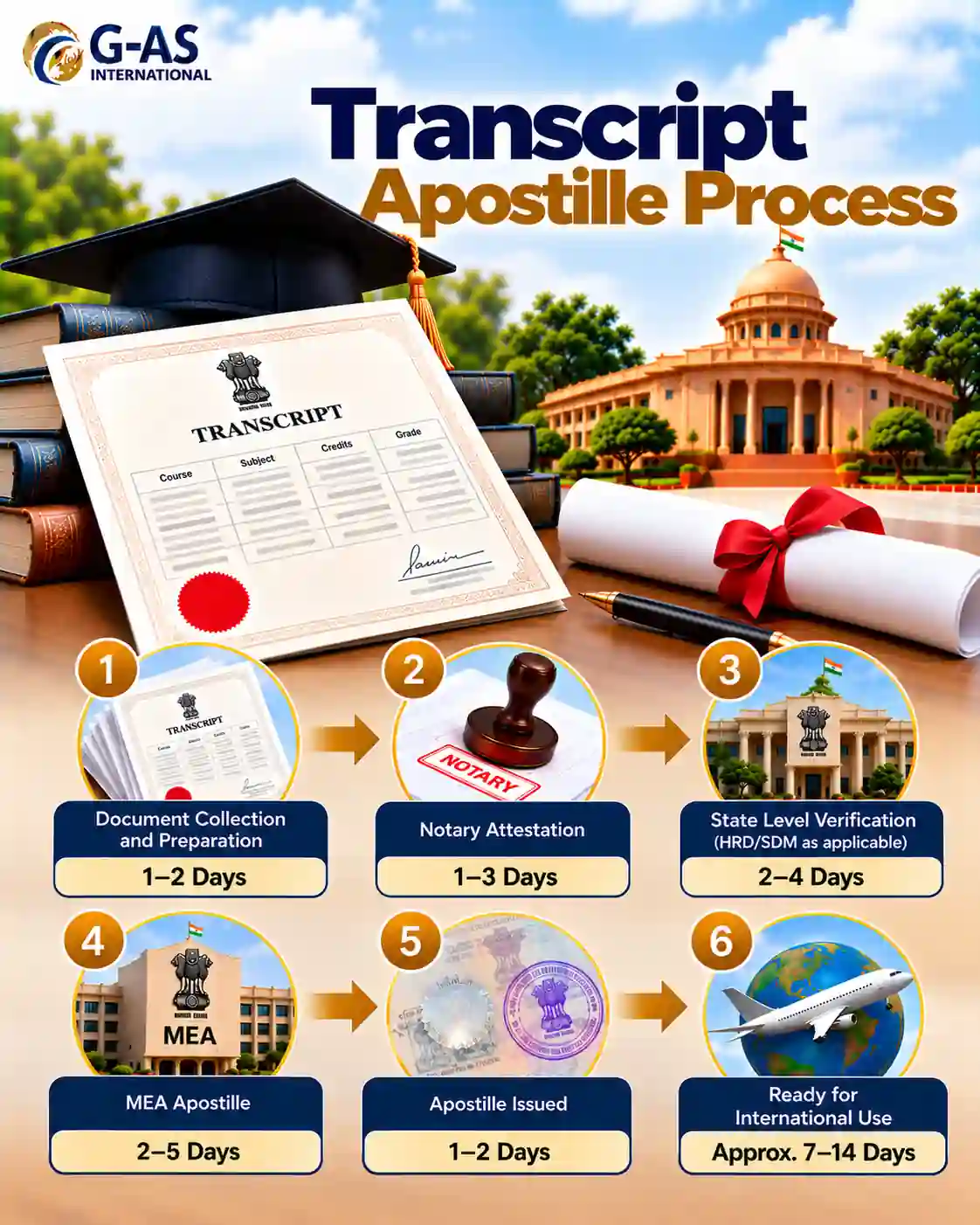
The Transcript Apostille Process is used to authenticate an Indian academic transcript for official use in a country that recognizes Apostilles under the Hague Convention. Depending on the applicable route, an educational transcript may require pre-authentication by the relevant State or Union Territory authority before the Ministry of External Affairs (MEA) completes the Apostille.
This guide explains how to apostille a transcript, the main verification stages, MEA submission routes, and important checks to make before starting. It also helps readers understand when university or state verification may apply and why the receiving university, employer, evaluator, or authority’s document instructions should be checked before submission.
The Transcript Apostille Process may be required when an Indian academic transcript must be presented to an institution or authority in a country where an Apostille is accepted.
Overseas universities may request authenticated academic records during admission, credit evaluation, qualification assessment, or enrolment. Applicants should confirm whether the receiving institution requires an Apostille on the transcript itself.
A foreign authority may ask for verified educational records when evaluating academic history. When a degree certificate is also being submitted, review the degree document authentication sequence separately because the supporting requirements may differ.
Transcripts can sometimes form part of professional registration, credential assessment, immigration, or other official documentation. The receiving authority should always be checked before beginning the Transcript Apostille Process.
Requirements depend on the issuing university, applicable State or Union Territory procedure, submission route, and destination authority. Confirm the current requirements before submitting the academic record.
The transcript should be issued by the appropriate university, institution, or examining authority and contain clear academic information that can be verified where required.
Identification or additional application information may be requested depending on the authority or submission channel. Do not assume the same supporting papers apply to every transcript.
Some universities or authorities may require supporting academic records or verification information before authenticating a transcript. See the detailed document checklist when preparing the file.
University-issued transcripts are not handled identically in every case. Verification procedures can vary according to the institution, State or Union Territory, available digital systems, and receiving authority.
The Process for Transcript Apostille generally involves confirming the receiving requirement, completing applicable educational-document authentication, and obtaining the Apostille from the competent Indian authority.
Check the instructions issued by the foreign university, credential evaluator, employer, immigration authority, or other recipient. Confirm that the transcript itself requires Apostille rather than assuming every academic document needs identical authentication.
The academic record may need verification through the issuing university or another designated educational authority. The exact verification route varies according to where and how the transcript was issued.
Educational documents may require authentication by the designated State or Union Territory authority before MEA Apostille. The applicable route should be confirmed for the issuing institution instead of following a route meant for another document category.
After the required authentication has been completed, the document proceeds for Ministry of External Affairs Apostille through the applicable submission mechanism. The Apostille certifies the relevant public-document authentication for use under the Hague Apostille framework.
The correct route is determined by the transcript's issuing authority and the authentication system available for that educational institution or jurisdiction.
Where the document is not processed through an integrated digital verification system, the Transcript MEA Apostille Process can involve verification and authentication through the relevant educational and State or Union Territory authorities before final Apostille processing.
e-Sanad provides an electronic verification and attestation framework for participating Document Issuing Authorities. Availability depends on whether the relevant institution and document can be processed through the supported digital system.
Review the verification-route guidance before submission when you are unsure which authentication path applies. Related application planning details can also be checked separately.
The overall Transcript Apostille Process does not have one universal completion period because verification and authentication stages can differ between institutions and authorities.
Verification can be the most variable part of the Transcript Apostille Procedure. Response times depend on the issuing university, record availability, authentication requirements, document condition, and whether additional confirmation is requested.
Applicants should account for university verification, applicable State or Union Territory authentication, submission handling, and MEA processing rather than calculating the timeline from the final Apostille stage alone.
For a more focused explanation of timing variables, see the transcript processing timeline guide.
Errors at the verification or authentication stage can interrupt Transcript Apostille Steps and require additional checks before processing can continue.
A marksheet, consolidated statement, transcript, and degree certificate are different records. Confirm exactly which document the receiving institution has requested before beginning authentication.
If the required issuing-institution verification has not been completed, later authentication may be delayed or the document may need to be returned for additional confirmation.
Following a procedure intended for another State, institution, or document category can result in unnecessary processing. Determine the applicable authority before submission.
Spelling differences, incomplete academic details, unclear copies, alterations, or inconsistent records can trigger additional verification. Review the common rejection and correction issues before submitting the transcript.
A few checks before submission can reduce avoidable verification problems and help ensure the document follows the correct route.
These answers cover practical questions that commonly arise when applicants need to know how to apostille transcript records issued in India.
No. Apostille requirements depend on the receiving country, institution, purpose, and requested document. Confirm the recipient's instructions before starting the Transcript Apostille Process.
It can, depending on the issuing institution and applicable authentication route. Some records require issuing-authority verification before the designated educational authority can complete the next stage.
It may be possible when the relevant issuing authority and document are supported by the e-Sanad system. Eligibility should be checked for the particular university and record.
No. Verification practices and authentication channels may vary between universities and jurisdictions, so the appropriate Transcript Apostille Steps should be established from the document's issuing details.
Not necessarily. University verification and Apostille serve different functions. Where prior educational authentication is required, it must be completed before the document reaches the final Apostille stage.
Confirm the exact document, authentication format, issuing authority details, and submission instructions requested by the receiving institution or authority before starting the Transcript Apostille Process.
Your Trust, Our Responsibility — That’s a G-AS Commitment.
Get Document Guidance