
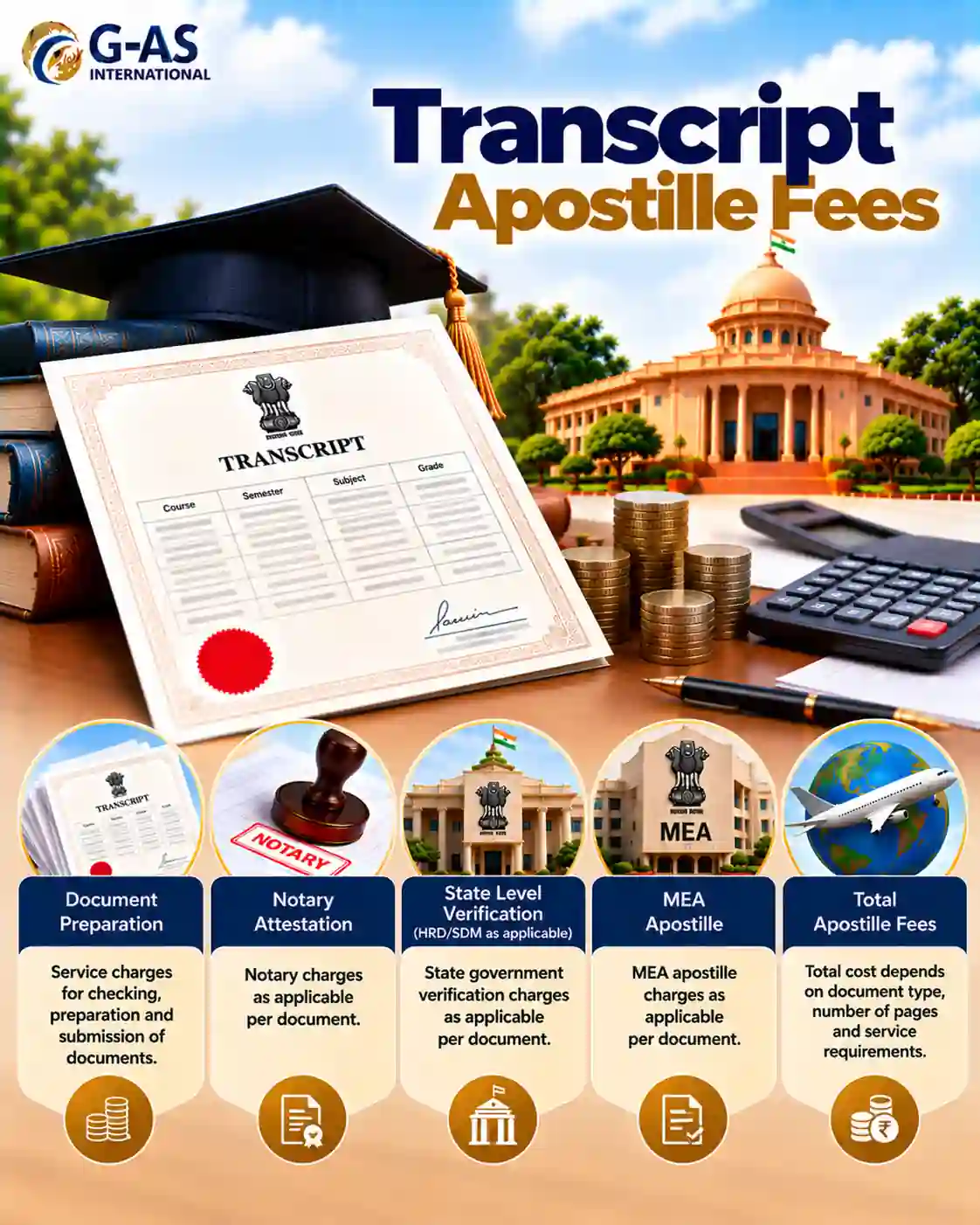
Transcript Apostille Fees in India can vary because the total amount may include more than the official apostille charge. The final cost can depend on the transcript’s issuing authority, required university or state verification, authentication route, document handling, and courier requirements.
This guide explains Transcript Apostille Cost, common charges involved, and the factors that can increase or reduce the final amount. It will also help you understand the difference between official MEA charges and additional verification or processing expenses before submitting an academic transcript.
An apostilled academic transcript may be requested when an Indian educational record has to be accepted by an authority, institution, employer, or other organisation in a Hague Convention destination.
Some universities or credential-related processes may ask for authenticated academic records. Applicants should confirm whether the receiving institution requires an apostille on the transcript itself or another form of verification.
Foreign employers, licensing bodies, or professional authorities may request verified educational records. Requirements differ by country and organisation, so the exact document format should be confirmed before submission.
When both a transcript and qualification certificate are requested, the two documents may follow related but separate checks. Review the degree certificate authentication process when the qualification certificate also needs authentication.
The required material can vary according to the issuing university, the verification route, and the destination authority. Confirm the applicable route before preparing the file.
Use the transcript issued by the competent university, college, board, or examining authority. The document should be clear, complete, and consistent with the issuing institution's records.
Additional records may be requested for verification depending on the institution or route. Check the supporting document checklist before arranging submission.
Confirm whether the receiving authority wants the apostilled transcript, a sealed university transcript, a translated copy, or another format. These requirements are not interchangeable.
Names, course details, institution information, seals, signatures, and page completeness should be checked before the document enters authentication or verification.
The route depends on how the transcript can be verified and whether the issuing authority is supported through a digital or physical authentication pathway.
Before starting, verify that an apostille is actually required for the transcript and that the destination accepts an apostille under the Hague Convention framework. This prevents unnecessary processing.
Educational documents may require verification or pre-authentication by the appropriate issuing or state-level authority before Ministry of External Affairs processing. The applicable academic verification route should be confirmed for the particular transcript.
After the required verification is complete, the document proceeds for apostille through the applicable Ministry of External Affairs channel. A detailed step-by-step transcript authentication procedure can help clarify the sequence.
After completion, verify that the apostille relates to the correct document and applicant details. Keep the document protected and submit it in the format requested by the foreign authority.
Completion depends on verification readiness, the issuing institution, the chosen route, authority workload, and document condition.
University verification, state-level authentication where applicable, corrections, holidays, dispatch arrangements, and authority workload can change the overall timeline. Review the turnaround factors for transcript authentication when planning a submission deadline.
A transcript from an institution integrated with a digital verification system may move differently from one requiring separate institutional or state verification. The issuing authority and current procedure should therefore be checked first.
Most avoidable problems arise from document inconsistencies, incomplete verification, unsuitable copies, or misunderstanding the receiving authority's requirement.
Differences in the applicant's name, course title, institution details, or other academic information can trigger additional checks or require correction before processing continues.
If the applicable educational verification has not been completed, the document may not be ready for the next stage. Route requirements should be checked in advance.
Unreadable text, missing pages, unclear seals, or poor scans can interfere with verification. A clean and complete transcript should be prepared before submission.
Submitting without checking destination or authority requirements can lead to repeat work. Review the common causes of transcript rejection before final submission.
A short pre-submission review can prevent avoidable corrections and help the document move through the applicable route smoothly.
No. Requirements depend on the institution, country, and purpose. Some organisations accept transcripts sent directly by the issuing university, while others may request authentication or apostille.
Yes. When separate institutional or state verification is required, the overall process may involve additional steps compared with documents that can follow a simpler verification route.
Not necessarily. Depending on the document and route, verification, authentication, handling, or dispatch requirements may also affect the amount involved in completing the process.
Yes. Although both are educational documents, their issuing records and verification requirements can differ. Each document should be checked independently before starting authentication.
The total can vary according to the issuing institution, verification route, document condition, processing requirements, and any supporting authentication needed before the final apostille stage.
Your Trust, Our Responsibility — That’s a G-AS Commitment.
Get Document Guidance