
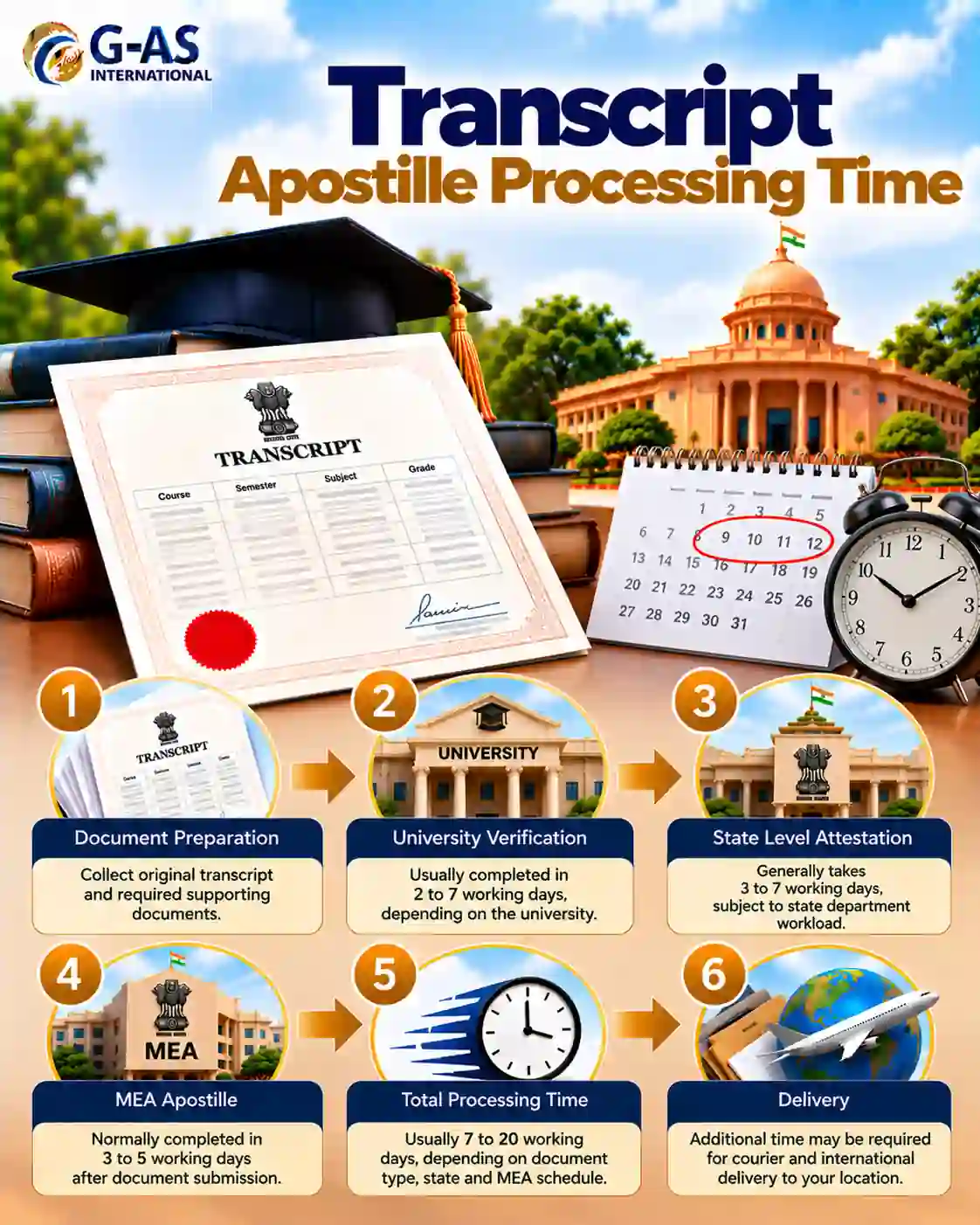
The Transfer Certificate Apostille Processing Time in India is not identical for every application. The time required can depend on the certificate’s issuing authority, the authentication route followed before MEA apostille, document accuracy, official holidays, and whether additional verification is requested.
Understanding the expected Transfer Certificate Apostille Timeline helps students and parents plan overseas admissions and document submission deadlines more effectively. This guide explains the usual processing stages, factors that may extend the duration, and practical points to consider when estimating how long the apostille process may take.
The Transfer Certificate Apostille Processing Time becomes important whenever a school, university, immigration authority, or other receiving organisation abroad asks for an apostilled transfer or leaving certificate.
Families relocating internationally may need a transfer or leaving certificate for a child’s new school. Reviewing the school-leaving certificate apostille procedure can help clarify related school-document steps.
Students changing institutions or continuing studies overseas may be asked to submit an authenticated transfer certificate. Starting early reduces the risk of missing admission, enrolment, or document-verification deadlines.
Some foreign authorities may request educational history documents as part of a broader application. In such cases, the destination authority’s exact requirement should be confirmed before apostille processing begins.
The Transfer Certificate Apostille Processing Time can increase when the submitted document or supporting information does not match the route required by the issuing authority or State/UT authentication system.
The certificate should be complete, readable, and carry the relevant issuing authority’s signature or seal. The applicable route may involve an original document or a digitally verifiable record, depending on eligibility.
Additional supporting papers can vary by State/UT, issuing institution, and submission route. Check the dedicated document requirements guide before sending the file for verification.
Confirm that the receiving country or organisation actually requires an apostille for the certificate. This avoids sending the document through an incorrect authentication or legalisation route.
Documents available through an eligible digital repository may follow e-Sanad, while documents outside that system may need State/UT pre-authentication before they reach the Ministry of External Affairs.
The Time Required for Transfer Certificate Apostille depends heavily on what must happen before the document reaches MEA. A case with pending institutional or State verification will naturally take longer.
An apostille is used for applicable public documents intended for use in another country where the Hague Apostille Convention applies. The receiving institution should also be checked because its document requirements may differ.
For documents not covered by e-Sanad, the applicable State/UT authentication stage generally needs to be completed before submission for apostille. See the verification-route explanation for a focused overview.
The issuing institution, Document Issuing Authority, Education Department, or another designated authority may need to confirm the document before it can move forward. This stage can create significant variation in the Transfer Certificate Apostille Processing Time.
After the applicable pre-authentication is complete, the document proceeds to MEA through the permitted channel. The detailed step-by-step TC apostille procedure explains how the stages connect.
There is no single end-to-end Transfer Certificate Apostille Processing Time that applies to every certificate because pre-authentication and verification can occur before MEA receives the document.
MEA’s 2025 Citizen’s Charter states that apostille is usually completed within seven working days after receipt in MEA, subject to complete documentation and required clearances or verification. The full Transfer Certificate Apostille Duration may be longer because State/UT or institutional verification can occur earlier.
For information intentionally kept separate from this timing guide, readers can refer to the dedicated fee-information page.
A delayed Transfer Certificate Apostille Processing Time is often connected to verification, document defects, or an incorrect route rather than the final apostille stage alone.
Faded seals, incomplete information, or unclear issuing-authority details can trigger additional checks or require a corrected document before processing continues.
Differences between the certificate and supporting records may need clarification. Resolve material inconsistencies before submission where possible instead of assuming they will be accepted automatically.
Submitting a document through a route that does not match its State/UT, issuing authority, or digital-repository status can result in resubmission and extend the overall timeline.
If an authority cannot verify the certificate or identifies a defect, the case may stop until it is corrected. Review the common rejection and correction issues before submission.
Good preparation cannot guarantee a fixed Transfer Certificate Apostille Processing Time, but it can reduce preventable queries, document corrections, and routing problems.
These answers address practical timing questions applicants commonly have before starting a transfer certificate apostille application.
The complete timeline varies. MEA’s 2025 Citizen’s Charter gives a usual timeline of within seven working days after the document is received by MEA, while earlier pre-authentication or institutional verification can add more time.
No. The MEA stage starts after the applicable prior requirements are complete. The full Transfer Certificate Apostille Processing Time may include issuing-authority checks, State/UT authentication, submission, processing, and document movement.
No. e-Sanad depends on the document being available through an integrated digital repository or eligible authority. Documents outside that coverage continue through the applicable pre-authentication and apostille procedure.
The Transfer Certificate Apostille Processing Time can increase when the certificate first needs confirmation from an issuing institution or designated State/UT authority. Document discrepancies, office closures, and additional verification can extend this stage.
No fixed completion date should be assumed. The route and required verification can differ by certificate, issuing authority, State/UT, and destination requirement, so applicants should keep reasonable time before their deadline.
Begin after confirming the receiving institution’s requirements and avoid waiting until the final days. A practical buffer helps accommodate verification requests, corrections, holidays, and document movement without disrupting the admission schedule.
Your Trust, Our Responsibility — That’s a G-AS Commitment.
Get Document Guidance