
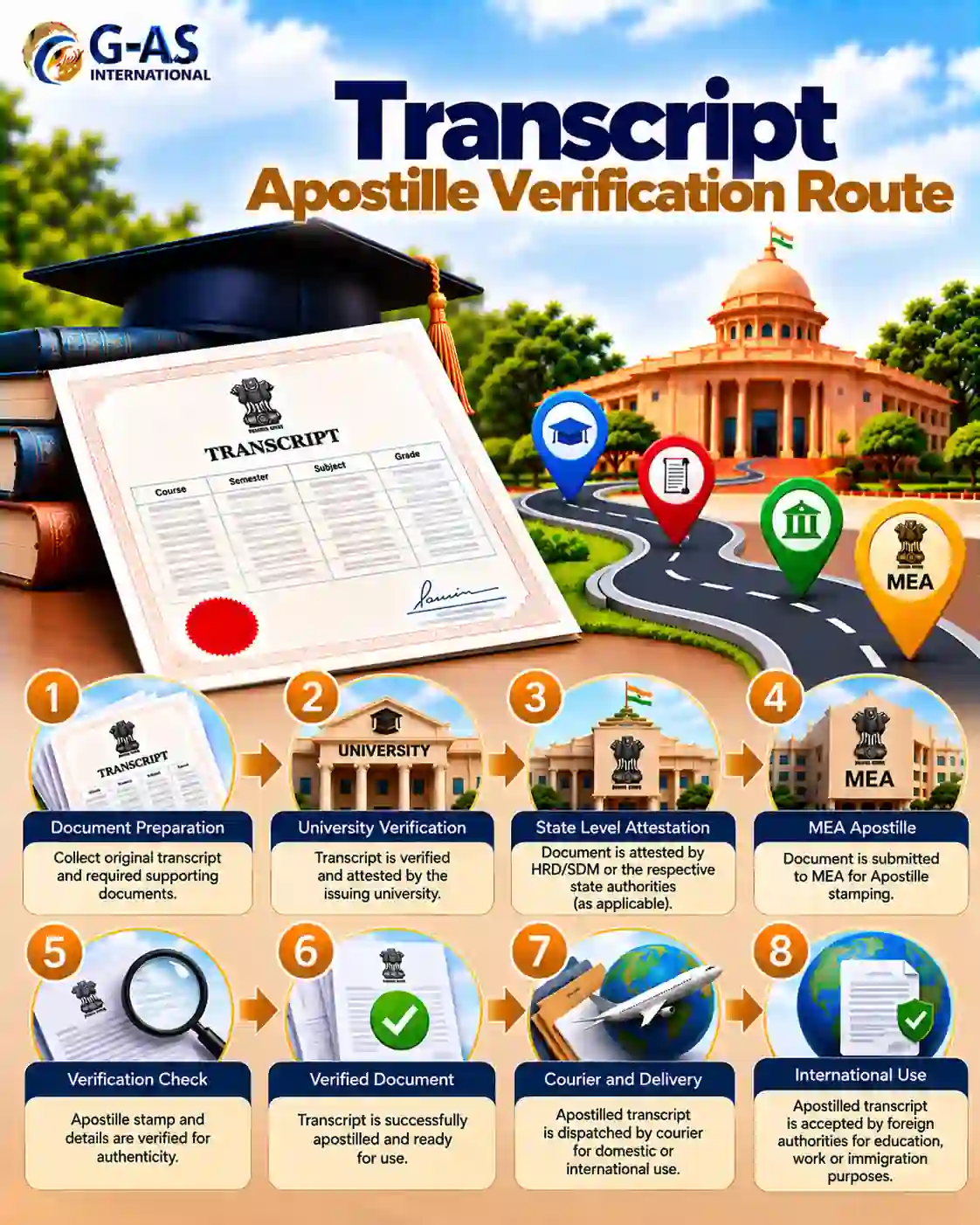
The Transfer Certificate Apostille Verification Route explains how an Indian school transfer or leaving certificate is authenticated before it can be accepted for official use in a Hague Convention country. Depending on the issuing authority, state requirements, and destination, verification may involve notarization or institutional checks, SDM or state-level authentication, followed by the Ministry of External Affairs (MEA) apostille.
This article explains the Transfer Certificate Apostille Verification Process, including how pre-authentication works, when SDM or state verification may apply, and where MEA fits into the final authentication stage. It will also clarify why the exact route can vary and why the receiving institution’s requirements should be confirmed before starting.
The Apostille Verification Route becomes relevant when a transfer or leaving certificate issued in India must be authenticated for use abroad and the receiving authority asks for an apostille.
A receiving school may ask for an authenticated transfer or leaving certificate before accepting a student’s previous-school record or completing enrollment formalities.
If the document is titled a leaving certificate rather than a transfer certificate, the school-leaving document workflow gives related process context without changing the need to confirm the correct verification path.
The Apostille Verification Route should be matched to the recipient’s written requirements because an apostille is relevant only when the destination and receiving authority accept that form of authentication.
Before starting the Apostille Verification Route, confirm the document’s issuing authority, destination country, receiving institution, and the verification channel available for that document.
Use a clear certificate containing the school or issuing authority details, student particulars, and the signatures or seals that appear on the issued document.
Confirm that the destination uses the Apostille Convention for the intended document and that the receiving school, authority, or institution actually requires an apostille.
Supporting requirements can differ by route. Review the supporting-document checklist before submission instead of assuming one universal set applies.
Whether an original, copy, or digitally verifiable record can be used depends on the applicable channel and issuing authority. Confirm this before beginning the Transfer Certificate Apostille Verification Route.
The Transfer Certificate Apostille Verification Route generally moves from eligibility and issuer checks to pre-authentication or digital verification, then to the Ministry of External Affairs for the apostille. For broader context, see the complete apostille workflow.
First verify that the certificate will be used in a country where the Apostille Convention applies and that the intended recipient expects an apostille rather than another form of legalization.
The Transfer Certificate Apostille Verification Route depends partly on who issued the certificate and whether that issuing authority supports digital verification through an integrated document repository or requires another verification path.
Where digital verification is available, the issuing authority can verify the record through the relevant online system. In other cases, the Transfer Certificate Apostille Verification Route may require an accepted pre-authentication path through the competent authority before MEA processing.
After the required verification or pre-authentication is complete, the document proceeds for MEA apostille. This final stage authenticates the origin of the public document for eligible cross-border use.
There is no single completion period for every Transfer Certificate Apostille Verification Route because issuer verification, route selection, document condition, and authority processing can differ.
A digitally verifiable document may follow a different path from a certificate requiring offline or state-level checks. Holidays, corrections, issuer response, and incomplete submissions can also affect progress. See the timing factors for this document.
The Transfer Certificate Apostille Verification Route can change according to the issuing body, state procedure, digital repository availability, and recipient requirement. A separate related administrative guide covers another practical aspect of planning the submission.
Most avoidable problems occur when the applicant assumes the wrong authority, skips a required verification step, or starts without confirming the receiving institution’s requirement.
Applying through a route that does not match the issuing authority or accepted procedure can lead to rework. The Transfer Certificate Apostille Verification Route should be confirmed before submission.
Unclear seals, signatures, issuer details, alterations, or mismatched particulars can interrupt verification. Review common submission problems before sending the certificate.
An apostille should not be assumed to be the correct route for every destination. Check the country’s status and the receiving institution’s document instructions first.
School-level transfer certificates do not have one universal HRD rule. The accepted authority can vary, so treat the Transfer Certificate Apostille Verification Route as document- and authority-specific.
Use this short check before starting the Transfer Certificate Apostille Verification Route to reduce avoidable corrections and route changes.
These answers address common questions about authority selection, digital verification, and the final apostille stage.
No. The phrase Transfer Certificate HRD or SDM Apostille describes possible pre-authentication routes, not a universal rule. The correct path depends on the document, issuing authority, accepted procedure, and recipient requirement.
It can be part of some accepted non-digital routes, but it should not be assumed automatically. Confirm whether the specific certificate and submission channel accept that verification path.
It may be available when the relevant document issuing authority and record are supported through the digital verification system. If the document is not digitally available, another accepted route may apply.
An apostille authenticates the origin of the public document, such as the relevant signature, seal, or authority. It does not independently certify the student’s academic performance or merit.
Transfer and leaving certificates are often closely related school records, but the verification route can still depend on the issuer, document format, state procedure, and recipient’s instructions.
The apostille route may not apply. Check the destination country’s embassy or consular requirements because another legalization process may be required for that document.
Your Trust, Our Responsibility — That’s a G-AS Commitment.
Get Document Guidance