
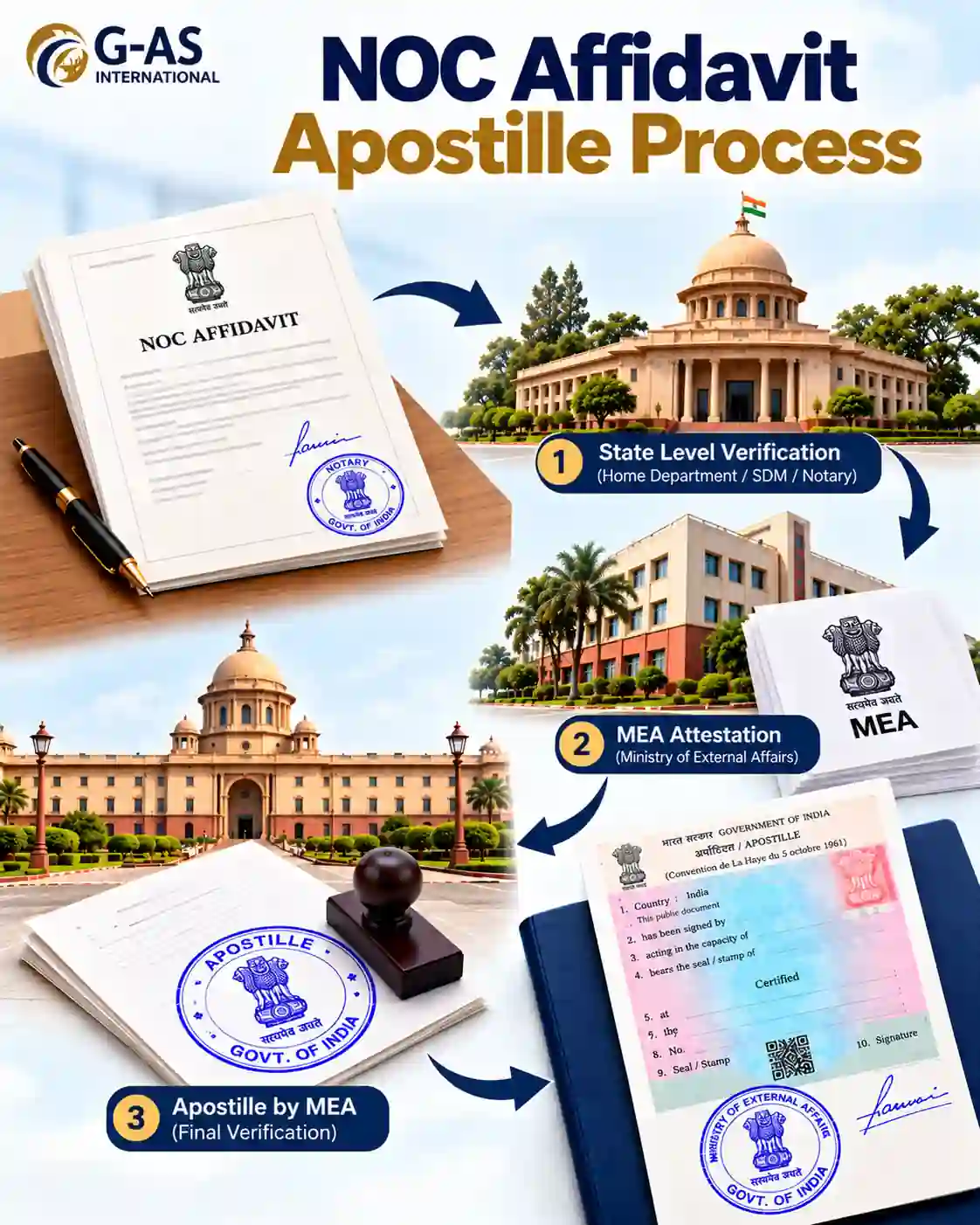
The NOC Affidavit Apostille Process is used when a no-objection affidavit executed in India needs authentication for use abroad and the receiving authority requires an apostille. The route generally involves correctly preparing and notarising the affidavit, completing the applicable State or Union Territory pre-authentication, and obtaining the final apostille from the Ministry of External Affairs.
Understanding the sequence before submission can help prevent issues caused by incorrect wording, inconsistent details, incomplete notarisation, or the wrong verification route. This guide explains the NOC Affidavit Apostille Procedure, the usual verification steps, document checks, and what to confirm with the overseas recipient before beginning the process.
The NOC Affidavit Apostille Process is generally required when a no-objection declaration executed in India must be presented to an overseas authority that accepts documents authenticated under the Hague Apostille Convention.
A no-objection affidavit may support family, guardianship, property, travel, inheritance, or other personal matters when the receiving organization specifically requests a sworn declaration from the concerned person.
When the declaration concerns birth information or parental consent, the underlying purpose should be checked carefully. A specifically birth-related declaration may follow a separate birth affidavit authentication route.
The receiving authority may ask for the affidavit to be notarised and authenticated before acceptance abroad. For broader context, review the general affidavit authentication sequence.
Requirements can vary according to the wording of the affidavit, jurisdiction, purpose, submission channel, and overseas recipient. Check the applicable requirements before beginning the NOC Affidavit Apostille Process.
The affidavit should clearly identify the parties, purpose, declaration, relevant dates, and other necessary facts without conflicting or incomplete information.
Where notarisation is required, the affidavit should carry the appropriate signature, notarial endorsement, stamp, seal, and date before further authentication is attempted.
Identity evidence, related certificates, authorization papers, or other supporting records may be requested depending on the declaration. Review the document preparation checklist for additional guidance.
An NOC affidavit does not automatically replace an official certificate or other primary record. Confirm the exact document expected by the foreign recipient before authentication.
The Process for NOC Affidavit Apostille should follow the verification route applicable to the document rather than assuming that every affidavit follows an identical pathway.
First confirm that the destination authority requires an apostille and accepts an NOC affidavit for the stated purpose. Check names, wording, language, supporting records, and whether any prescribed format applies.
Complete the declaration with accurate information and obtain notarisation where applicable. Names, dates, signatures, seals, notarial details, and referenced records should remain consistent throughout the document.
Before the MEA stage, the document may require verification from the designated State or Union Territory authority or another competent channel applicable to that document. Check the pre-authentication route details before submission.
After the required prior verification is complete, the eligible document proceeds through the applicable Ministry of External Affairs channel. The apostille authenticates the relevant official signature, capacity, seal, or stamp rather than proving every statement contained in the affidavit.
Overall completion depends on more than the final MEA stage because preparation, notarisation, pre-authentication, corrections, submission, and delivery can affect the sequence.
Timing varies with document readiness, the authority handling pre-authentication, current workload, submission method, and whether corrections are required. See the detailed timing factors before planning around a fixed deadline.
The applicable State or Union Territory, affidavit purpose, verification channel, destination requirements, document condition, and delivery arrangement can change the practical sequence. Separate cost-related factors may also depend on the route selected.
Most avoidable problems occur before the final apostille stage when the document details or authentication route have not been checked carefully.
Differences in names, dates, addresses, declarations, or supporting records can lead to correction requests before the NOC Affidavit Apostille Process continues.
Missing signatures, unclear seals, incomplete endorsements, or unsuitable alterations can prevent the affidavit from moving smoothly to the next verification stage.
Submitting the affidavit through an inapplicable pre-authentication route may require the document to be returned and processed again through the correct authority.
Incorrect execution, document defects, unsuitable supporting records, or recipient-specific problems may interrupt processing. Review the common rejection causes before submitting the document.
A short document review can reduce preventable corrections and help keep the application on the appropriate authentication route.
These answers address practical questions commonly considered before beginning the NOC Affidavit Apostille Process.
Not automatically. The affidavit must be suitable for authentication, complete the applicable Indian verification requirements, and be intended for use where an apostille is accepted.
Usually not. Notarisation may be an initial requirement, while additional pre-authentication can be needed before the document reaches the Ministry of External Affairs stage.
An apostille authenticates the origin of the relevant public document or official signature, capacity, seal, or stamp. It does not independently establish the truth of the declaration.
Yes. The competent pre-authentication authority and practical submission route can vary by State or Union Territory, document type, and currently available processing channel.
Online eligibility depends on whether the relevant document and verifying authority are supported by the available government system. Documents outside that framework follow the applicable alternative route.
Confirm the destination requirement, prepare and execute the affidavit correctly, complete the applicable pre-authentication, and then proceed through the appropriate MEA apostille channel.
Your Trust, Our Responsibility — That’s a G-AS Commitment.
Get Document Guidance