
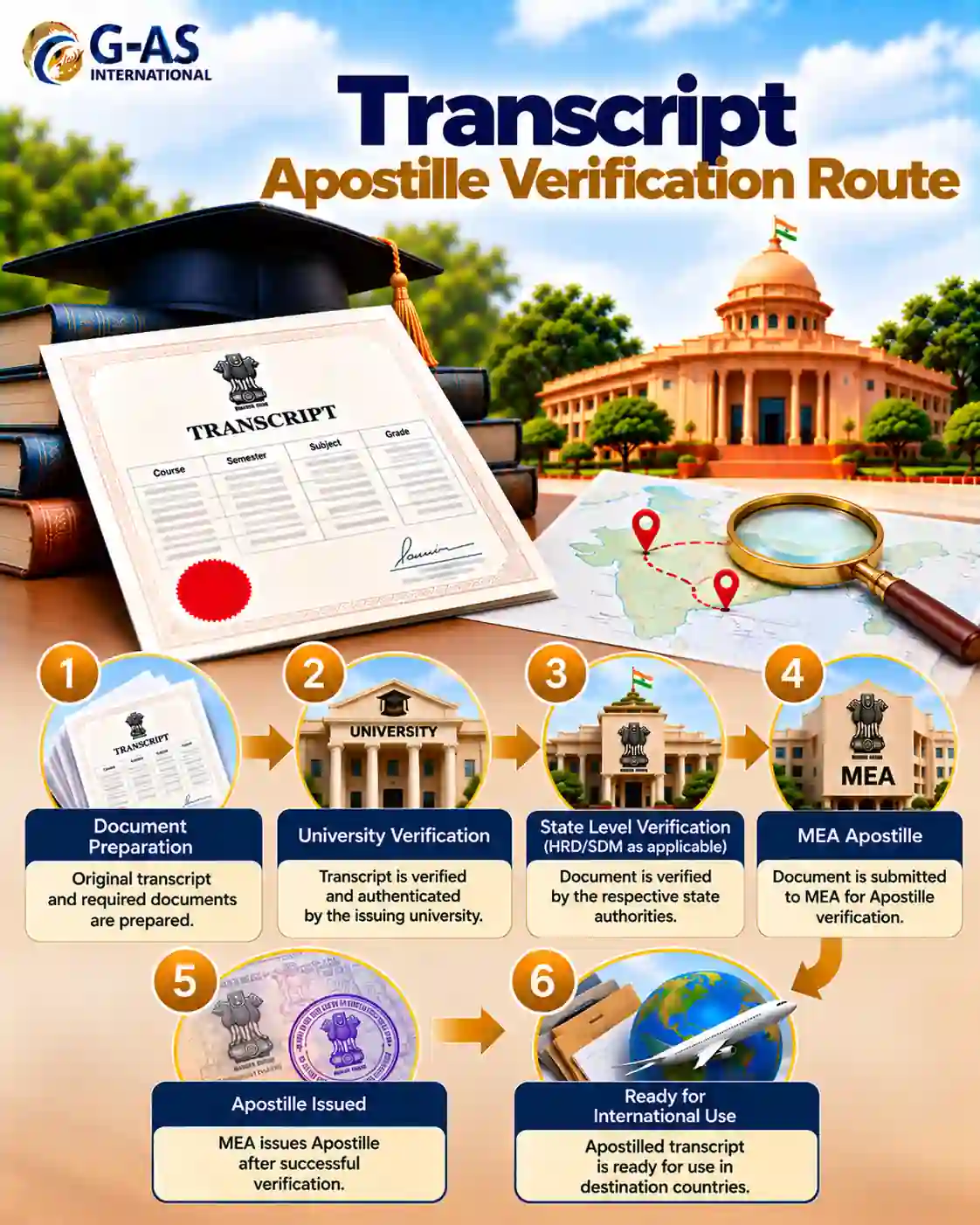
The Transcript Apostille Verification Route explains how an academic transcript is checked before it receives an apostille for overseas use. Depending on how and where the transcript was issued, verification may involve confirmation by the issuing university, validation of signatures or seals, and authentication through the designated state or digital channel before the document reaches the apostille stage.
This article explains the Transcript Apostille Verification Process, including university verification, state authentication, HRD or other applicable pre-authentication routes, e-Sanad considerations, and the final MEA apostille step. It will also help readers understand why the exact route can vary by issuing institution, state authority, document format, and verification method.
The Transcript Apostille Verification Route matters when an Indian academic transcript must be authenticated for official use in a country where an apostille is accepted.
Foreign universities, credential evaluators, or education authorities may request an authenticated transcript to confirm that the document originated from the stated Indian institution.
Employers or professional bodies may ask for authenticated academic records when qualifications form part of an overseas employment, licensing, or registration application.
Some immigration, residence, or official assessment procedures require educational records to be authenticated before they can be accepted by the receiving authority abroad.
The documents needed for verification depend on the issuing university, the State or Union Territory route, and whether the record is available through an integrated digital repository.
The transcript should be issued or certified by the competent university or institution and contain identifiable official signatures, seals, or other authentication details.
Where required, the university may need to confirm the registrar, authorized signatory, seal, student record, or document reference before the next authentication stage.
Related records may be requested to resolve a mismatch or verification query. A practical supporting document checklist can help prepare the file correctly.
The applicable authority and document format can vary by issuing institution, State or Union Territory, and digital availability, so one route should not be assumed for every transcript.
The Transcript Apostille Verification Process normally moves from document and destination checks to issuing-authority verification, applicable pre-authentication, and final apostille processing.
First confirm that the destination accepts apostilles under the Hague Apostille Convention and that the receiving organization actually requires the transcript in authenticated form.
The institution may verify the transcript, registrar signature, official seal, or academic record. This stage establishes that the document came from the stated issuing authority.
For educational documents outside an eligible digital workflow, pre-authentication may be required through the designated State or Union Territory authority. The degree-certificate authentication sequence also illustrates why educational records can follow authority-specific checks.
After the required verification or pre-authentication is complete, the document proceeds for apostille through the applicable MEA channel. For broader context, review the full transcript authentication procedure.
Total completion time depends heavily on how quickly the transcript can be verified before it reaches the final apostille stage.
University response time, State or Union Territory pre-authentication, e-Sanad eligibility, document corrections, and final processing can all affect the schedule. The published MEA service timeline applies after a document reaches MEA, not necessarily to the entire pre-verification journey. See the typical transcript processing timeline for timing factors.
Most delays arise before final apostille when the document, signatory, issuing institution, or selected verification route cannot be confirmed smoothly.
An unclear, outdated, or unrecognized signature or seal can trigger additional university confirmation before the transcript moves forward.
Using a route that does not match the issuing State, institution, or current government workflow can result in redirection or repeat verification.
Differences in name spelling, registration details, transcript references, or supporting academic records may require correction or fresh confirmation from the issuing institution.
Missing pages, unclear seals, damaged records, or an unsuitable copy may prevent verification. Review common transcript rejection causes before submission.
Before starting, verify the document and route carefully so avoidable authority checks do not interrupt processing.
No. The applicable route depends on the issuing institution, State or Union Territory, and current government workflow. Educational records should follow the authority designated for that document and jurisdiction.
This phrase is commonly used when comparing possible pre-authentication routes. For educational records, the correct route should be confirmed against the issuing State or Union Territory and current MEA requirements rather than assumed from a generic label.
It may be possible when the relevant document-issuing authority and record are available through an integrated digital repository. Unsupported documents continue through the applicable non-digital pre-authentication route.
No. An apostille authenticates the origin of the public document, including the relevant signature, seal, or official capacity. It does not independently confirm academic performance or evaluate grades.
Universities may differ in digital integration, signatory verification, State jurisdiction, and record-verification procedures. These differences can change the authority checks and pre-authentication sequence.
Confirm the destination requirement, issuing institution, document condition, names, signatures, seals, supporting records, and the correct verification authority before starting the Transcript Apostille Verification Route.
Your Trust, Our Responsibility — That’s a G-AS Commitment.
Get Document Guidance