
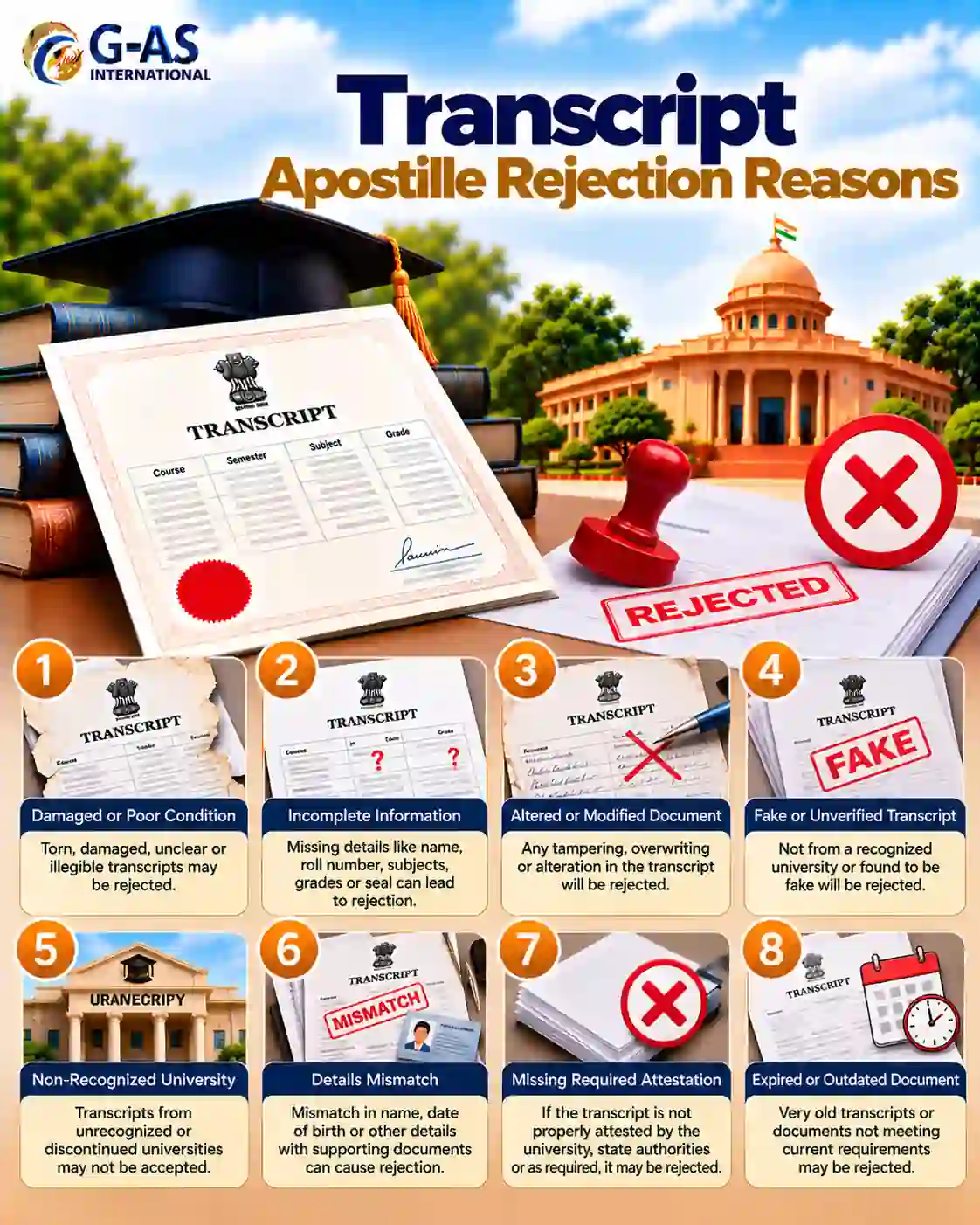
Transfer Certificate Apostille Rejection Reasons commonly involve problems such as incorrect or inconsistent details, unclear institutional seals or signatures, incomplete supporting documents, or an authentication route that does not match the document’s issuing authority. Checking the transfer certificate carefully before submission can help identify issues that may otherwise cause rejection or processing delays.
This guide explains why transfer certificate apostille gets rejected, the common mistakes applicants should watch for, and the practical checks that can reduce avoidable problems. It will also help readers understand document verification, detail mismatches, authentication requirements, and appropriate corrective steps before resubmitting a rejected certificate.
Transfer Certificate Apostille Rejection Reasons can arise before final apostille, during preliminary authentication, or when the receiving country's requirements do not match the route followed.
A transfer certificate and a school leaving certificate may be treated differently depending on the issuing institution and purpose. If the document is actually a leaving certificate, review the school-leaving certificate procedure before proceeding.
Documents outside the applicable e-Sanad route may require authentication by a designated authority before MEA processing. Using an unsuitable preliminary route can therefore create verification problems.
An apostille is intended for use between countries where the Hague Apostille Convention applies. A different legalization or attestation route may be required when apostille is not applicable to the destination.
Before resubmission, compare the rejected file with the applicable submission document checklist and verify that every required item is complete and readable.
Check that the certificate is genuine, legible, properly issued, and contains the institutional details, signature, seal, or other authentication features applicable to that document.
MEA guidance for documents submitted through its outsourced apostille channel requires the document submission to be accompanied by the prescribed photocopies, including the applicant's passport copy.
If a rejection concerns incorrect names, dates, institutional details, or another certificate error, obtain the appropriate correction or reissued document from the competent authority before resubmitting.
An application can be complete while the underlying certificate still contains a discrepancy. Compare the document carefully with the records that will be used abroad.
The appropriate correction depends on why the application failed. Review the full apostille procedure before restarting any completed stage.
Determine whether the issue concerns the certificate itself, missing supporting material, preliminary authentication, the selected legalization route, or a requirement imposed by the receiving institution or destination country.
If names, dates, signatures, seals, or issuing details are incorrect or unclear, contact the issuing educational institution or other competent authority rather than altering the certificate independently.
For documents requiring authentication before apostille, verify which designated authority applies. The verification-route guidance explains this part separately.
Before resubmission, confirm that the corrected certificate, required copies, applicable authentication, and destination requirements now align. Repeating the same incomplete submission can create another avoidable delay.
A correction can add time because the document may need to return to an earlier verification or issuing-authority stage.
There is no universal additional duration after rejection. The effect depends on what must be corrected and whether authentication must be repeated. Review the separate processing-time factors when planning a new submission.
Diagnose the rejection first rather than assuming an administrative payment issue caused it. Questions relating specifically to that topic can be checked on the separate administrative-fee overview.
Most preventable Transfer Certificate Apostille Problems involve document accuracy, route selection, incomplete preparation, or assumptions about overseas acceptance.
Different spellings, incorrect dates, or inconsistent institutional details can require clarification or correction before the certificate can move through the required verification chain.
MEA legalizes documents on the basis of signatures from designated authorities. Skipping an applicable authentication requirement can prevent the document from being processed correctly.
Missing copies or other required submission material can interrupt processing even when the transfer certificate itself is otherwise suitable for authentication.
Apostille and normal attestation are different procedures. Confirm the destination country's applicable legalization requirement before beginning the process.
A short document review before resubmission can prevent the same issue from being carried into another application.
A significant discrepancy may require correction or additional clarification. The safest approach is to have incorrect certificate details corrected by the issuing institution or competent authority before resubmission.
Resubmission without correcting the identified issue may result in the same problem. First establish whether the rejection relates to the document, supporting papers, authentication, or destination requirement.
MEA states that it legalizes documents on the basis of signatures of designated authorities and does not take responsibility for the document's contents. Certificate accuracy should therefore be checked separately.
No. Apostille applies where the Hague Apostille Convention is applicable between the relevant countries. Other destinations may require a different attestation or legalization procedure.
Start with the rejection reason or processing objection, then review the certificate details, supporting documents, applicable authentication route, and the receiving country's legalization requirement.
Check document accuracy, confirm the correct route, prepare all required submission material, and verify destination requirements before the certificate enters the apostille process.
Your Trust, Our Responsibility — That’s a G-AS Commitment.
Get Document Guidance